 ONTEA
ONTEA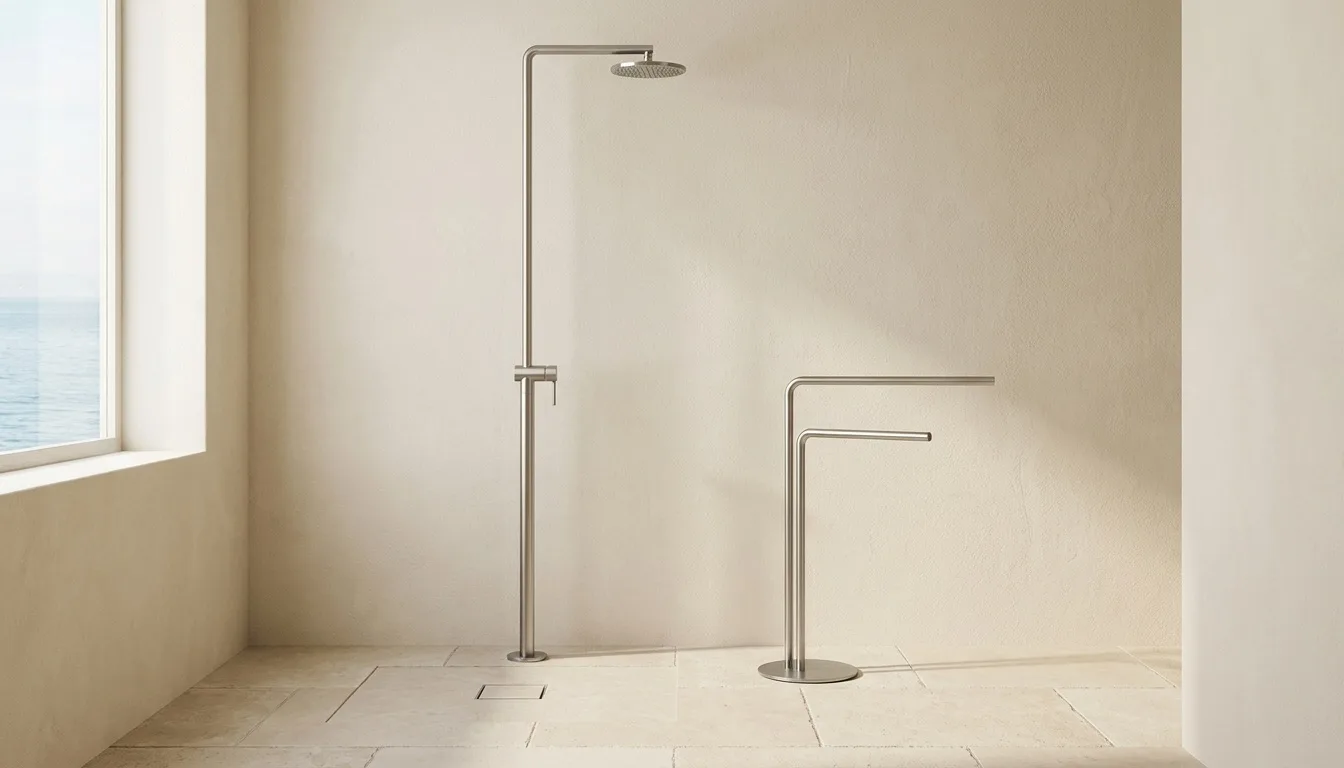
Salt-laden air attacks stainless steel fittings in a seafront bathroom through a gradient, not a switch. An exposed seafront elevation, a sheltered coastal plot and an inland site do not present the same chloride load, and the fittings that survive one are not automatically right for the next. Once chloride is present, what determines performance is not the alloy label alone but the finish, the detailing, the drainage, the ventilation and the maintenance regime. This guide works through that gradient, shows what each attack mechanism looks like so it can be caught early, and sets out what to write into a coastal fit-out schedule and a maintenance plan.
Key Takeaways
- Chloride exposure is a gradient. An exposed seafront elevation, a sheltered coastal plot and an inland site each present a different load, and the sheltered, non-rain-washed case can be the most aggressive of the three.
- Grade choice matters, but finish, joint design, drainage and ventilation decide whether chloride ever gets the chance to act.
- Pitting, crevice corrosion and galvanic attack each look different and each point to a specific design fault, so early identification tells you what to fix.
- The schedule should carry exposure, grade, finish, joint design, drainage, ventilation, inspection interval and cleaning method as separate lines.
The companion articles cover the alloy argument in full: AISI 304 versus 316L stainless steel taps explains the grade comparison itself, and whether marine-grade 316L is worth its cost settles the money question. This article deliberately stays off the grade-versus-grade comparison and concentrates on the coastal environment itself: what the air and the room actually do, and what happens at a seafront over time.
The chloride gradient along a seafront
What defines a marine site
The Nickel Institute's architectural guidelines, as summarised by the British Stainless Steel Association, sort sites into four categories. "Marine sites are defined as areas where wind borne sea spray or mist may be present. These contain chlorides which can also concentrate in condensates or as surface moisture evaporates." That last clause is the one that matters for an interior: chloride does not need to be sprayed onto a fitting directly. It only needs to be present and a film of moisture to evaporate, which concentrates it on the surface.
Three positions on the same development
The International Standard ISO 9223, which classifies the corrosivity of atmospheres, sets out typical outdoor environments against six categories of corrosivity, from C1 (very low) to CX (extreme). Its informative table places coastal locations across several categories depending on how exposed they are:
| Position | Typical ISO 9223 environment | What it means for fittings |
|---|---|---|
| Inland, unpolluted | Rural, very low to low corrosivity | Ordinary interior exposure |
| Coastal, some chloride effect | C3, medium, "coastal areas with low deposition of chlorides" | A real but modest chloride load |
| Coastal without salt spray, sheltered coastline positions | C4 to C5, high to very high | Salt accumulates rather than washes away |
| Coastal and offshore, occasional salt spray contact | CX, extreme | The highest classified atmospheric exposure |
Two notes in the standard's own annexes are worth reading closely, because they invert the intuition that "sheltered means safer". Note 2 to Table C.1 states that "extreme effect by chlorides, which is typical of marine splash or heavy salt spray, is outside of the scope of this International Standard". And Note 4 to the same table states that "surfaces that are sheltered and not rain-washed in marine atmospheric environments where chlorides are deposited and cumulated can experience a higher corrosivity category due to the presence of hygroscopic salts". So the sheltered coastal plot, where rain no longer washes salt away and hygroscopic salts draw moisture from the air, can sit at a higher effective category than the elevation that is being drenched and rinsed every day.
The standard is also explicit about what it does not cover: it "does not take into consideration the design and mode of operation of the product, which can influence its corrosion resistance, since these effects are highly specific and cannot be generalized". A developer handing a schedule to a supplier is still responsible for those specifics, which is why the rest of this guide is about detailing rather than alloy.
Why time of wetness is the hidden variable
ISO 9223 groups atmospheres by their time of wetness, the period during which a metallic surface is covered by a film of electrolyte capable of causing corrosion, and its table records how shelter changes that figure. The key note reads: "Sheltered surfaces in marine atmospheres, where chlorides are deposited, can experience substantially increased times of wetness, due to the presence of hygroscopic salts." Wetness is what turns deposited salt from a dry powder into an active electrolyte. Cutting the wetness is therefore as valuable as cutting the salt, which is a ventilation and detailing argument rather than a material one.
Distance from the sea is not the only variable
The standard notes that chloride deposition "is strongly dependent on the variables influencing the transport inland of sea-salt, such as wind direction, wind velocity, local topography, wind sheltering islands outside the coast, distance of the exposure site from the sea". A bathroom facing inland on the same floor may receive less salt than one on the exposed corner, and a first-floor unit sees a different load from a ground-floor one. The BSSA's site-selection guidance makes the same point, recommending that "micro-climates can exist in coastal locations" and "may be worth investigating for any proposed site before a final stainless steel grade selection is made".
What corrosion actually looks like
Before a specifier can react to corrosion, they need to recognise it. Each mechanism produces a distinct signature, and the signature tells you where the fault is in the detail rather than just that there is a fault.
Pitting corrosion
Pitting is the localised attack the BSSA describes as arising "as a result of exposure to specific environments, most notably those containing chlorides". It appears as small, discrete pits or pinholes on an otherwise bright surface, often concentrated where a droplet dried, or where a splash landed and evaporated. In most structural applications the BSSA says "the extent of pitting is likely to be superficial and the reduction in section of a component is negligible", but adds that "corrosion products can stain architectural features". That is the honest scale of the risk on a fitting: mostly a surface and appearance issue, but the pits are sites where the next cycle starts.
Crevice corrosion
Crevice corrosion "is initiated by the extremely low availability of oxygen in a crevice" and is "only likely to be a problem in stagnant solutions where a build-up of chlorides can occur". What distinguishes it visually is where it appears: not on an open face, but along a line of contact. The BSSA notes that "the narrower, (around 25 microns), and deeper the crevice, the more severe is the corrosion", and that crevices "typically occur between nuts and washers, or around the thread of a screw or the shank of a bolt", as well as in incomplete welds and under deposits. On a bathroom fitting this shows up as a rust-coloured or stained line at the base of a wall post, around a fixing, in the gap behind a wall plate, or where a rail meets its stand-off, because those are the gaps housekeeping cannot reach.
Bimetallic (galvanic) corrosion
When two dissimilar metals sit in contact in moisture, "the less noble metal, (the anode), corrodes at a faster rate than would have occurred if the metals were not in contact". The BSSA warns that "the larger the area of the cathode in relation to that of the anode, the greater is the rate of attack", and singles out fasteners: "carbon steel bolts in stainless steel members should be avoided". The visual signature is a small, sharply localised attack at a single fixing point, or a white or grey powdery residue where stainless meets aluminium or zinc. This is why a stainless accessory paired with an ordinary steel screw can fail at the screw while the visible body is untouched.
Rust-coloured staining that is not the stainless corroding
One important distinction for early identification: brown or orange marks on stainless steel are often not the steel corroding at all. The BSSA's cleaning guidance states that "rust marks or staining on stainless steels is unlikely to be the result of corrosion to the stainless steel itself (similar marks may also be found on porcelain and plastic sinks)", and that such marks "are likely to result from small particles of carbon steel from wire wool or scouring pads becoming attached or embedded in the surface", which then rust in the damp. Iron contamination during storage and installation is the usual route, and the architectural selection guidance calls it "a common cause of unnecessary rust staining and attendant remedial post hand-over costs". Telling these apart matters, because iron-contamination staining is a cleaning and handling problem, while pitting and crevice attack are a design and detailing problem.
What chloride-bearing cleaners add
The same cleaning guidance is blunt about maintenance chemistry: "chloride-containing solutions, including hydrochloric acid-based cleaning agents and hypochlorite bleaches can cause unacceptable surface staining and pitting, and should not be used in contact with stainless steels", and "a frequent cause of staining and micropitting of stainless steels is splashing with undiluted bleach solutions and mortar cleaners". Salt and vinegar mixtures are named too. On a seafront fit-out, the housekeeping regime is part of the corrosion exposure, not an afterthought to it.
Finish, joint design, drainage and ventilation
Having established the exposure gradient and the appearance of each attack, the practical work is in the four levers that decide whether chloride ever gets to act.
Surface finish
The BSSA's rule is that "the smoother the finish, the better is the corrosion resistance" and that "the more corrosive the environment, the more critical is the surface finish selection". For its external marine applications the guidance is explicit: "in all marine environments, the default choice is 316 mirror polished. In no circumstances should a standard 240 alumina brushed finish be used in a marine environment, even with grade 316."
That is a statement about external architectural stainless steel, not about interior bathroom fittings, and it is worth reading carefully rather than borrowing it wholesale. It does establish the principle that finish matters more as exposure rises, and it establishes that a coarse brushed texture is the wrong choice in the harshest environments. A bathroom fitting lives in a milder environment than a facade, so the practical reading is to treat finish as a line in the schedule that gets reviewed when the exposure changes, not to assume a brushed bathroom accessory needs a mirror polish. The catalogue states its finish and grade per product, so both can be checked before an item goes on a coastal schedule.
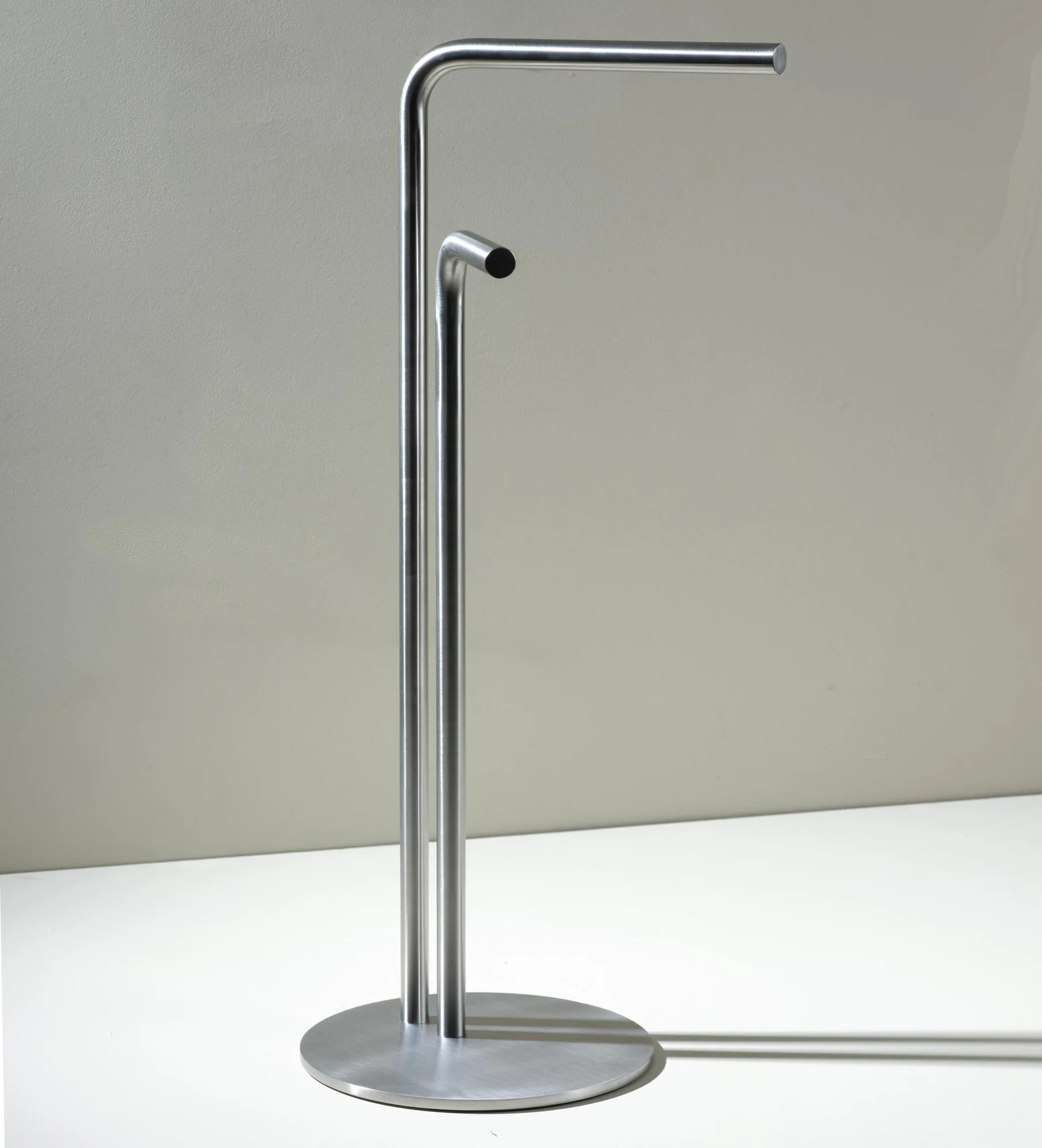 ProductFreestanding Two Rail Towel Stand2MS3408-BSAISI 316 stainless steel, guide price £680 per unit ex VAT. Two rails at different heights let a bath towel dry clear of a damp hand towel. The catalogue records no dimensions beyond the drawing; take the overall height and rail lengths from the current product data.View in catalogue →
Joint design and crevices
"Crevices must be avoided, as these can be sites for localised corrosion" is the BSSA's design rule. For wall-mounted fittings this means reviewing every line where the accessory meets the wall, every gap behind a back plate, and every screw or fixing that could form a crevice. The BSSA's corrosion-mechanisms guidance adds that welds that "fail to penetrate" are themselves crevices, and that fabricators should "consider" fabrication methods "that avoid crevices". Where a fitting has to be fixed, the design question is whether the joint can drain and dry, or whether it is a permanent pocket.
Drainage
Water that never leaves a detail becomes the electrolyte that drives every chloride attack. The BSSA's advice on external applications includes avoiding "moisture traps at any mechanically fastened joints", and it treats natural rain-washing as an advantage. In an interior there is no rain, so drainage has to be designed in: fall away from the wall, no horizontal ledges behind fittings, no seal that traps water, and fixings sealed so water does not track into the cabinet or substrate behind. The deck-mounted dispensers below are specified with that in mind.
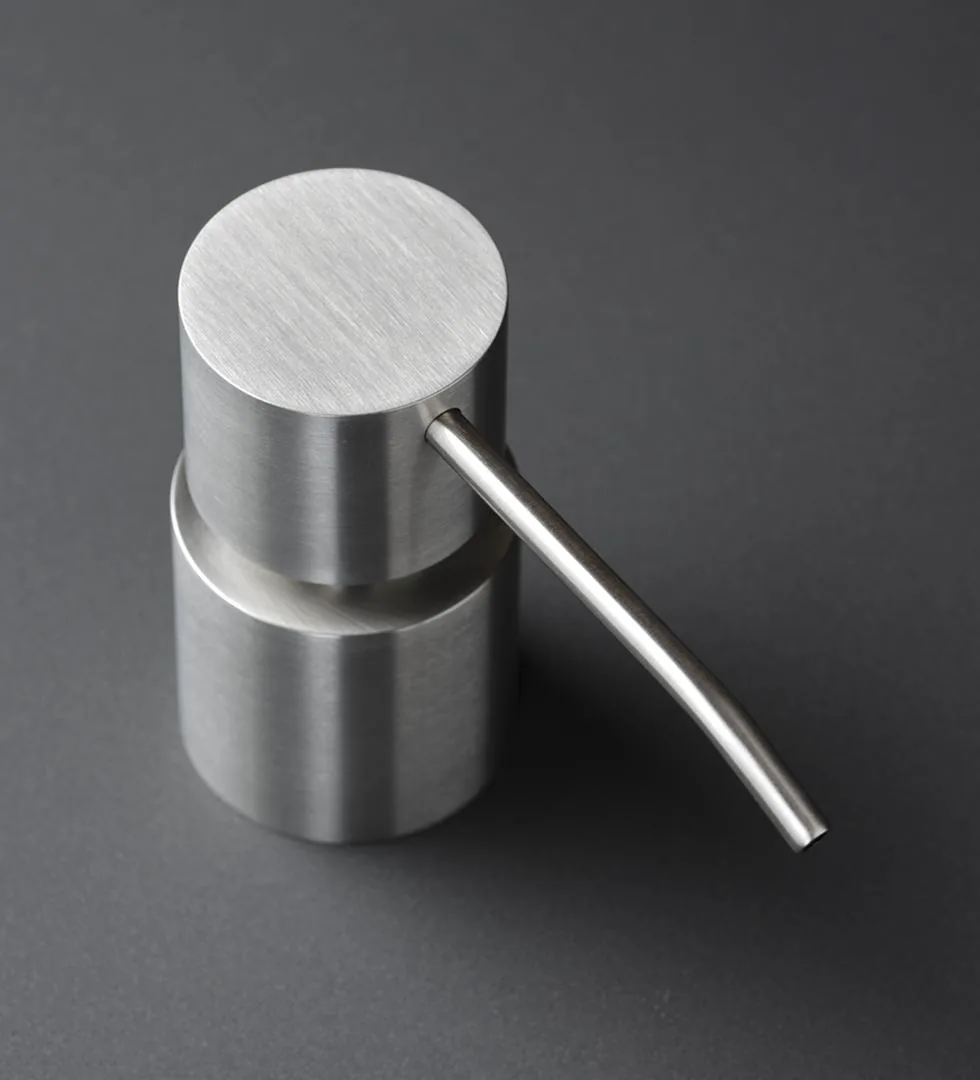 ProductDeck Mounted Soap Dispenser2AE0315-BSAISI 316L stainless steel, guide price £290 per unit ex VAT. Mounts on the basin rim or an adjacent counter, and the fixing is sealed so no water tracks into the cabinet below. The catalogue does not record the aperture size or reservoir volume.View in catalogue →
Ventilation
Ventilation is the lever that attacks time of wetness directly. The ISO 9223 note on hygroscopic salts means that a coastal bathroom which stays humid keeps its fittings wet for longer than the same room inland, and wetness is the precondition for chloride attack. Extractor provision, window opening and the drying behaviour of the room all belong in the design conversation. It also shows up at product level in how a fitting lets a towel dry. The stand-off behind a wall rail is the clearest example, because it exists so damp fabric does not sit flat against the steel.
 ProductWall Mounted Towel Rail, 650 mm2MS3794-BSAISI 304 stainless steel, guide price £150 per unit ex VAT. Fixed flat to the wall on a stand off so the towel dries rather than rests against the steel. This is published as 304, not a coastal grade, so confirm the grade for a seafront scheme. The catalogue records that the projection and fixing detail are not published.View in catalogue →
That grade difference is the honest point of this card. The ventilation benefit of a stand-off applies to any grade, but on an exposed seafront elevation the grade question is separate and is settled on the exposure classification, not on the accessory's ventilation feature.
Fitting the wet zone and the isolated WC
Two room positions deserve their own detailing because they concentrate water or sit away from the main wall run.
Wet-zone shower sets
The wet zone is where the fitting is wet by design, so isolation and access matter more than anywhere else. The BSSA notes that stress corrosion cracking "is uncommon in normal building atmospheres", but advises caution "when stainless steel members containing high residual stresses, (e.g. due to cold working), are used in chloride rich environments, (e.g. swimming pools enclosures, marine, offshore)". In practice this is an argument for careful service access: a valve group buried behind tiling that cannot be reached turns a small maintenance job into a wall repair.
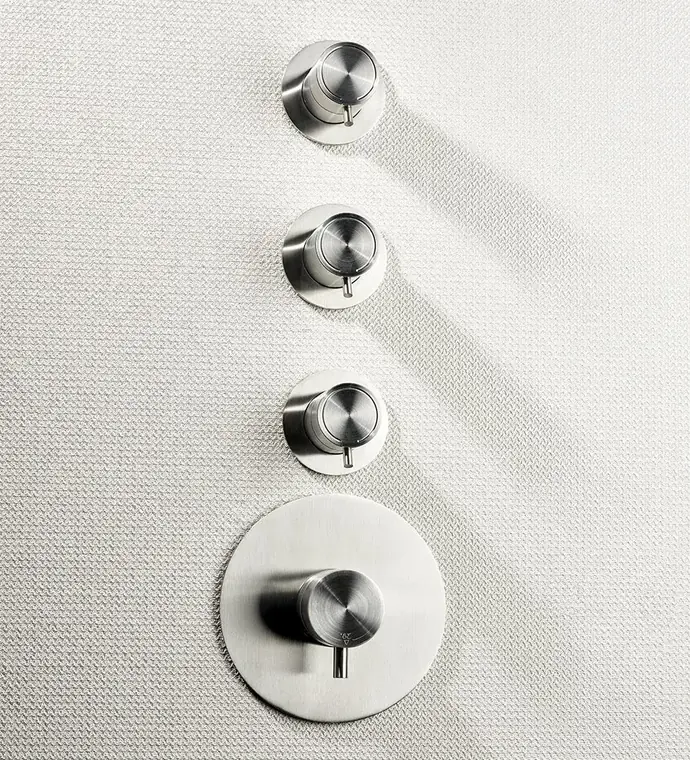 ProductThermostatic Shower Set With Three Shut Off Valves2SO99S6-BSAISI 316L stainless steel on half inch connections, guide price £2300 per unit ex VAT. Each of three outlets has its own isolation point. Plan an access panel over the valve group before tiling. The catalogue holds no dimensions for the projection or branch spacing; confirm them with the supplier.View in catalogue →
Freestanding and floor-fed fittings
A floor-standing fitting removes the deck but moves the water into the floor, where the joint is concealed. Where the wet room has a glass screen and the plumbing rises through the floor, a freestanding shower column is the arrangement that takes the wall out of the equation entirely, which is useful in a coastal room where the wall run is already carrying tiling and backer.
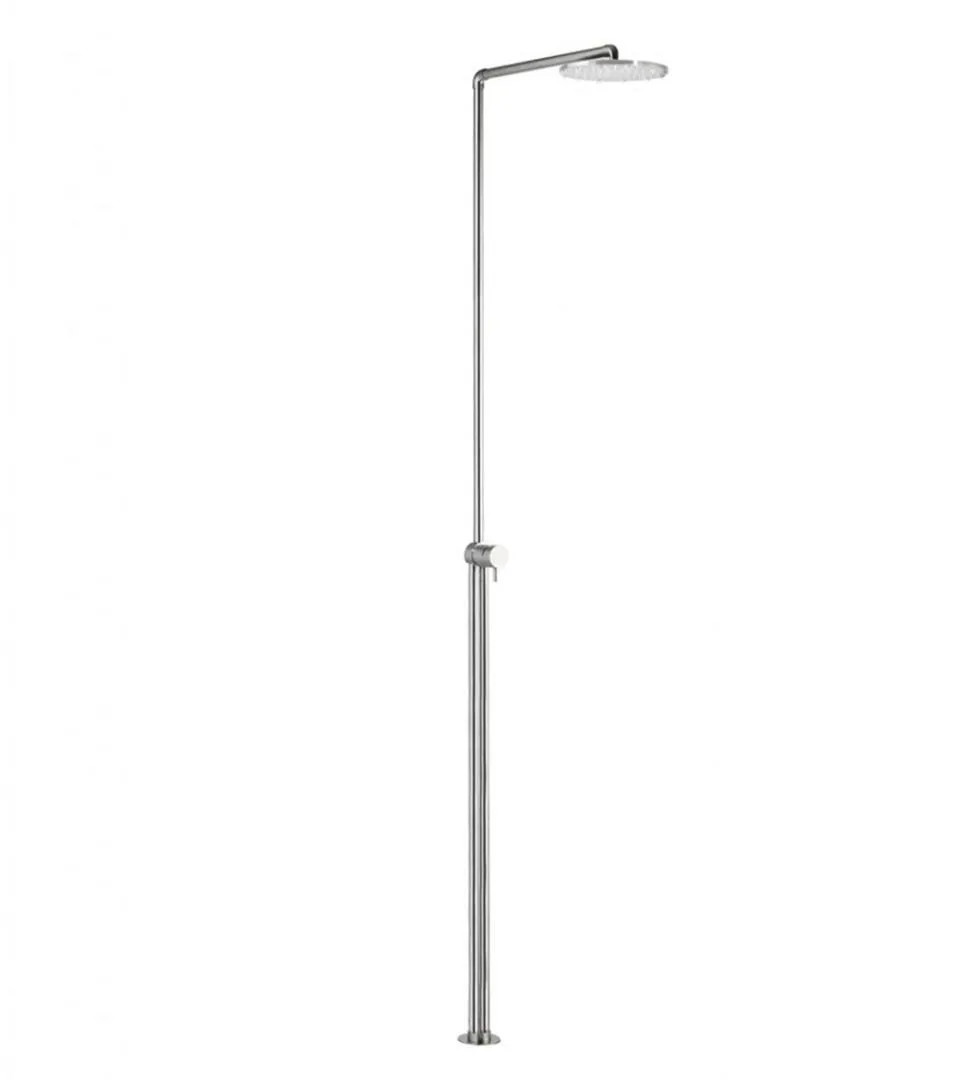 ProductFreestanding Shower Column with Mixer and Overhead Head2TE2033Z-BSAISI 316L stainless steel, guide price £1775 per unit ex VAT. A single riser from the floor with a mixer and a 200 mm overhead head. Check the ceiling height against the bather before the riser is cut. The catalogue does not record the overall height as a text dimension; take it from the drawing.View in catalogue →
The same reasoning applies at the basin. The catalogue's own installation notes on the column below instruct the installer to waterproof the supplies in the deck before the basin is set, and to level the column once the layout is fixed. That is a drainage and sequencing instruction as much as a fitting one.
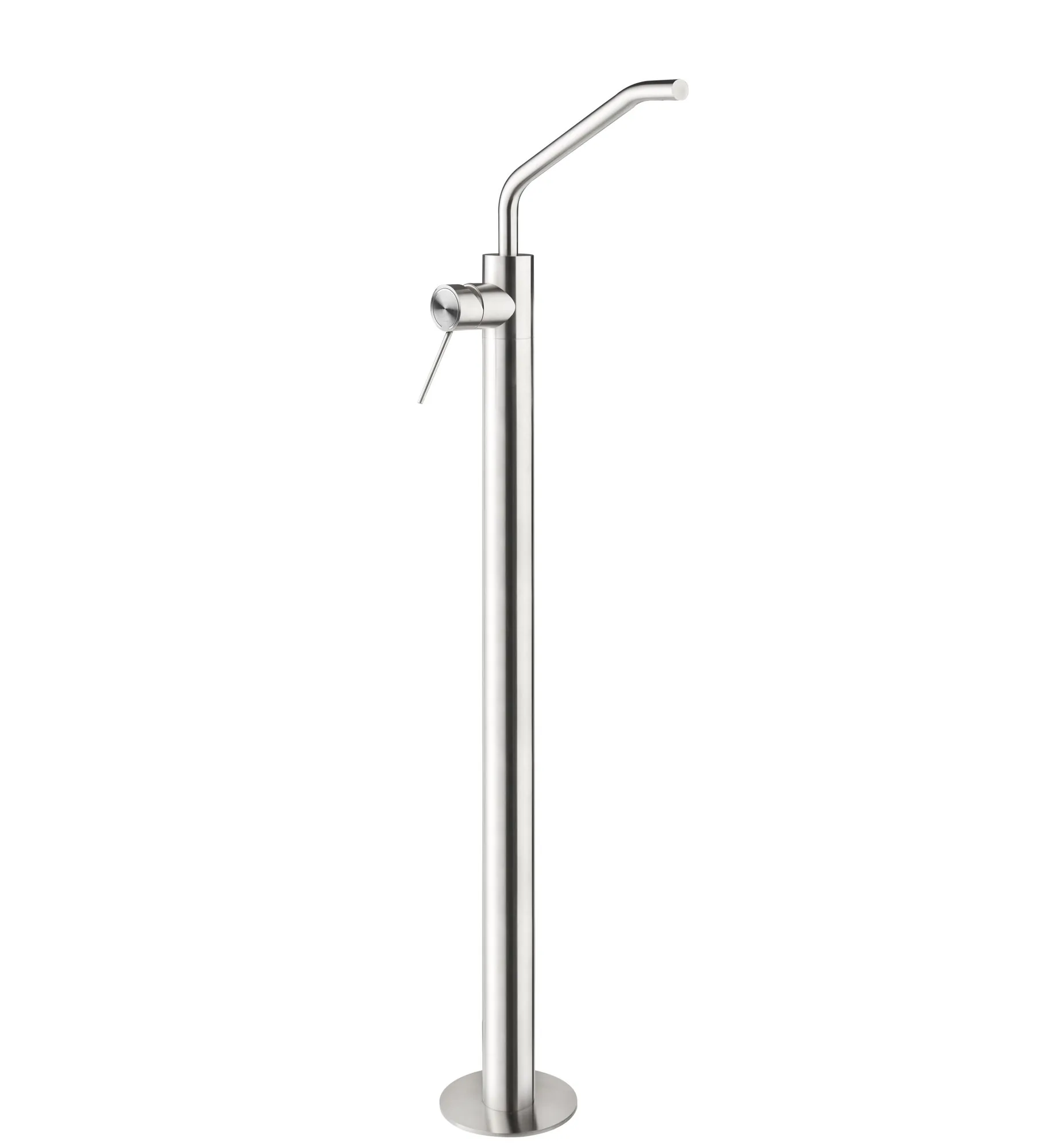 ProductFloor Standing Basin Mixer Column2SL33606X-BSAISI 316L stainless steel, guide price £1950 per unit ex VAT. Fed from the floor, so the supplies are waterproofed in the deck before the basin is set. Paired with the matching floor standing spout. The catalogue does not record the column height as a text dimension; take it from the drawing.View in catalogue →
Where a WC sits away from the main bathroom wall run, or where the coastal room has tiled walls with no practical substrate for a wall fixing, a freestanding unit takes the fitting off the wall entirely and takes the fixing problem with it.
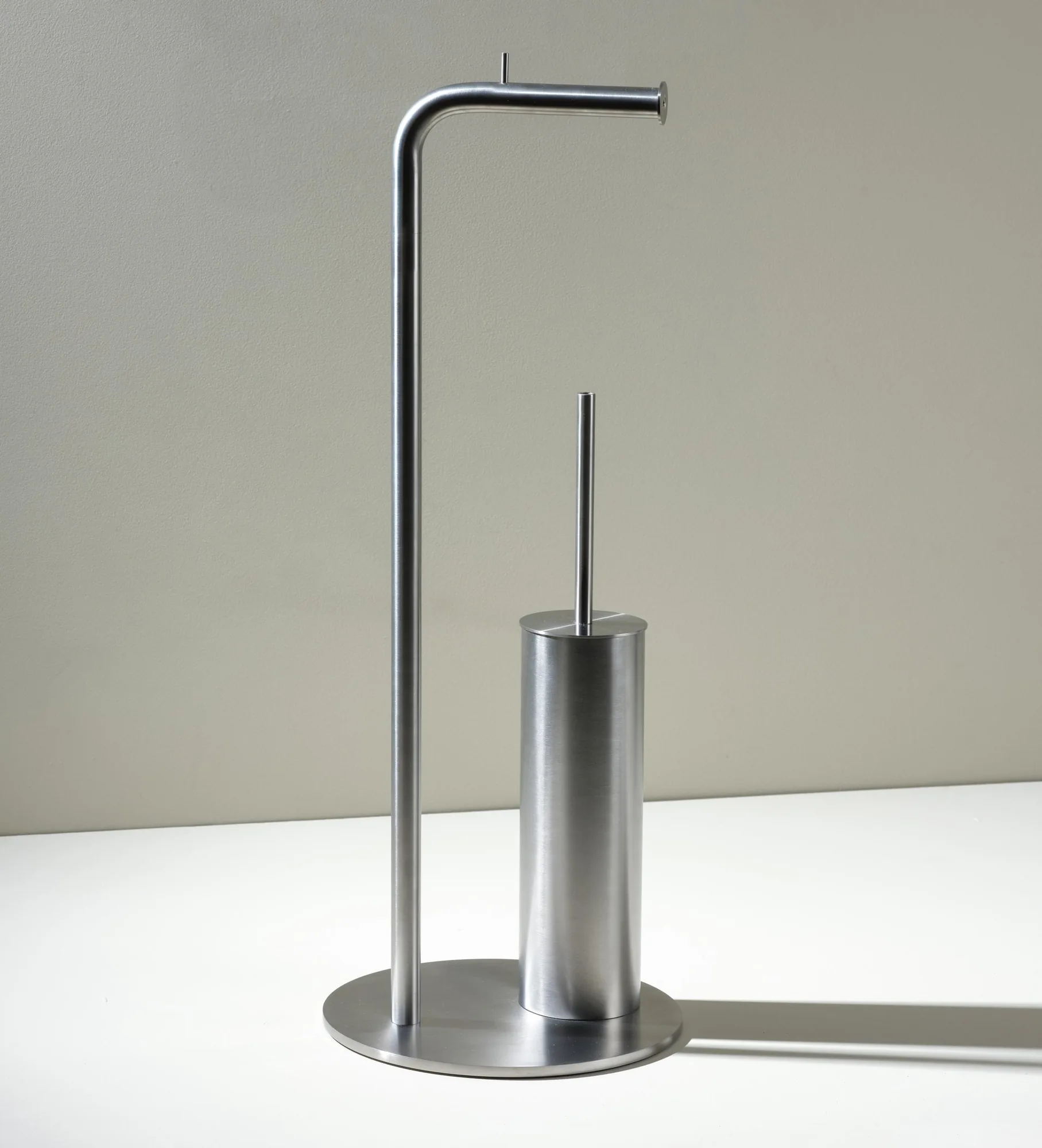 ProductFreestanding Toilet Roll and Brush Holder Unit2MS3403-BSAISI 316 stainless steel, guide price £650 per unit ex VAT. Roll holder and brush holder on one stand, with no wall fixing beside the pan. The catalogue page names coastal, spa and pool environments as the case it suits. Published grade is 316 rather than 316L; confirm on the current data if the schedule calls for the low-carbon grade.View in catalogue →
What to write into a coastal fit-out schedule
A coastal schedule is a set of separate decisions, and each belongs on its own line rather than being collapsed into "316L accessories". The following is the set the exposure analysis above implies.
| Schedule line | What it records | Why it belongs there |
|---|---|---|
| Exposure position | Exposed elevation, sheltered coastal plot or inland | Sets the chloride load and the wetness profile |
| Chloride environment | The ISO 9223 category the position corresponds to | Gives the exposure a name both parties can reference |
| Material grade | The AISI grade on each visible and concealed component | Grade is a line of its own, not a range name |
| Surface finish | The finish name, code and approved sample | Finish matters more as exposure rises |
| Joint design | Crevice, stand-off and fixing detail at each wall interface | Crevices are the sites of crevice corrosion |
| Drainage | Fall, outlets and sealed penetrations | Removes the electrolyte before it forms |
| Ventilation | Extract provision and the room's drying behaviour | Cuts time of wetness |
| Fixings | Material of screws, brackets and concealed parts | Prevents galvanic attack at the fixing |
| Cleaning method | Approved products, dilution and frequency | Chloride-bearing cleaners pit stainless |
| Inspection interval | How often and who checks, and what they look for | Catches pitting and crevice attack early |
| Replacement reference | Product code and catalogue link for spares | Makes the maintenance plan actionable |
What the maintenance plan needs to contain
The maintenance plan follows directly from the exposure analysis, and the BSSA's cleaning guidance sets the baseline it works from: "washing with soap or mild detergent and warm water followed by a clear water rinse is usually quite adequate". On top of that baseline, a coastal plan needs:
- A rinse cycle, so salt is removed before it dries and concentrates into a deposit.
- A drying step, because leaving the surface wet is what keeps the electrolyte in contact with the steel.
- A named list of approved cleaners and an explicit exclusion of chloride-bearing products, bleach and hydrochloric-acid cleaners.
- A shorter inspection interval on exposed elevations and near open windows, where deposits arrive fastest.
- A named person and a date, so the plan is an instruction rather than an aspiration.
How the industry measures corrosion, and what those numbers mean
A schedule may need to refer to laboratory evidence, and it helps to know exactly what the common test does and does not establish.
ISO 9227 is a salt spray (fog) test method covering neutral, acetic acid and copper-accelerated salt spray procedures for metals, metallic coatings and organic coatings. Its scope is a laboratory procedure. As the method's own technical literature notes, it "doesn't necessarily create excellent correlation to outdoor corrosive conditions", and while it produces results quickly with good repeatability, the test conditions "do not accurately replicate real environmental conditions like humidity, temperature fluctuations, complex salts, or industrial pollutants". It is a quality-control and comparison tool, not a prediction of service life at a specific building.
The distinction between the two families matters. ISO 9227 is an accelerated laboratory test; ISO 9223 is a classification of real atmospheric corrosivity. Neither is a guarantee of service life at a given elevation. Where a reader needs to know how to read a test report itself, and which details to ask for, that is covered in salt spray test reports for stainless steel accessories.
Coastal specification checklist
- Exposure position recorded for each room, not just "coastal"
- Chloride environment named, and the sheltered positions reviewed separately
- Grade confirmed per product, not per collection or range
- Finish sample approved against the exposure, with the finish's care instructions
- Joints and stand-offs reviewed for crevices and for drainage
- Fixing materials matched to avoid galvanic pairs in a damp location
- Ventilation and drying provision confirmed for each room
- Approved cleaning products listed, chloride-bearing products excluded
- Inspection interval set, with an escalation route for early-stage pitting
- Catalogue links and product codes on every schedule line
- Handover pack carries the cleaning routine and inspection notes
For the wider accessory specification, see 316L stainless steel bathroom accessories for coastal and seafront properties, and for how to fix fittings into coastal walls, wall backing and stainless fixings for towel rails and robe hooks.
Specify for the exposure you actually have
A seafront bathroom does not fail because the wrong alloy was chosen, and it does not succeed because the right one was. It fails when chloride, moisture and time meet in a crevice that was never detailed. The grade decision is real and is set out in AISI 304 versus 316L stainless steel taps, and the cost question in whether marine-grade 316L is worth it, but the grade only sets the margin. The finish, the joints, the drainage, the ventilation and the cleaning regime decide whether that margin is ever used.
Classify the exposure honestly, including the sheltered positions that never get washed. Review every joint for a crevice. Design the water out of the detail and the damp out of the room. Put the inspection interval in the schedule, not in a policy document nobody opens. That is what determines whether a fitting is still bright in year ten at a seafront.
Specify it from the catalogue
Every fitting mentioned here is stocked and specified in the FONTEA trade catalogue: full technical data, finishes and wholesale tiers.
Related reading
-
 Specification
Salt Spray Test Reports for Stainless Steel Bathroom Accessories
Read salt-spray reports by checking method, specimen, finish, exposure conditions and failure criteria, and avoid treating test hours as a service-life promise.
-
 Materials
Is Marine-Grade 316L Stainless Steel Worth It for a UK Bathroom?
Sometimes. 316L earns its premium where chlorides genuinely reach the fittings, and wastes money on a standard inland bathroom. Here is how to tell which situation you are in before you pay.
-
 Finishes
Matching accessory finishes across a project: the extended accessory palette
How to hold one finish across every accessory in a scheme, which pieces must match exactly, which can vary, how to build a finish schedule, and what to do when a combination does not exist.