 ONTEA
ONTEA
Sometimes, yes, and the test is whether chlorides genuinely reach the fittings rather than how prestigious the specification sounds. In a seafront apartment, a coastal hotel or a washroom cleaned daily with chlorine-based products, 316L buys real resistance to pitting that AISI 304 cannot match. In a standard inland bathroom on ordinary mains water with a standard cleaning routine, the same premium buys you almost nothing, because the failure mechanism 316L is added to resist is one your bathroom probably never produces.
Key Takeaways
- 316L is 304 plus roughly 2 to 2.5% molybdenum. That molybdenum is the entire reason for the grade and the entire reason for the price.
- UK water-industry guidance treats 304 as suitable below about 200 mg/L chloride and 316 below about 1000 mg/L, so most UK bathrooms sit comfortably inside the 304 range.
- BSSA is explicit that 316 "cannot be considered 'corrosion proof'", and that 304 "should not be considered suitable for seawater service". Read together, they tell you 316L buys margin, not immunity.
- The FONTEA catalogue publishes no controlled 304-versus-316L pair, so there is no honest percentage premium to quote. Nearest-position products differ in design and collection as well as grade.
- What a buyer can actually check: the grade on the product page, the composition certificate, and a critical pitting temperature figure rather than a salt-spray hour count.
What 316L actually is, chemically
Both grades are austenitic stainless steels. The difference is a small, deliberate addition.
The UK water industry's joint guidance note, produced with the British Stainless Steel Association and the Nickel Institute, tabulates the alloying elements for the grades named in EN 10088-1. AISI 304 (1.4301) carries 17.0 to 19.5% chromium and 8.0 to 10.5% nickel with no molybdenum. AISI 316L (1.4404) carries 16.5 to 18.5% chromium, 10.0 to 13.0% nickel and 2.0 to 2.5% molybdenum. Carbon drops from 0.07% maximum in 304 to 0.03% in 316L, which is what the "L" means (IGN 4-25-02, Applications for Stainless Steel in the Water Industry, Issue 2, August 2023, Table 3-1).
That same document names the mechanism directly: "The pitting and crevice corrosion resistance increases as the molybdenum content is raised from 1.4301, through 1.4401 to 1.4436 (304, through 316 to 316 high Mo)" (IGN 4-25-02, Table 3-1). The British Stainless Steel Association puts the same point more bluntly on corrosion mechanisms: "If there is a known pitting hazard, then a molybdenum bearing stainless steel will be required" (BSSA, Corrosion mechanisms in stainless steel).
Nickel does a different job. The BSSA's graduated list of grades runs 304 to 316 by "adding molybdenum reduces the effectiveness of chloride ions in locally breaking down the passive layer", and notes separately that nickel "aids the reformation of the passive layer if it is disturbed" (BSSA, An introduction to the corrosion resistance of stainless steels). Molybdenum defends the passive film against chloride. Nickel helps it heal. Both matter; only the molybdenum is what separates 316 from 304.
The "L" is about welds, not about salt
The low-carbon suffix exists for a different reason entirely, and buyers routinely conflate it with the marine story. Carbon in stainless steel "reacts with chromium and precipitates chromium carbides on grain boundaries under certain thermal cycles, e.g. in weld heat affected zones", and a low-carbon alloy reduces that (IGN 4-25-02, Section 3). On the 304L row of the same table the note reads: "The principal difference between the standard and lower carbon 'L' grades is that the latter have greater resistance to sensitisation (reduction in corrosion resistance) in weld heat affected zones."
So the "L" protects corrosion behaviour around welded joints. It does not add chloride resistance. A 316L fitting bought for its welded-joint integrity is a legitimate reason to prefer it, but it is a different reason from marine grade, and on a cold-formed accessory body with minimal welding it may not matter much either way.
 CollectionFONTEA AISI 316L material pageEvery product in the catalogue states its own AISI grade. Check it per product rather than per collection.View in catalogue →
What the molybdenum actually buys
Chloride ions attack stainless steel by breaking down the thin passive oxide film at a single microscopic point, and corrosion then concentrates there as pitting. Molybdenum thickens the grade's resistance to that breakdown. The standard way to express the difference is the pitting resistance equivalent number, calculated as PREN = Cr + 3.3Mo + 16N.
The BSSA publishes the resulting ranges: 304 (1.4301) sits at PREN 17.5 to 20.8, while 316 and 316L (1.4401/1.4404) sit at 23.1 to 28.5 (BSSA, Calculation of pitting resistance equivalent numbers). That is a meaningful jump, and it is why 316 is the default for marine service.
Now read the same BSSA page's warning, which matters more than the number: the PREN figures are "useful for ranking and comparing the different grades, but cannot be used to predict whether a particular grade will be suitable for a given application, where pitting corrosion may be a hazard". The water-industry note says the same from the design side: "material selection decisions cannot be based on PREN rankings alone" (IGN 4-25-02, Appendix A). A PREN figure is a ranking, never an approval.
The honest limit of the claim
The British Stainless Steel Association is careful not to oversell, and the care in its wording is the point a buyer should take to a supplier. On seawater selection: "The 316 types are used widely in marine applications, but their corrosion resistance in contact with seawater is limited and they cannot be considered 'corrosion proof' under all situations. They are susceptible to localised attack mechanisms, principally crevice and pitting corrosion" (BSSA, Selection of 316, 304 and 303 types of stainless steels for seawater applications). The same page adds that "The 304, and more especially the free machining 303 types, should not be considered suitable for seawater service."
Read those two sentences together and the honest position emerges. 316L is not a seawater grade in the sense that it survives immersion. It is a seawater-grade starting point, with design, drainage and cleaning still determining the outcome.
Which environments genuinely need it, and which do not
This is the decision, and it is a question about chlorides reaching the fitting rather than about how posh the property is.
The UK water industry guidance gives the clearest published thresholds available for a British buyer. In the pH range 6 to 8.5 normally encountered in potable waters, "304 types are considered suitable for chloride levels up to about 200 mg/L and 316 types for chloride levels up to about 1000 mg/L" (IGN 4-25-02, section 5.3.3). It then offers a more conservative reading for designers who want margin: "A more conservative approach would be to consider 304 types for chloride levels up to 50 mg/L and 316 types for chloride levels up to 250 mg/L."
Chloride exposure is not the only variable either. The same note tabulates chlorine limits for long-term exposure: 304 tolerates up to 2 mg/L free chlorine, 316 up to 5 mg/L (IGN 4-25-02, Table 5-3). A washroom cleaned with chlorine-based products every day is therefore a stronger case for 316L than a slightly harder water supply.
Where 316L earns the premium
- Coastal and seafront properties. Wind-borne salt reaches fittings that never touch a tap outlet. BSSA notes that chloride levels can concentrate as surface moisture evaporates, and that this "could increase the corrosion risks in splash zones, if the chlorides concentrate in a damp or wet environment".
- Developments where maintenance is outsourced and the cleaning regime is aggressive. Contract cleaning is where 304 meets the 2 mg/L free chlorine ceiling.
- Wet rooms, shower zones and any fitting left wet. BSSA's seawater guidance is emphatic that free-draining surfaces and avoiding horizontal runs matter, and that stagnant conditions must be avoided.
Where it is money spent on nothing
- An inland bathroom on ordinary mains water. UK potable water sits well inside the 200 mg/L figure above, so the pitting mechanism 316L resists is largely absent.
- A bathroom that is wiped down and dried. Where drainage and ventilation already work, the extra margin buys nothing you can observe.
- Anything where the premium is being justified by the word "marine" rather than by an exposure assessment. If nobody on the project can name the chloride source, the premium is decoration.
If you want the same reasoning applied to accessories specifically, 316L stainless steel bathroom accessories for coastal properties covers towel rails, hooks and holders in detail, and 316L for high-traffic office washrooms covers the case where traffic and exposure are confused for each other. The technical grade comparison itself lives in AISI 304 versus 316L stainless steel taps.
What it costs against 304 in practice
The honest answer has three parts, and two of them are "the catalogue does not publish that".
There is no controlled comparison in the FONTEA catalogue. The catalogue does not offer the same design in both grades at two published prices, so no honest percentage premium can be quoted for a grade-only upgrade. Anyone giving you a clean percentage is either extrapolating from steel pricing or inventing it.
What the catalogue does publish is real, and it is not a grade premium. These are different products in different positions, not the same design in two alloys. The grade difference is the point being illustrated, but it is never the only thing that separates them:
| Product | Grade | Guide price, ex VAT |
|---|---|---|
| Deck mounted basin mixer without pop-up waste | AISI 316L | £590 per unit |
| Deck mounted countertop basin mixer | AISI 316L | £1950 per unit |
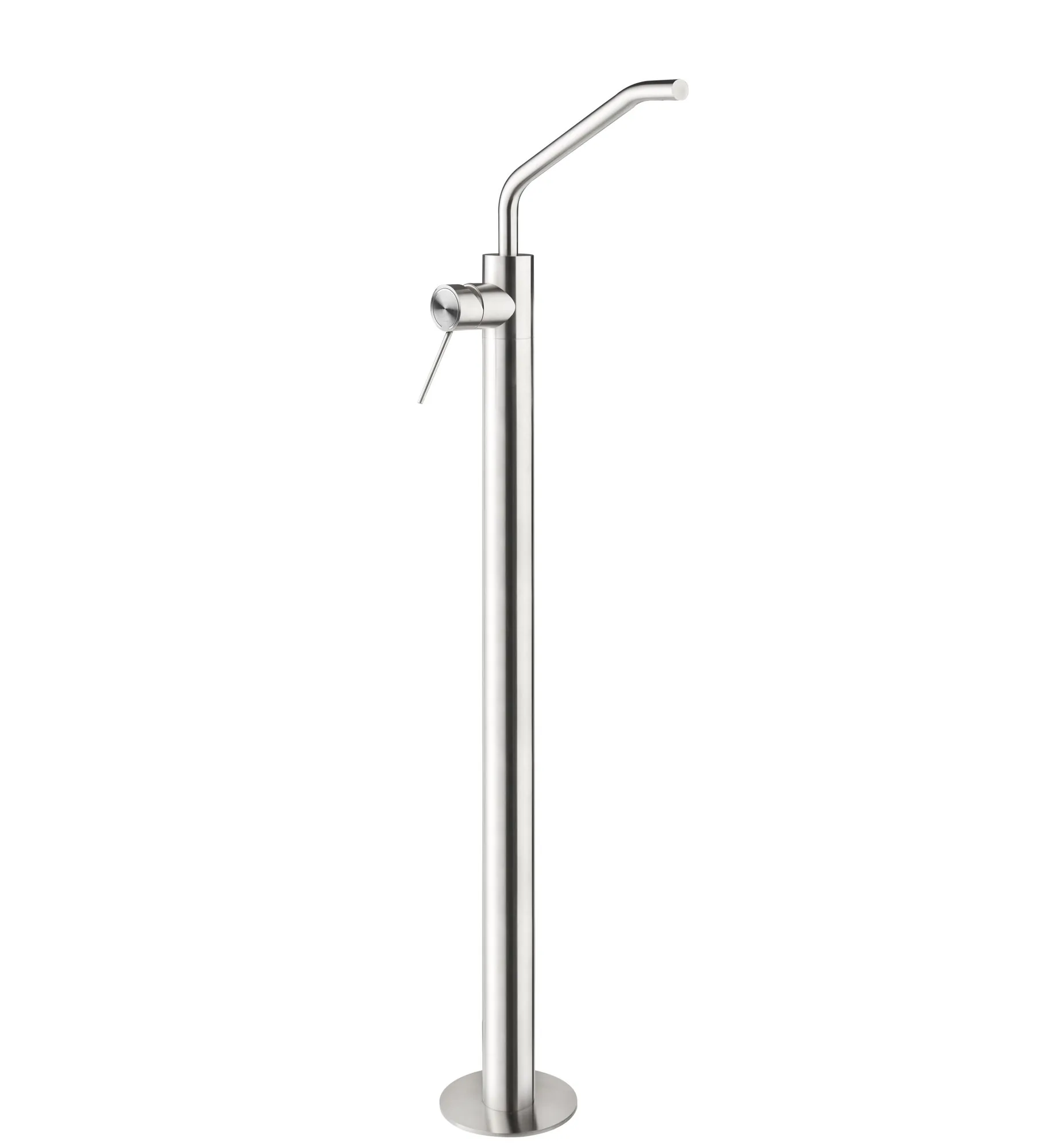
| Floor standing basin mixer column | AISI 316L | £1950 per unit |
| Freestanding stainless steel towel rail | AISI 304 | £580 per unit |
| Wall mounted towel rail, 650 mm | AISI 304 | £150 per unit |
Every figure above is the catalogue's own indicative guide price per unit, ex VAT, and the catalogue states alongside each one that "Firm trade pricing is quoted per order based on volume and finish."
Read that table the way a buyer should, not the way a salesperson would. The single deck-mounted basin mixer is £590 and the countertop equivalent is £1950. Neither is a 316L-versus-304 comparison, and quoting the difference as evidence that 316L costs four times more would be nonsense. The only fair reading is that the price tracks the product's position and specification, and that the grade is one line in the specification rather than the whole of it.
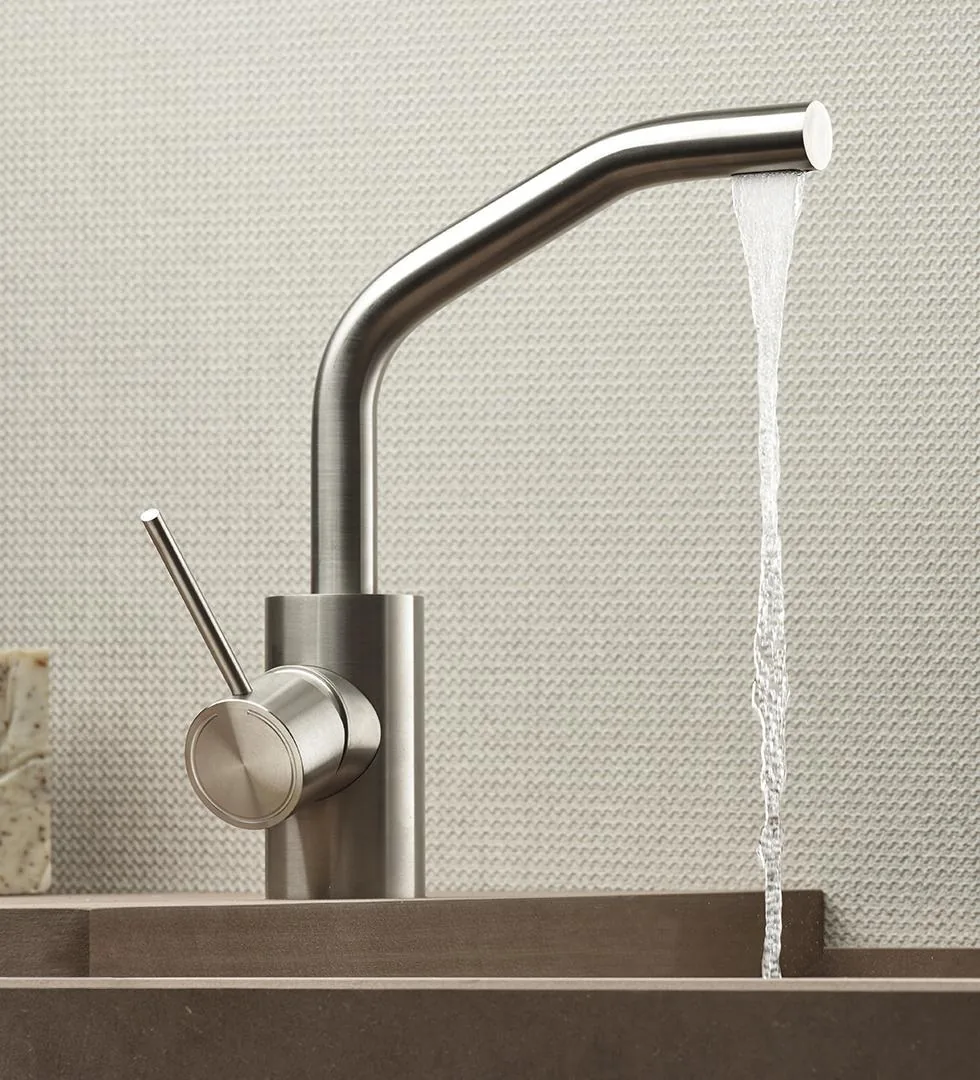 ProductDeck mounted basin mixer supplied without pop-up waste2SL33339-BSAISI 316L, indicative guide price £590 per unit ex VAT. Supplied without a waste, so the basin and waste specification stays with the buyer.View in catalogue →
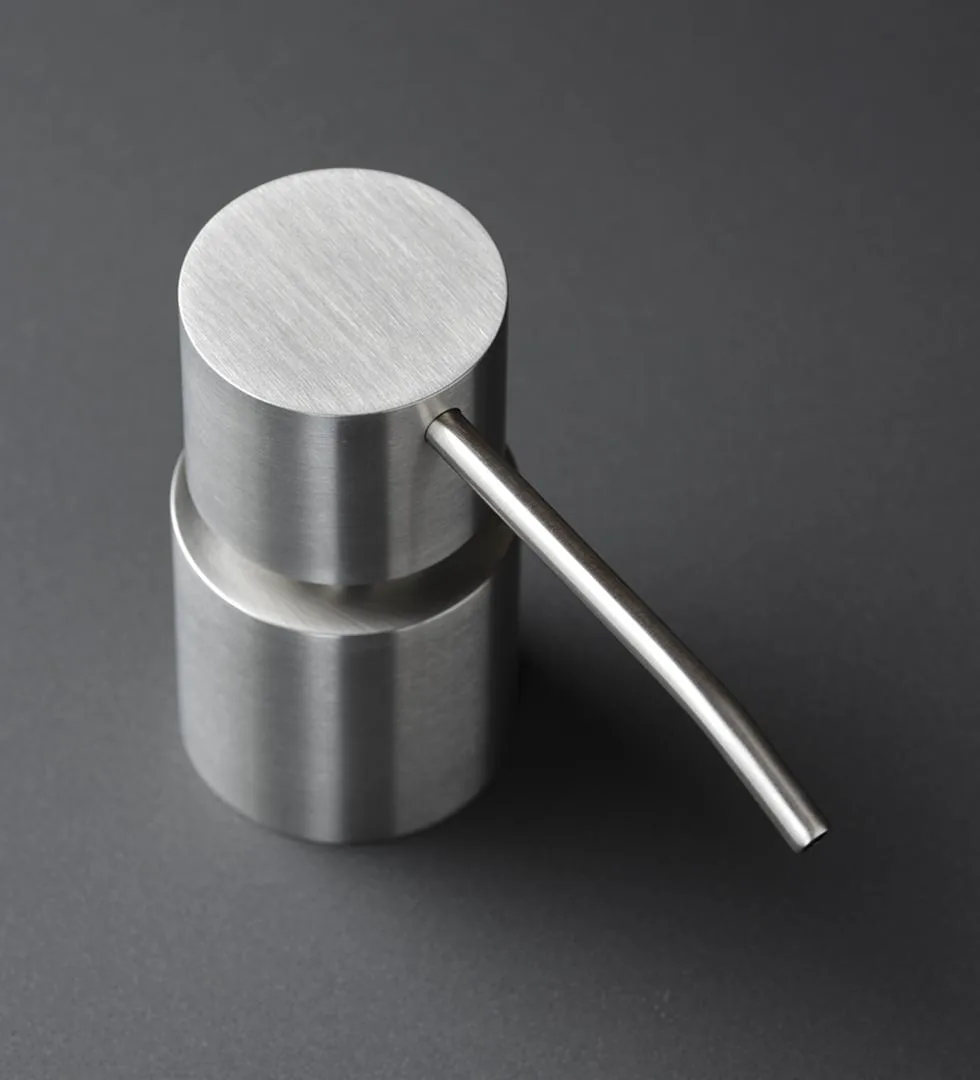 ProductDeck mounted soap dispenser2AE0315-BSAISI 316L throughout, indicative guide price £290 per unit ex VAT. Aimed at hard water, coastal rooms and hospitality washrooms where a plastic dispenser would be on a replacement cycle.View in catalogue →
Where the raw material premium is documented. One component of the cost is published by a steel producer. ArcelorMittal Industeel's monthly alloy surcharge table, updated 16 February 2026, lists 304L (1.4307) at €2,189 per tonne and 316L (1.4404/1.4406) at €3,372 per tonne for February 2026, against €2,152 and €3,283 respectively in January 2026 (ArcelorMittal Industeel, Monthly Alloy Surcharges for Stainless Steels, updated 2026-02-16). The sheet notes that from November 2022 this surcharge excludes the energy surcharge, which is instead included in base prices at order.
That makes the alloy surcharge on 316L roughly half again the 304L surcharge. It is a surcharge on one cost component of raw steel, not a delivered mill price and not a bathroom fitting price. Use it to understand why 316L products cost more, not to predict what a finished tap will cost.
What to check before you pay the premium
- Name the chloride source in writing. If the specification says 316L but nobody can say whether the driver is sea air, mains chloride, or cleaning chemistry, the upgrade has not been justified. Write the source into the specification.
- Check the grade on the product, not the collection. Grades are published per product. A brand page describing a range as 316L does not make every product in it 316L.
- Ask for a mill certificate rather than a marketing claim. An EN 10204 3.1 or 3.2 certificate states the actual composition, including molybdenum and carbon. That is the document that settles it.
- Ask for a critical pitting temperature, not salt-spray hours. The critical pitting temperature is the ranking test for stainless steels. ASTM G48 Method E exposes specimens in 24-hour steps in a 6% ferric chloride solution with 1% hydrochloric acid, raising the temperature in 5°C increments until corrosion starts (Outokumpu, Testing stainless steel for resistance to pitting corrosion). Outokumpu's own caution is worth quoting to a supplier: "A higher CPT value indicates that one stainless steel will perform better than a grade with a lower value, however the value cannot be used directly to predict performance in a real application."
- Do not accept a salt-spray hour count as a grade ranking. A salt-spray result cannot predict service life. Bodycote's technical note on the method quotes the standard's own position: "It is often not possible to use results gained from salt spray testing as a comparative guide to the long-term behaviour of different coating systems, as the corrosion stress during these tests differs significantly from the corrosion stresses encountered in practice," and describes the results as "Very unreliable results; Cannot be correlated to actual performance in service" (Bodycote, Salt Spray Test: Suitable For Stainless Steels?, October 2018). If you are approving a salt-spray report, read what a salt-spray test report can and cannot show first.
- Match the whole assembly. A 316L body on a bracket and screws of another grade keeps the weak point the upgrade was meant to remove. The water-industry guidance makes the parallel point on bolting: where a material operates near its chloride limit, "crevice corrosion of the bolts is a risk", and the fix is to raise the bolting grade too.
- Price the consequence of getting it wrong. If 304 is genuinely adequate, paying more for 316L is a small loss. If 316L is genuinely needed and you specified 304, the cost is pitted fittings and a replacement programme across every affected room. For a developer fitting out hundreds of units, that asymmetry, not the unit price, is the real money question.
Frequently asked questions
Is 316L worth the money in an ordinary UK bathroom?
Usually not. UK water-industry guidance treats 304 as suitable for potable water below about 200 mg/L chloride, and most UK mains supplies sit well inside that figure, so the chloride pitting mechanism that 316L resists is largely absent from a standard inland bathroom. The premium is justified when there is a real chloride or chlorine source, not because a room is expensive.
Is "marine grade" a guarantee it will not rust?
No. The British Stainless Steel Association states that 316 types "cannot be considered 'corrosion proof' under all situations", and that they remain "susceptible to localised attack mechanisms, principally crevice and pitting corrosion". Marine grade describes a starting point for selection, not a warranty. Design, drainage, ventilation and cleaning still decide the outcome.
Can 316L be distinguished from 304 by eye or by a magnet?
Not by eye. Both grades take the same brushed and PVD finishes. A magnet does not separate them either: austenitic stainless steels are essentially non-magnetic, and cold working can introduce a magnetic phase without changing the grade. Confirm the grade from a certificate or the product page.
Does paying more for 316L mean I can clean it with bleach?
No. Chlorine-based products attack stainless steel, and BSSA warns that chloride-containing cleaners can stain and pit it regardless of grade. The water-industry guidance places 316's long-term free chlorine tolerance above 304's, but the higher figure is a ceiling, not an endorsement of routine bleach use. Use the approved cleaning method for the product. See which cleaning chemicals damage stainless bathroom accessories for the operator-side detail.
Does the L in 316L mean extra corrosion protection?
Only in one specific place. The "L" denotes a lower carbon content, 0.03% maximum rather than 0.07%, and its purpose is to protect corrosion resistance in the heat-affected zone of welds against sensitisation. It adds nothing to chloride pitting resistance. The molybdenum does that.
The decision in one paragraph
Pay for 316L when you can name where the chlorides come from: sea air on a coastal elevation, a mains supply above roughly 200 mg/L chloride, or a cleaning regime with regular chlorine-based products. Do not pay for it because "marine grade" sounds like the right answer for a nice bathroom, because the PREN number is higher, or because the salt-spray report says a product survived a few hundred hours in a chamber. Where the chloride source is real, 316L is a margin that matters and the catalogue's 316L ranges are built for it. Where it is not, AISI 304 is the sound specification and the saving is real money on every unit in the schedule.
Browse the FONTEA AISI 304 and AISI 316L material pages to check the grade on individual products before you place an order. The Fontea brand page publishes the split across its own range: 316L is the grade on 274 of its 360 stocked products, with the balance in AISI 304, and it describes 316L as the cornerstone of the range rather than a specialist upgrade. Send your room schedule and quantities through the contact page for trade pricing.
Specify it from the catalogue
Every fitting mentioned here is stocked and specified in the FONTEA trade catalogue: full technical data, finishes and wholesale tiers.
Related reading
-
 Specification
Stainless Steel Bathroom Fittings for Coastal and Seafront Developments: A Salt-Air Corrosion Guide
What actually governs whether bathroom fittings survive a seafront elevation: the chloride gradient, finish, joint design, drainage and ventilation, how corrosion appears, and what to schedule.
-
 Materials
AISI 304 vs 304L vs 316L: what the "L" actually changes
The L suffix marks a lower carbon limit, not a stronger or more corrosion-resistant alloy. Here is exactly what it changes around welds, what it leaves alone, and whether it should change your order.
-
 Materials
AISI 304 vs 316L Stainless Steel Taps: Which Grade for Which Job
How AISI 304 and 316L stainless steel taps differ, when 316L's molybdenum content earns its extra cost, and how to specify the right grade for coastal, hard-water and commercial jobs.