 ONTEA
ONTEA
AISI 316L is the better default for coastal, hard-water and heavy-commercial installations because its molybdenum content resists chloride pitting that AISI 304 cannot. AISI 304 remains a sound, lower-cost choice for standard residential and light-commercial bathrooms away from salt air. The grade stamped on a spec sheet changes how a tap ages, not how it looks on day one, so the decision is worth making deliberately rather than by default.
Key Takeaways
- 316L adds roughly 2 to 2.5% molybdenum over 304, which is what improves resistance to chloride-driven pitting and crevice corrosion (thyssenkrupp Materials, 2025).
- The British Stainless Steel Association advises that plain 304 types "should not be considered suitable for seawater service," while 316 is used more widely in marine settings, though with real limits (BSSA, retrieved 2026-09-28).
- Neither grade is corrosion-proof. Design, drainage, weld quality and cleaning regime matter alongside grade choice (UK Water Industry IGN 4-25-02, August 2023).
- For a standard inland bathroom with normal mains water, 304 is a reasonable specification; for coastal, high-chloride or heavy-duty commercial settings, 316L is the safer default.
What actually separates 304 from 316L
Both grades are austenitic stainless steel, built on a similar chromium-nickel base. 304 has around 17-18% chromium and 8-10% nickel. 316 has around 16.5-18.5% chromium and 10-13% nickel, plus roughly 2.0-2.5% molybdenum that 304 does not have. That molybdenum is the part that matters for a tap: it is what raises resistance to localised, chloride-driven attack (thyssenkrupp Materials UK, retrieved 2026-09-28).
The "L" suffix on 316L (and on 304L) marks a lower-carbon version of the same specification. It exists to protect corrosion resistance around welds, not to change everyday performance (UK Water Industry IGN 4-25-02: Applications for Stainless Steel in the Water Industry, August 2023, Issue 2, section 3). Fontea's ranges use 316L rather than plain 316 for that reason. A tap body has welded or formed joints, and the low-carbon grade holds its corrosion resistance better at those joints over the product's life.
Where 304 is fine, and where it stops being fine
304 is the material most kitchen sinks and general food-contact equipment are made from, and it performs well in ordinary tap water without chloride loading. It is the right call for most inland residential and light-commercial bathrooms.
Its weak point is chlorides. The British Stainless Steel Association states plainly that plain 304 types "should not be considered suitable for seawater service" (retrieved 2026-09-28). A domestic bathroom is not seawater immersion. But the same mechanism still applies at a lower intensity: chloride ions break down the metal's protective oxide layer at one microscopic point, and pitting spreads from there. Salt-laden air, chloride-treated water and heavy chlorine-based cleaning products all feed that same mechanism over years. That is the gap 316L is built to close. It is the reason Fontea's own 316L guidance for coastal bathroom accessories reaches the same conclusion for towel rails and holders that this article reaches for taps. Where the catalogue's 304 tap stock sits today is a separate question, answered in the closing line below.
Why 316L earns its place in coastal and hard-water specs
The same BSSA source is careful not to oversell 316 either. Its corrosion resistance in marine conditions is described as "limited," and 316 types "cannot be considered 'corrosion proof' under all situations." Both can still suffer localised crevice and pitting attack in aggressive enough conditions (BSSA, retrieved 2026-09-28). What 316L buys a specifier is a wider safety margin before that failure starts, not immunity from it.
The UK Water Industry's joint guidance note, from the British Stainless Steel Association, Nickel Institute and Steel Construction Institute, treats this as a composition question first. Corrosion resistance in chloride environments "is further enhanced by additions of molybdenum," and the note names "304" and "316" as the two most widely used standard austenitic grades in water-industry equipment (IGN 4-25-02, August 2023, section 3.1-3.2). But the same document is direct that grade choice interacts with design. Flow, aeration, crevice geometry and weld condition all change how a grade performs in service. A 316L tap fitted with a crevice-trapping washer, or left permanently wet in a poorly ventilated space, will still corrode faster than good practice allows.
Coastal specifiers who want to see how 316L's chloride resistance is actually reported, rather than only claimed, can read how to interpret a salt spray test report before approving a finish.
In practice, that guidance points to 316L as the safer specification for:
- Coastal and seafront properties, where airborne salt reaches every fitting, not only ones facing the sea.
- Areas with genuinely hard or chloride-treated mains water, where standing droplets leave mineral and chloride deposits on the tap body repeatedly.
- Commercial and hospitality settings where cleaning schedules use chlorine-based products at a frequency a domestic bathroom never sees.
Cost and finish: the trade-off that actually shows up on an invoice
316L's extra molybdenum costs more to produce, and thyssenkrupp Materials UK confirms 316 is "a more expensive grade of metal" than 304 for that reason (thyssenkrupp Materials, retrieved 2026-09-28).
What the catalogue can and cannot show. On the FONTEA catalogue the extra cost is visible, but it is not a clean grade-for-grade premium. The floor standing basin mixer column and the upright floor mixer column for a basin are both AISI 316L and both stand on the floor beside a bowl, yet the catalogue lists them at £1950 and £1350 per unit respectively. Nothing published separates grade from body size, finish and design at that price. A lower-priced 316L product is cheaper because it is a different product in a different position, not because a cheaper alloy does the same job. Read the price against the specification, not against the grade alone.
Finish is a separate decision from grade. Both 304 and 316L taps across the catalogue are offered in brushed steel and in PVD colour finishes, because PVD is a surface treatment bonded onto the base metal rather than a substitute for it. Choosing a PVD finish does not change which grade sits underneath it, and a coastal project should still specify 316L under a PVD finish rather than treating the coating as the corrosion protection.
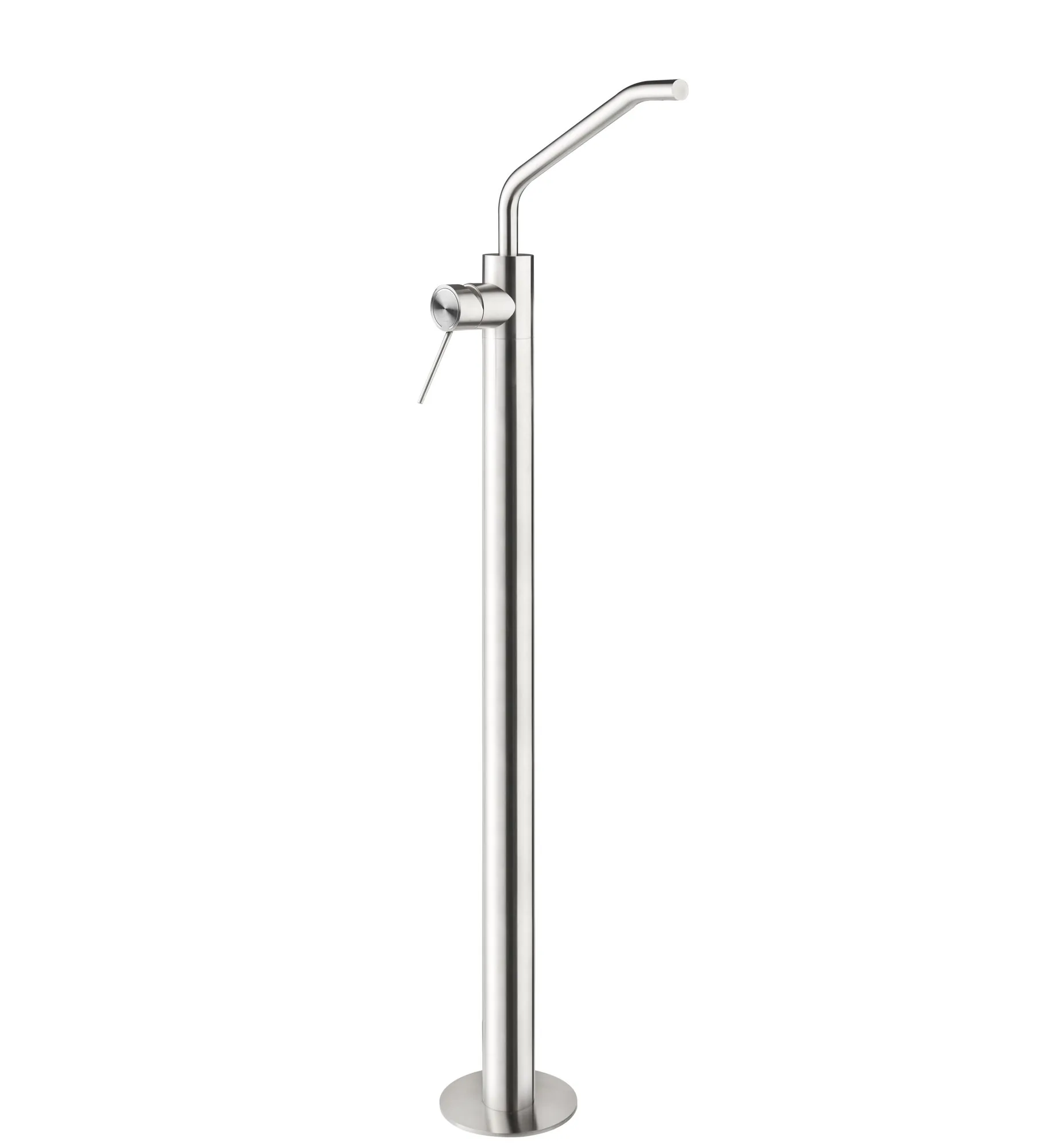 ProductUpright Floor Mixer Column for a Basin2LI8512Z-BSAISI 316L stainless steel, indicative guide price £1350 per unit ex VAT. The standard commercial specification, and the everyday choice for an inland bathroom.View in catalogue →
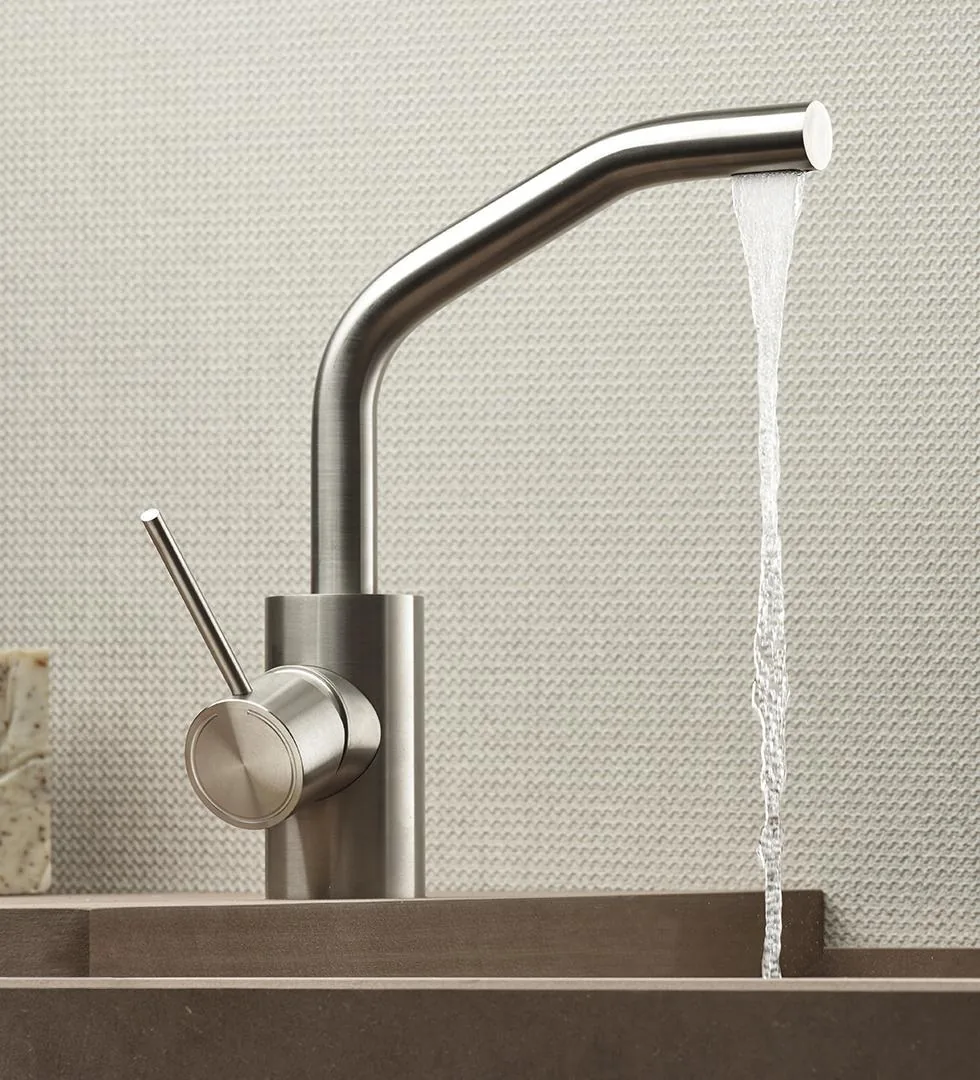 ProductFloor Standing Basin Mixer Column2SL33606X-BSAISI 316L stainless steel, indicative guide price £1950 per unit ex VAT. The larger column, used where the basin is a design feature and the mixer reads as a vertical element in the room.View in catalogue →
A short specification checklist
- Confirm the exposure, not just the room type. A bathroom 200 metres from the sea, a wet room with a softener adding chloride to the supply, and a hotel washroom cleaned daily with bleach-based products all sit closer to 316L territory than a standard suburban bathroom does.
- Ask what grade sits behind the finish. A brushed or PVD finish tells you nothing about the base metal; request the AISI grade in writing on the spec sheet or order confirmation.
- Treat 316L as risk reduction, not a guarantee. Both BSSA and the UK Water Industry guidance are explicit that no austenitic grade is immune to pitting in a bad enough environment; drainage, ventilation and cleaning chemistry still matter after the grade decision is made.
- Match fixings and concealed parts to the visible grade. A 316L tap body paired with lower-grade concealed valve components or fixings reintroduces the weak point the grade choice was meant to remove.
- Budget the real difference. Expect 316L products to cost more than a comparable 304 product for the same design. That gap reflects material cost, not a finish or design premium. Equally, do not treat the cheapest 316L mixer as the entry price for the grade: catalogue price tracks the product's position and specification, so a smaller 316L column and a larger one can differ by several hundred pounds for reasons that have nothing to do with the alloy.
Frequently asked questions
Can I tell 304 and 316L apart by looking at a tap?
No. Both grades take the same brushed and PVD finishes, and there is no visual difference between them once fitted. The grade has to be confirmed on the spec sheet, product page or order confirmation, not read off the finish.
Is 316L worth it for a normal inland bathroom with mains water?
Usually not. The molybdenum that makes 316L more chloride-resistant addresses a specific failure mode, salt and chloride-driven pitting, that a standard inland bathroom with normal mains water and ordinary cleaning products rarely triggers. 304 is a reasonable, lower-cost specification in that setting.
Does a magnet test tell you the grade?
No. Both 304 and 316L are austenitic stainless steels, and both are broadly non-magnetic in their normal state. A strong magnetic response can suggest a tap is not stainless steel at all, but a weak or missing response cannot tell 304 from 316L, since cold-worked areas of either grade can pick up slight magnetism. Rely on the documented specification, not a magnet.
Does 316L need less maintenance than 304?
No. Neither grade removes the need for routine care. The UK Water Industry guidance and the British Stainless Steel Association both treat drainage, ventilation, weld quality and cleaning regime as factors that matter alongside grade choice, not instead of it (IGN 4-25-02, August 2023; BSSA, retrieved 2026-09-28). A 316L tap left permanently wet with chloride-laden cleaning residue will still corrode faster than good practice allows.
The decision, in one line
Specify AISI 304 for standard, inland, domestically-cleaned bathrooms where chloride exposure is low. Specify AISI 316L wherever salt air, hard or chloride-treated water, or frequent chemical cleaning will touch the tap for years, and expect to pay more for that margin. For a deeper look at how the same material choice plays out for accessories rather than taps, see the 304 vs 316 comparison for office washrooms and the 316L guide for coastal bathroom accessories.
Browse the AISI 304 and AISI 316L ranges on the FONTEA catalogue to compare specific products by grade before placing an order. On the current catalogue the AISI 304 range is entirely accessories, hand showers and shower heads: there is no 304 tap or mixer in it, so every mixer a buyer can specify today is 316L. That does not make 304 wrong, it makes the grade decision a supplier conversation rather than a line on this page.
Specify it from the catalogue
Every fitting mentioned here is stocked and specified in the FONTEA trade catalogue: full technical data, finishes and wholesale tiers.
Related reading
-
 Materials
AISI 304 vs 304L vs 316L: what the "L" actually changes
The L suffix marks a lower carbon limit, not a stronger or more corrosion-resistant alloy. Here is exactly what it changes around welds, what it leaves alone, and whether it should change your order.
-
 Materials
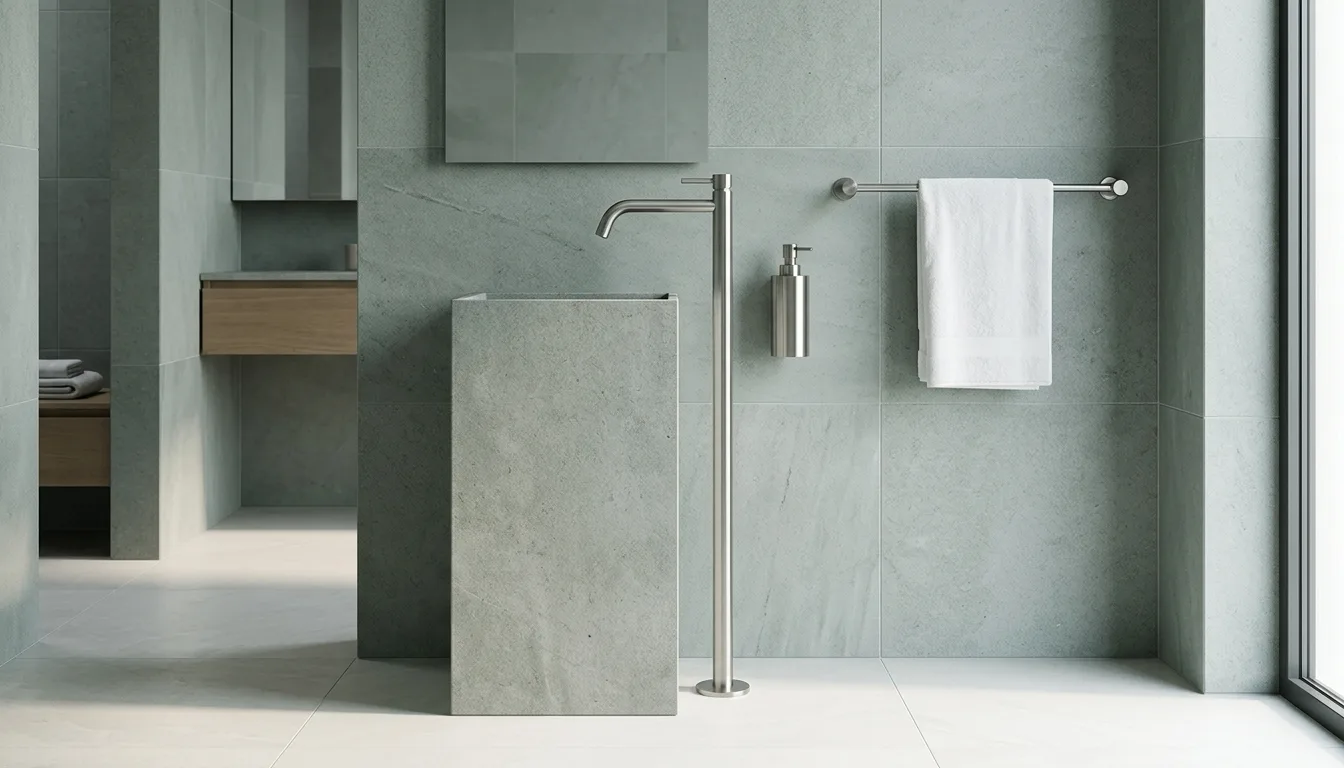
Is Marine-Grade 316L Stainless Steel Worth It for a UK Bathroom?
Sometimes. 316L earns its premium where chlorides genuinely reach the fittings, and wastes money on a standard inland bathroom. Here is how to tell which situation you are in before you pay.
-
 Materials
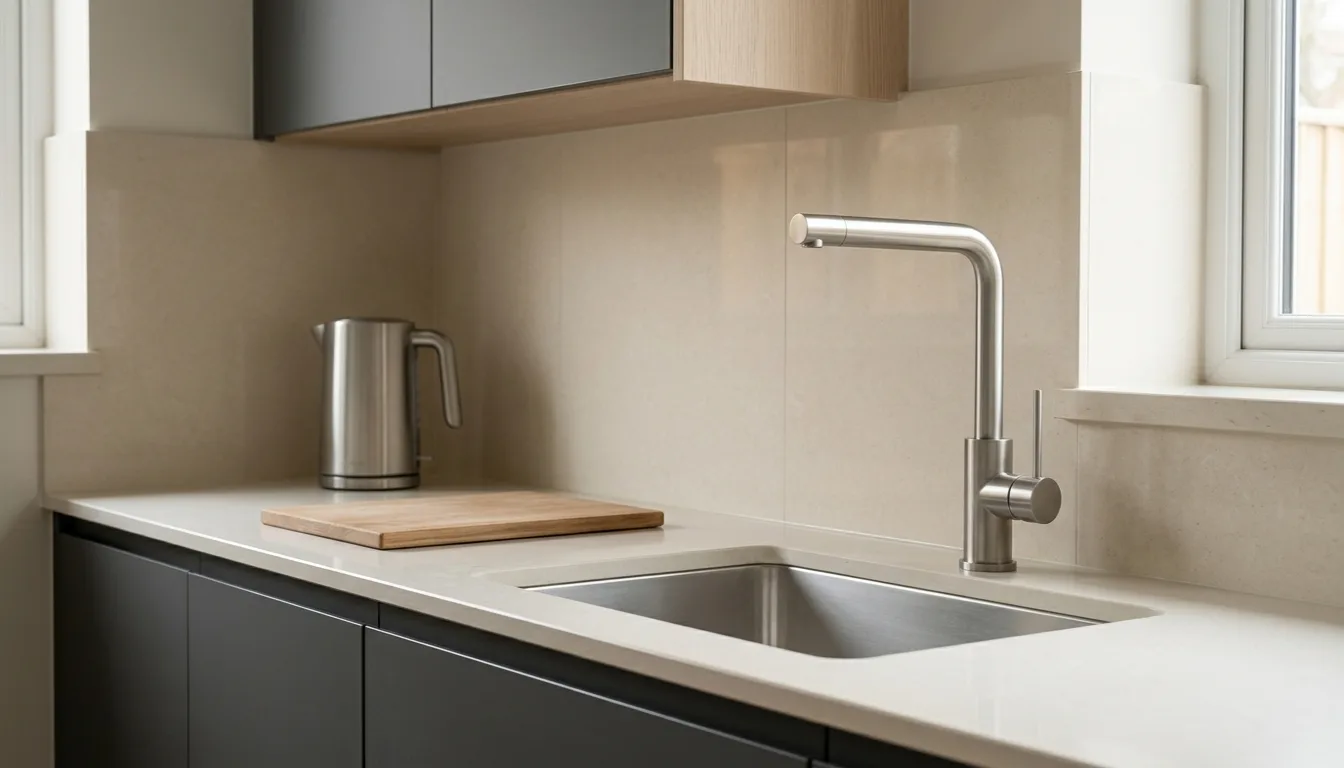
Kitchen Sink Mixer Materials: Why Food-Grade AISI 304 Rather Than Brass
A kitchen mixer is handled all day and splashed with fat, detergent and food acids. Here is why solid AISI 304 stainless is the right default there, where brass is a fair choice, and when to step up to 316L.