 ONTEA
ONTEA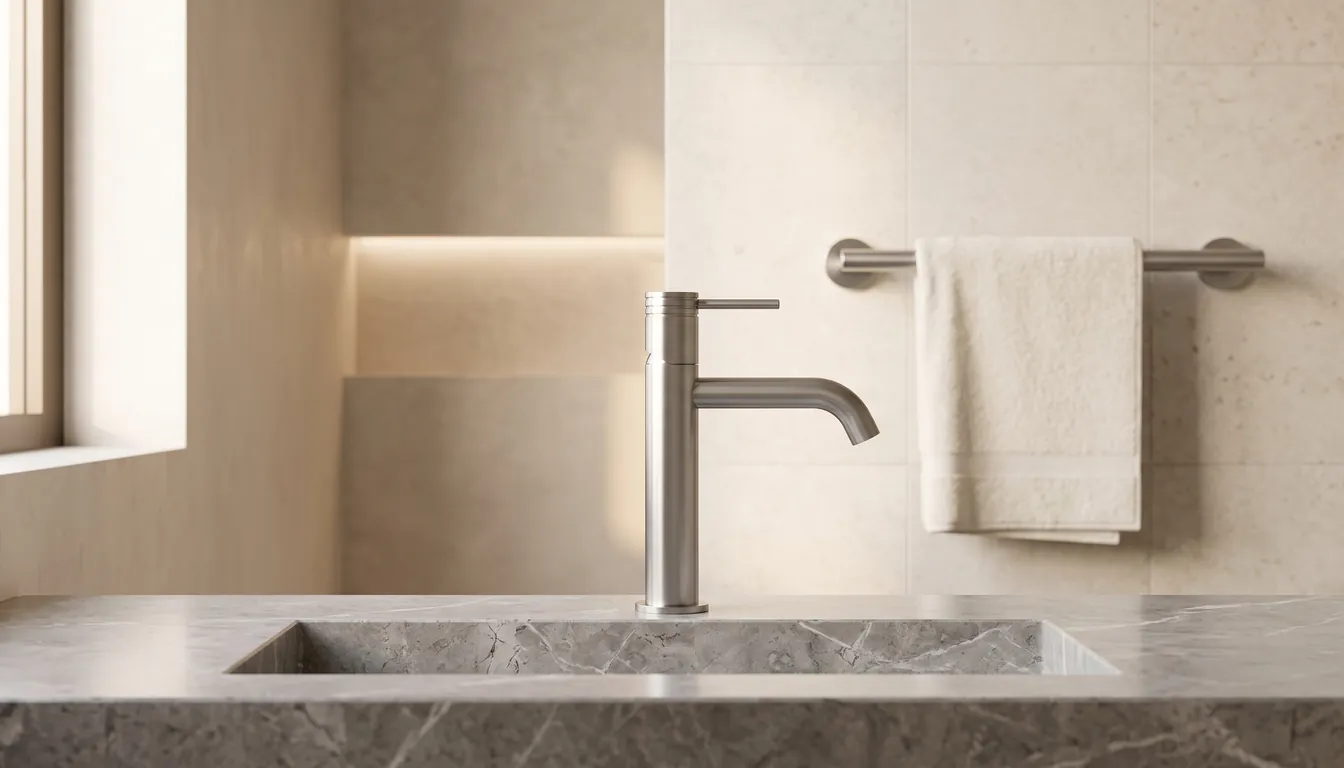
Brushed or satin stainless steel hides limescale best in a hard-water area, because its fine directional grain breaks up the pale deposit instead of presenting it as a hard-edged mark. The worst offender is matte black, which shows white scale more conspicuously than polished chrome does, not less. No finish prevents limescale; the choice changes how visible the deposit looks between wipe-downs, and how often you need to wipe it down.
Key Takeaways
- Brushed and satin stainless steel disguise a thin limescale film best, because the grain scatters the contrast that would otherwise outline the deposit.
- Polished steel and chrome show scale immediately, since a deposit interrupts a continuous mirror reflection.
- Matte black PVD is the hardest case: pale scale on a near-black surface gives the highest light-to-dark contrast in the range.
- The Drinking Water Inspectorate counts water above 200 mg/l of calcium carbonate as hard, so know your number before you specify.
- No finish is limescale-proof. Specifying a finish changes the cleaning interval, not the water.
Know how hard your water actually is
Start with the number, because "hard water area" covers a wide range of behaviour. The Drinking Water Inspectorate classifies supply hardness in milligrams per litre of calcium carbonate: soft up to 100, slightly hard 100 to 150, moderately hard 150 to 200, hard 200 to 300, and very hard above 300. The same page notes that hard water leaves tide marks on basins, sinks, baths and toilets, which is the same mineral deposit you see on a tap.
The inspectorate also points to the World Health Organization's drinking-water quality guidelines, which identify water at 200 mg/l or above as water that will produce scale. For an accurate figure, ask your water company directly, because local geology varies within a single supplier's area.
One practical consequence follows from this. The deposit forms where water evaporates, so it concentrates on the aerator outlet and the spout tip, on the lever where a hand dries it, and on any upward-facing ledge. A finish that hides film well is worth most on those specific surfaces, because those are the surfaces you will not wipe daily. On a deck-mounted basin mixer that means the spout tip and the top of the lever, which is exactly where a low-reflectance brushed surface earns its keep.
What actually makes one finish hide scale better than another
Two properties decide how visible a deposit becomes: how much the surface reflects as a mirror, and how dark the base colour is.
Surface roughness governs the reflection. The British Stainless Steel Association's finish guidance reproduces the coding table from Table 6 of BS EN 10088-2:2024 and lists the roughness values behind each code. A brushed or dull polished finish (code 1J or 2J) has a typical roughness of 0.2 to 1.5 micrometres and a unidirectional texture that is "not very reflective". A satin polished finish (1K or 2K) is the smoothest of the non-reflective special finishes, at less than 0.5 micrometres. A bright polished finish (1P or 2P), which can be a mirror finish, sits below 0.1 micrometres.
That progression is the mechanism in plain terms. On a near-mirror surface, the eye reads any discontinuity as a sharp shape, because the reflection is meant to be continuous and a deposit breaks it. On a surface carrying a directional grain, there is no continuous reflection to break. A deposit sitting in the grain changes the local scattering without producing an outline, so a thin film barely registers.
This is why the industry treats "matt" as a family rather than a single finish. The same BSSA table separates ground (1G or 2G), brushed (1J or 2J), satin (1K or 2K), bright polished (1P or 2P) and patterned (1M or 2M) surfaces, with very different roughness values across them. Two products both described as matt in a brochure may sit at opposite ends of that range and behave very differently against scale.
Finish by finish: how limescale presents
Here is the catalogue's own set of finishes, compared on the question a buyer in a hard-water area is actually asking.
Brushed and satin stainless steel. The best performer. The finish is bare stainless steel given a fine satin grain, with no coating and no plating, so the grain is part of the metal itself. The catalogue's brushed stainless steel finish page states that the soft matte surface hides fingerprints and water spots far better than polished chrome, and that it is available on every model in the catalogue in both 316L and 304 steel. In roughness terms this is the 2J or 2K family described above. Expect the deposit to be present but visually diffuse, and expect it to wipe off with a damp cloth and mild detergent.
Polished stainless steel. The worst performer. Polished steel sits at the 1P or 2P end of the same BSSA table, below 0.1 micrometres, and can be a mirror finish. Every thumbprint, droplet and pale deposit lands on an unbroken reflection, so the mark is sharply outlined the moment the surface dries. If a room is genuinely hard on water, polished steel is the finish to specify least often, and the polished stainless steel finish page is worth checking against whatever else is on the schedule.
Black PVD. The hardest case, and the one most buyers get wrong. The reasoning runs backwards from the intuitive answer. Black PVD is a matte finish, so it has the rough surface that reduces reflection, and the black PVD finish page describes it as a deep matte black bonded to the steel by physical vapour deposition. But the base colour is near-black, so a white calcium deposit produces the highest light-to-dark contrast in the whole range. A fine film that would disappear on brushed grey is unmistakable on matte black. Expect to wipe black PVD more often, not less, and keep the steel and chrome comparison for how finishes fail in view when weighing it.
Gold and copper PVD. Mid-range, and better than their colour suggests. Gold PVD is described on its catalogue finish page as a warm brushed gold, so it inherits the brushed advantage of scattering rather than reflecting. Copper PVD is the same family. Both are mid-tone rather than dark, so contrast against white scale is moderate. These are reasonable hard-water choices when the scheme needs warmth, and the Pearl coating page describes the pearl coating as a thin film carrying metallic pigments, which is the one finish in the range where the deposit sits on a film rather than on the metal or on a vapour-deposited layer.
Deep grey. The practical middle. Mid-tone with a low-reflectance surface, it behaves like a brushed finish for deposit visibility while staying darker than natural steel. The catalogue's deep grey finish range covers it.
The same product in two finishes proves the point
The most useful evidence is a single product in more than one finish, because the body, the spout and the geometry stay identical and only the surface changes. The catalogue's deck-mounted basin mixer without waste is one such product: the same AISI 316L single-lever body is offered in brushed stainless steel, polished stainless steel, deep grey, gold PVD and Tinta.
That product spans both ends of this article's argument in a single body. Brushed is the finish that disguises a thin film, polished stainless steel is the finish that outlines it, and the price step between them is small, so the argument is a specification decision rather than a budget one.
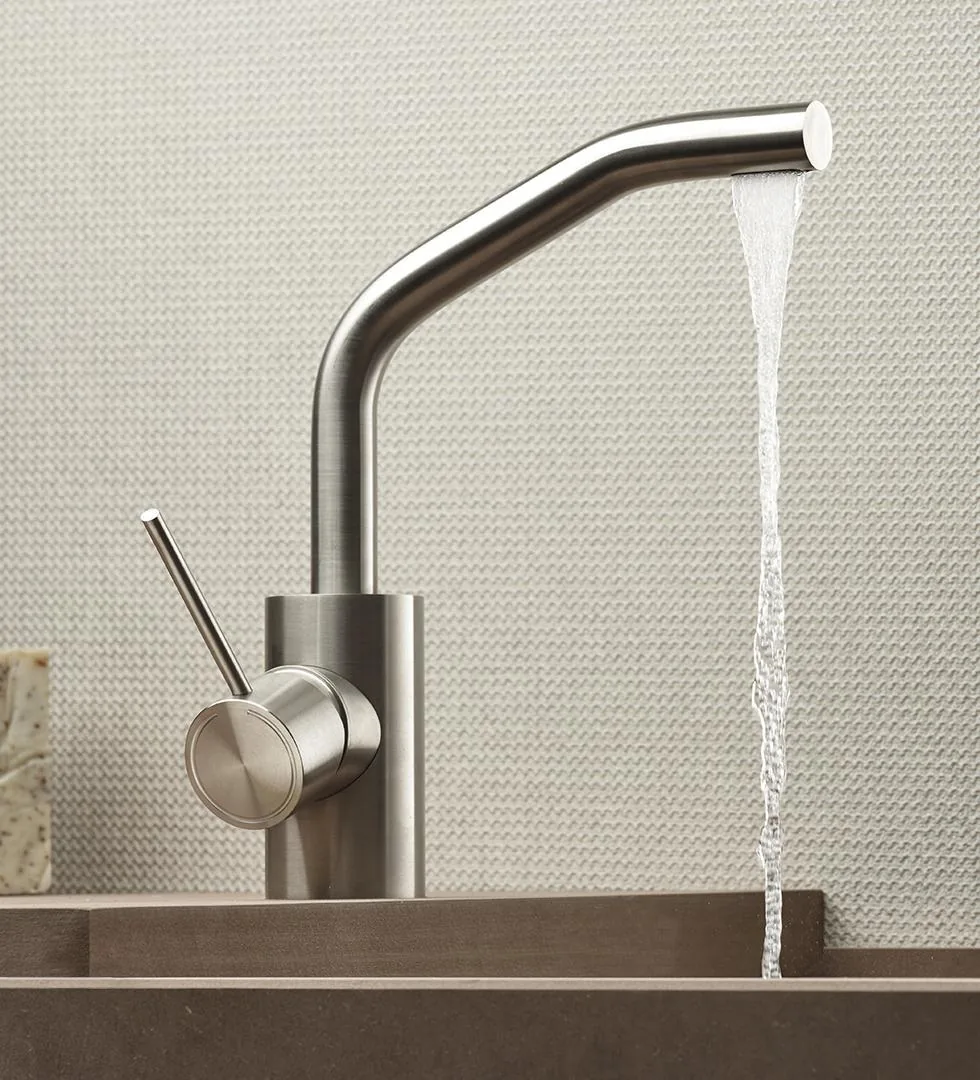 ProductDeck-mounted basin mixer without waste, 316L, brushed stainless steel2SL33339-BSOffered in brushed stainless, polished stainless, deep grey, gold PVD and Tinta. Brushed keeps a limescale film least visible in a hard-water area.View in catalogue →
ProductDeck-mounted basin mixer without waste, 316L, polished stainless steel2SL33339-PSIdentical body to the brushed version, on the mirror end of the same roughness scale. Expect the deposit to outline rather than diffuse.View in catalogue →
ProductDeck-mounted basin mixer without waste, 316L, brushed stainless steel2SL33339-BSOffered in brushed stainless, polished stainless, deep grey, gold PVD and Tinta. Brushed keeps a limescale film least visible in a hard-water area.View in catalogue →
ProductDeck-mounted basin mixer without waste, 316L, polished stainless steel2SL33339-PSIdentical body to the brushed version, on the mirror end of the same roughness scale. Expect the deposit to outline rather than diffuse.View in catalogue →
Deep grey is the mid-tone comparison between them, and the shower control shows the same spread across a different fitting type, where the deposit lands on the lever rather than the spout.
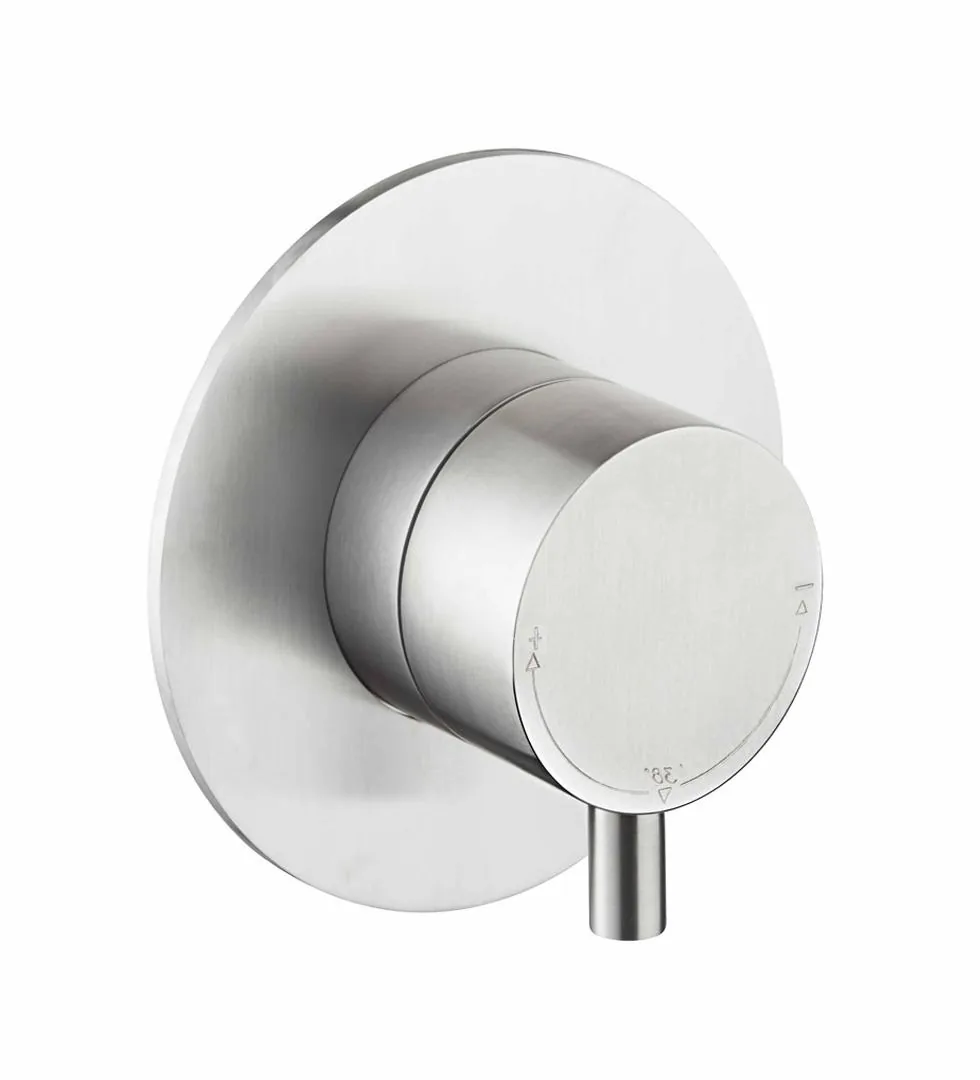 ProductHalf-inch wall-mounted thermostatic shower mixer, 316L, brushed stainless steel2POJV44X18-BSThermostatic control on a 316L body, exposed on the wall so the cartridge stays serviceable. Offered in brushed, polished, deep grey, gold PVD and Tinta.View in catalogue →
The accessories carry the same lesson, and one accessory detail is worth flagging. The catalogue's 320 mm towel rail is listed in AISI 304 rather than 316L, so the accessory grade is a separate decision from the tap grade in a hard-water room.
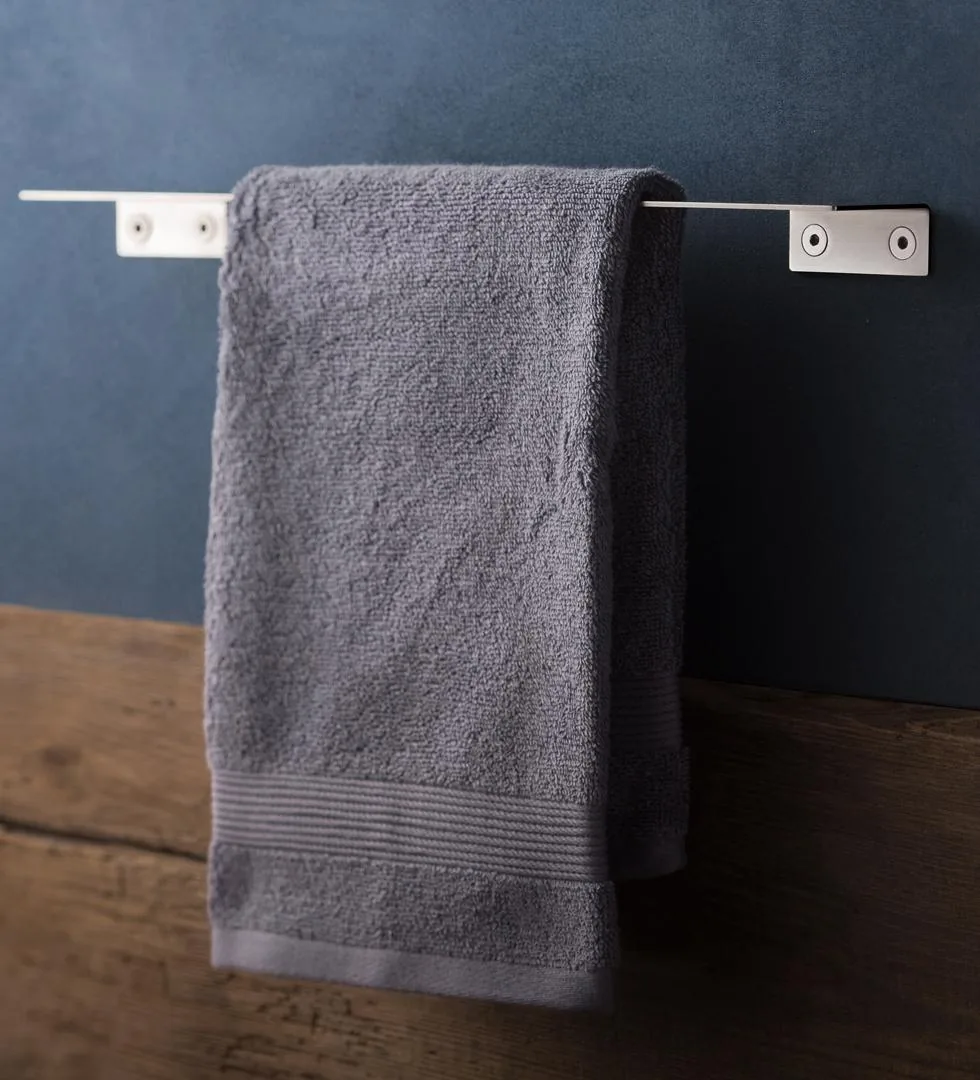 ProductWall-mounted towel rail, 320 mm, brushed stainless steel2MS3795-BSAISI 304 stainless steel, four finishes. Sized for a hand towel; fix to a structural wall rather than to tile alone.View in catalogue →
How the cleaning regime changes with the finish
The finish changes how often you wipe, not whether you wipe. No supplier on this catalogue claims a finish is limescale-proof, and the honest position is that limescale forms on every surface the water touches.
What changes is the method and the frequency, and the differences are large enough to matter in a busy property.
For brushed and satin stainless steel, a damp cloth with mild detergent and a rinse is enough for routine film. The BSSA cleaning guidance states that washing with soap or mild detergent and warm water followed by a clear rinse is usually adequate for domestic and architectural equipment, and it specifies clean rinsing water, an air blower or clean disposable wipes to avoid water marks.
For a genuine adherent scale, the same BSSA sheet gives a method: a 10 to 15 volume percent phosphoric acid solution used warm, neutralised with dilute ammonia, rinsed with clean water and dried, or a 25 percent vinegar solution with a nylon brush. It also carries the warning that matters most in a hard-water property: chloride-containing solutions including hydrochloric acid cleaners and hypochlorite bleaches can cause staining and pitting on stainless steel and must not contact it.
For a coated finish, the method changes again. Franke's tap care guidance separates its finishes explicitly: for PVD it advises against abrasive cleaners and recommends a vinegar-and-water mixture for limescale removal or soapy water for routine cleaning, while noting that a matt finish alone is not limescale-resistant. The same page advises frequent cleaning of tap surfaces in hard-water areas to stop limescale building up, and regular cleaning of the aerator to protect flow rate.
The wider care regime, including the chemical side of housekeeping work, is covered in our guide to how cleaning chemicals affect stainless steel accessories.
Material still matters, finish is not a substitute for it
Choosing a finish for hard water does not remove the need to choose a grade. The British Stainless Steel Association's corrosion overview explains that molybdenum reduces the effectiveness of chloride ions in locally breaking down the passive layer, which is what gives 316 its advantage over 304. It also warns that 316 resists localised attack rather than being immune to it.
The catalogue's AISI 316L material page states the same practical position: 316L suits coastal air, salt and hard water, and it is the grade to specify for a coastal home, a wet room or anywhere water is hard. If you are choosing a finish for scale visibility and also choosing a grade, the two decisions are separate lines in a schedule, and our guide to 304 versus 316L taps covers the second in full.
What to specify, and what to accept
A hard-water finish specification needs five lines. Naming the colour is not one of them.
| Schedule field | What to record |
|---|---|
| Finish name and code | The catalogue finish name and the finish code on the product, not a descriptive word like "matt black" |
| Roughness family | Brushed or dull polished, satin, or bright polished, so a sample and a delivery can be compared like for like |
| Material grade | AISI 316L for hard-water rooms, with the grade of concealed parts and fixings noted separately |
| Cleaning method | The approved cleaner, the acids to avoid, rinse and dry, and who signs the routine at handover |
| Aerator | Whether it is removable, its size, and how often it will be descaled |
Two acceptance points are worth writing down explicitly, because they are the ones that cause disputes.
Accept that limescale will form. A finish that hides a film is not a finish that prevents scale, and no supplier here claims otherwise. Accept a defined cleaning interval instead: in a very hard area, weekly for brushed and satin surfaces, and more often for black PVD and polished surfaces where the deposit is conspicuous.
Do not accept a description that cannot be checked. If a schedule says only "matt black" with no finish code, no product reference and no sample, there is nothing to inspect on delivery. That is the point at which a visible finish sample, approved in the room it will be used in, does real work.
For a project where many rooms must match, the sampling and batch-control process matters more here than in a soft-water area, because the finish is doing more daily work. See how to approve samples and control finish consistency across hundreds of rooms.
Frequently asked questions
Which tap finish hides limescale best?
Brushed or satin stainless steel. Its directional grain scatters light instead of producing a continuous reflection, so a thin mineral film has no hard edge to catch the eye, and the catalogue's brushed finish page describes the surface as hiding fingerprints and water spots far better than polished chrome.
Is matte black good in a hard-water area?
It is the hardest case in the range, not the easiest. Matte black PVD has the low-reflectance surface that reduces mirror outlines, but white calcium carbonate against a near-black base gives the highest contrast available, so the deposit shows sooner and shows more clearly. Black remains a reasonable specification where the scheme requires it, provided the cleaning interval is shorter.
Does PVD stop limescale building up?
No. PVD is a colour and durability treatment, not a scale-repellent coating. ISO 23100:2024, the standard for decorative PVD coatings on kitchen and sanitary ware fittings, specifies tests for discolouration, abrasion, corrosion and adhesion, and limescale resistance is not among them. Protection comes from the wipe-down routine and, internally, from components such as anti-limescale cartridges and aerators.
Do I need a special cleaner for a PVD finish?
Abrasives are the thing to avoid. Manufacturer care guidance for PVD surfaces generally rules out abrasive cleaners and pads, recommending soapy water for routine cleaning and an acid such as vinegar for limescale removal. On stainless steel, the BSSA warns specifically against hydrochloric acid and hypochlorite products. The care sheet supplied with the specified product takes priority over any general advice.
Does polished stainless steel really show limescale that badly?
Yes, and the reason is measurable. In BS EN 10088-2:2024 as reproduced by the BSSA, a bright polished finish sits below 0.1 micrometres roughness against 0.2 to 1.5 for brushed. The smoother the reflection, the more obvious any deposit that interrupts it.
Specify the finish that reduces the wiping, not the one that prevents the scale
In a genuinely hard-water area, the finish decision is about maintenance load rather than durability. Brushed and satin stainless steel carry the lowest visible deposit and the gentlest routine. Deep grey and the brushed PVD finishes sit in the middle. Polished surfaces and matte black carry the highest visible deposit and should be specified with a shorter, written cleaning interval rather than an assumption of low maintenance.
Ask the supplier for the finish code, the roughness family, the grade and the care sheet, and check the finish sample in the room where it will live. Then set the cleaning interval in the handover pack. Browse the FONTEA catalogue for the current finish range, or send a room schedule through the contact page when samples or trade pricing need review.
Specify it from the catalogue
Every fitting mentioned here is stocked and specified in the FONTEA trade catalogue: full technical data, finishes and wholesale tiers.
Related reading
-
 Maintenance
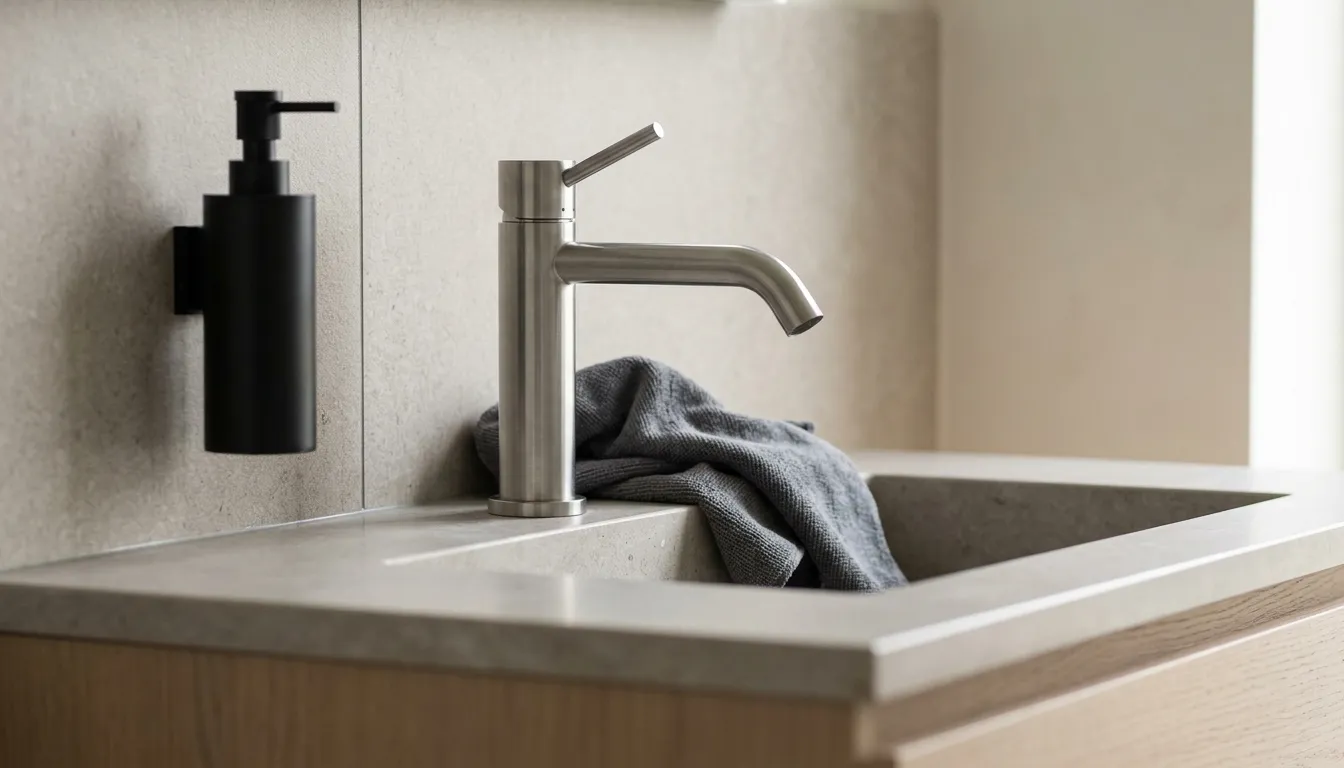
How to clean and care for PVD and brushed stainless steel taps without damaging the finish
A gentle routine of soft-cloth cleaning, warm water and mild detergent protects PVD and brushed stainless tap finishes, while acids, alkalis, chlorides and abrasives damage them.
-
 Finishes
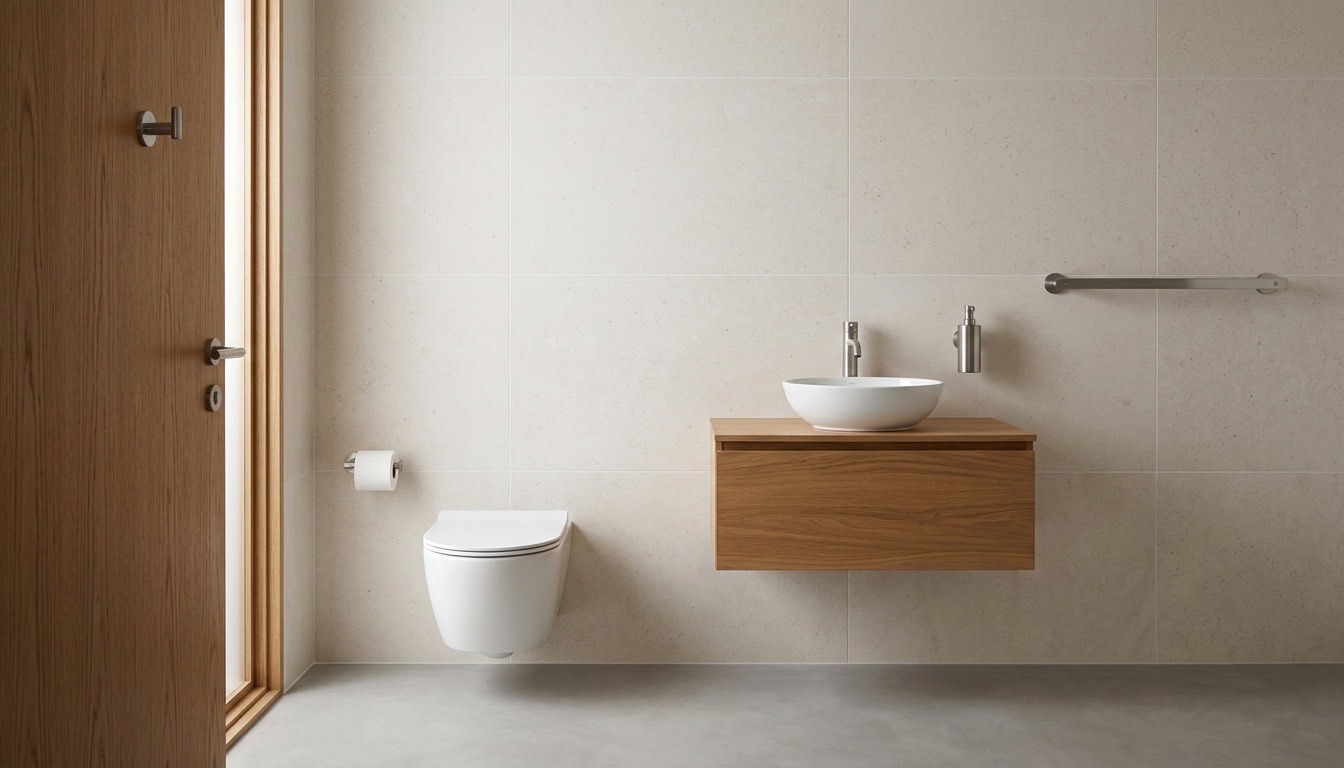
Matching accessory finishes across a project: the extended accessory palette
How to hold one finish across every accessory in a scheme, which pieces must match exactly, which can vary, how to build a finish schedule, and what to do when a combination does not exist.
-
 Finishes
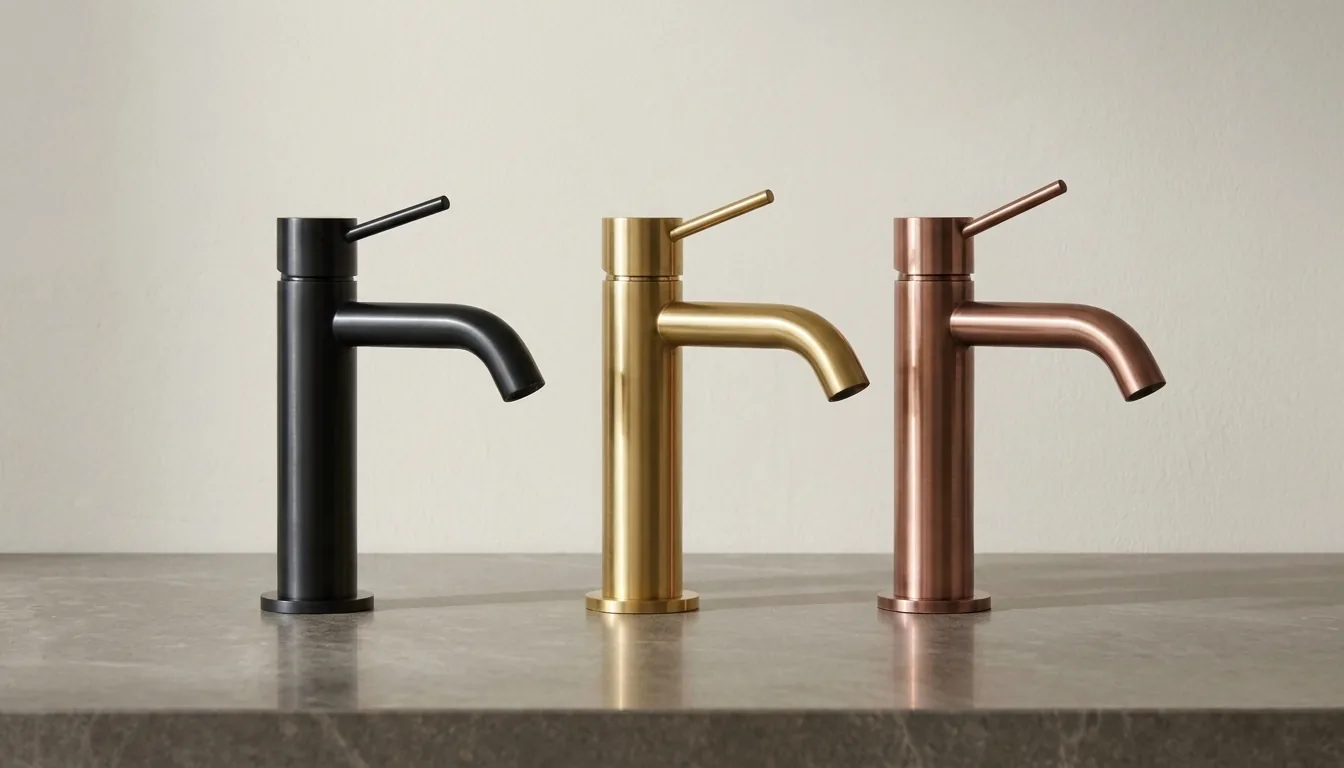
PVD Tap Finish Explained: How Black, Gold and Copper Are Applied
PVD bonds a thin metallic layer onto stainless steel in a vacuum, so the colour is part of the metal rather than a paint or electroplate. Here is what black, gold and copper PVD actually are and how long they last.