 ONTEA
ONTEA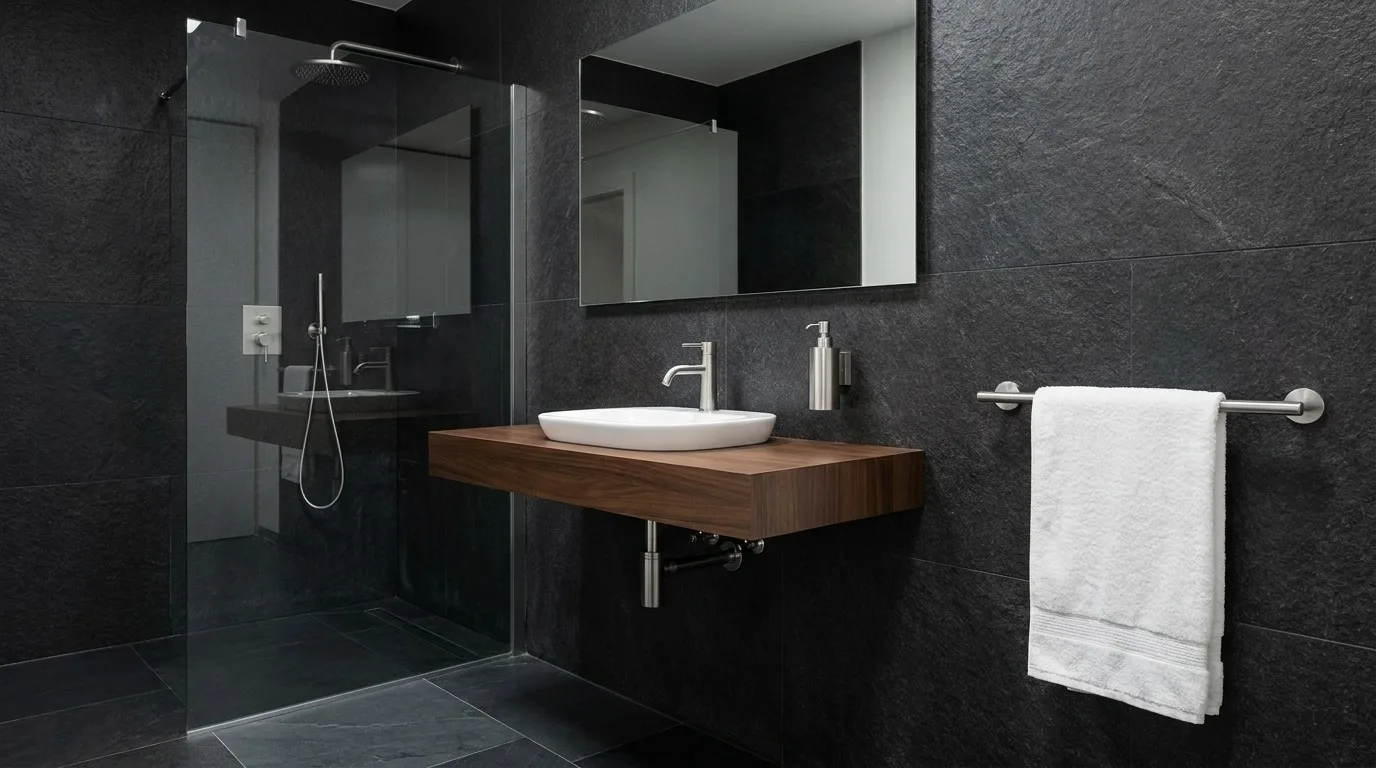
Chrome-plated brass and solid stainless steel fail in different ways. Chrome is a layer roughly 0.25 to 1.5 microns thick over nickel (ASM Handbook), bonded onto a brass or zinc-alloy body. Once it chips, pits or wears through, the base metal is exposed and the usual fix is replacement. A solid stainless towel rail or roll holder is the same metal all the way through, so there is no layer to breach. No published test we found compares the two head to head, so this article explains the failure modes and leaves the service-life numbers to your own conditions.
Quick answer: choose solid 316L stainless for hard-water areas, coastal homes, and commercial spaces with heavy daily handling, where a fitting with no coating to wear through is the lower-risk choice. Chrome-plated brass can be an adequate choice for light use in a soft-water home.
Stainless steel vs chrome at a glance
The table sets out the practical differences for fixed bathroom fittings such as towel rails, roll holders, robe hooks and soap dispensers.
| Chrome-plated brass or zinc alloy | Solid 316L stainless steel | |
|---|---|---|
| Construction | Thin chrome layer over a cast base | One alloy, surface to core |
| Typical failure | Plating pits or wears through, base metal corrodes | No plating layer to lose |
| Hard water and cleaners | Acid descalers and abrasives can damage the plating (see care below) | Sensitive to chloride and hydrochloric-acid cleaners, fine with mild detergent |
| Coastal or salt air | Exposed base metal is vulnerable to salt | Molybdenum in 316L improves chloride pitting resistance |
| Repairable | Not practical once the plating is through | Depends on the finish; check the product's care sheet |
| Upfront cost | Lower | Higher |
| Finishes | Polished or brushed chrome | Brushed, plus PVD colours |
How chrome plating fails on bathroom accessories
Chrome fails because the plating is only a thin protective skin over a different metal, and once that skin is breached the metal underneath is exposed. This article covers fixed fittings such as towel rails, robe hooks, roll holders and tumblers, not heated chrome towel radiators.
The plating sits over a brass or zinc-alloy casting. Decorative chromium is very thin: an ASM Handbook chapter on nickel plating puts it at roughly 0.25 to 1.5 microns, over 15 to 40 microns of nickel that does most of the corrosion work (Di Bari, ASM Handbook Vol. 5). The same chapter lists plumbing fixtures and bathroom accessories as moderate-service applications. The layer is cosmetic and protective, not structural. Two things typically go wrong:
- Pitting corrosion. Where the plating has pores or damage, corrosion can start at that point and spread beneath the surface, not just at the visible mark. Harsh cleaners and abrasive pads add to the wear (see care below).
- Mechanical wear. Contact points, such as where a rail is gripped or a hook takes repeated load, thin the plating over the years. Once bare metal shows, the plating cannot be restored in place, so the part is usually replaced.
A blister, flake or dull spot near a fixing or edge is a typical sign that the plating has been breached.
Why solid stainless steel holds up
Solid 316L stainless steel is a low-carbon, molybdenum-bearing austenitic stainless alloy used as one piece of metal, not as a coating over another base. Its corrosion resistance is part of the metal itself, not something applied on top. A fitting made from AISI 304 or 316L stainless is the same alloy from surface to core. There is no plating layer to wear through. Stainless has its own weak spot, chlorides, covered below.
The resistance comes from chromium in the alloy, which forms a thin, self-repairing oxide film. In a peer-reviewed study of Type 316, a close relative of 316L (about 16.5% chromium and 2.2% molybdenum by weight), chloride ions were a key driver of pitting breakdown of that film (Yoo et al., Materials, 2023). If the surface is scratched, the film reforms in the presence of oxygen. Chrome plating cannot do this, because the protection is a separate layer on a different metal.
The ASM chapter explains the mechanism: when corrosion starts at a pore in conventional chromium, the large chromium surface around the pore accelerates attack on the nickel beneath, so pitting can progress quickly. ISO 1456, the standard for decorative nickel-chromium coatings, notes that multilayer nickel and micro-discontinuous chromium protect better than the conventional versions (ISO 1456:2009). Both sources describe plated steel rather than brass, and neither compares plating with solid stainless, so treat them as evidence for how plating fails, not for a service life.
What does 316L add over 304?
316L adds molybdenum, which improves resistance to chloride-driven pitting. That is why it is commonly specified for marine hardware: the Australian Stainless Steel Development Association notes that 316 suits deck fittings and rigging where salt can concentrate, conditions that can pit 304. It is also why 316L suits a coastal bathroom or a home with a salt-based water softener. Grade 304 is a sound choice for many indoor settings, but where salt or chlorides are present, 316L is the safer specification.
When stainless steel is worth the extra cost
Stainless is worth the extra cost when the bathroom will face conditions that punish plating, and it costs more upfront than chrome. For light domestic use in a soft-water area, mid-range chrome-plated brass can be adequate. Stainless is the stronger case when at least one of these applies:
- Hard water. Limescale is a bigger problem where the water is hard, which varies across the UK, and the acid descalers that remove it are the products chrome makers warn against (see care below). Check your local water company's hardness information for your postcode.
- Commercial or hospitality use with heavier daily handling.
- Coastal or salt-exposed air.
- A 316L specification already in the room, such as taps and shower fittings, where accessories should match in finish and service life.
Two examples from the current FONTEA range, both solid stainless rather than a coating over another metal. Each page lists its own material, so check the page before you rely on the grade. Prices vary by finish, so check each product page for the current guide price.
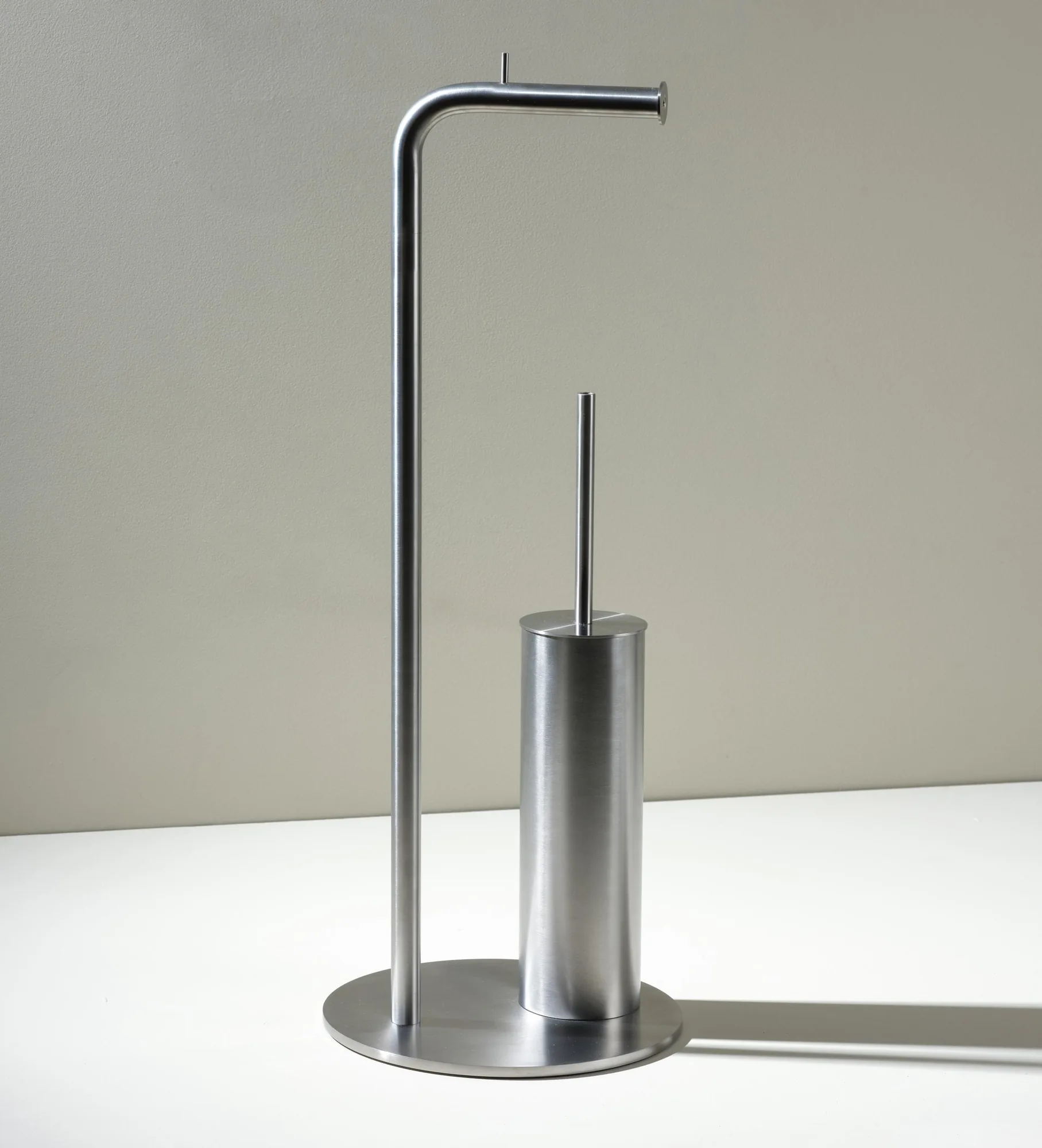 ProductFreestanding Toilet Roll and Brush Holder Unit2MS3403-BSAISI 316 stainless steel, indicative guide price £650 per unit ex VAT. A molybdenum bearing grade that resists chloride attack and holds up in coastal, spa and pool environments. Freestanding, so no wall fixing is needed beside the pan. Offered in brushed stainless steel, deep grey, Tinta and gold PVD.View in catalogue →
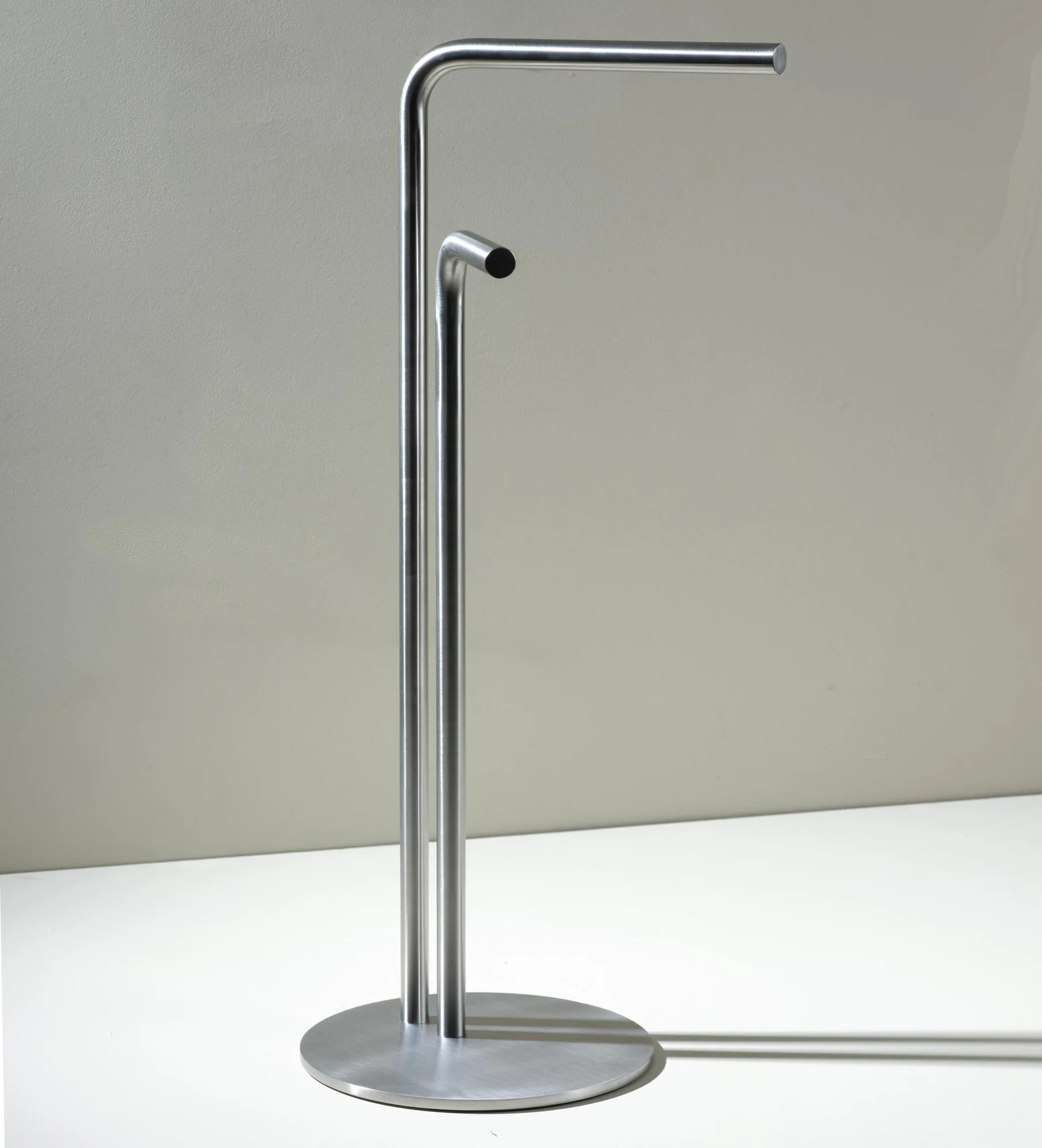 ProductFreestanding Two Rail Towel Stand2MS3408-BSAISI 316 stainless steel, indicative guide price £680 per unit ex VAT. Two rails give separate levels for a bath towel and a hand towel. It sits on the floor and takes up no wall fixing at all. Four finishes, from brushed stainless steel through to gold PVD.View in catalogue →
Where the 316L wall-mounted rail and roll holder sit today
The two products above are the closest genuinely equivalent fittings in the FONTEA range, because they are the ones that make the same argument: solid molybdenum bearing stainless steel with no plating layer to lose, in the conditions described above. They are freestanding rather than wall mounted, and they are AISI 316 rather than 316L. Both are the catalogue's current position, stated here rather than implied.
The grade and the mounting method are two separate things, and it is worth being exact about each:
- The FONTEA range publishes no AISI 316L wall-mounted towel rail and no AISI 316L wall-mounted toilet roll holder. Every wall-mounted towel rail in the range (320, 425, 430, 560 and 650 mm) and every wall-mounted roll holder, including the left-hand and right-hand fixing versions, is AISI 304. Checking the whole stocked range confirms it: AISI 316L is the grade on 274 of the brand's 360 products, and those five rails and all three roll holders sit among the 32 products published as AISI 304. The catalogue's own AISI 316L material page lists no towel rail or roll holder at all.
- Where a wall-mounted fixing is fixed, the specification therefore has two parts. Ask the supplier for the AISI grade in writing on the spec sheet or order confirmation, because the visible finish tells you nothing about what sits underneath it, and if the room is genuinely coastal or chloride exposed, specify the grade rather than accepting the default. The wall-mounted fittings are still solid stainless steel with no chrome layer, which is the comparison this article makes. What AISI 304 cannot give you is the molybdenum margin against chloride, and for a hard-water, coastal or heavily cleaned room that margin is the reason to pay for 316L in the first place.
This is the honest version of the same conclusion: for coastal, hard-water and commercial bathrooms, 316L is the right specification and the fittings to demonstrate it are currently freestanding.
Can stainless steel accessories match other finishes?
Yes. Stainless is not limited to a brushed look. The current range includes Black PVD, Gold PVD and Copper PVD, plus eight accessory finishes: Anthracite, Coal, Desert, Olive tree, Pearl, Powder, Rock and Snow. All are applied by physical vapour deposition (PVD), a thin, hard finish bonded to the solid steel rather than an electroplated layer over a different base metal. A patent background from The Chinese University of Hong Kong describes decorative PVD nitrides such as TiN and ZrN, typically 0.2 to 3 microns thick, as harder than plated chromium and nickel in that patent, about 20 GPa against 10 to 11 GPa by the applicants' own figures. We have not confirmed which coating each finish in our range uses, so read this as general PVD context (US 7,264,668 B2).
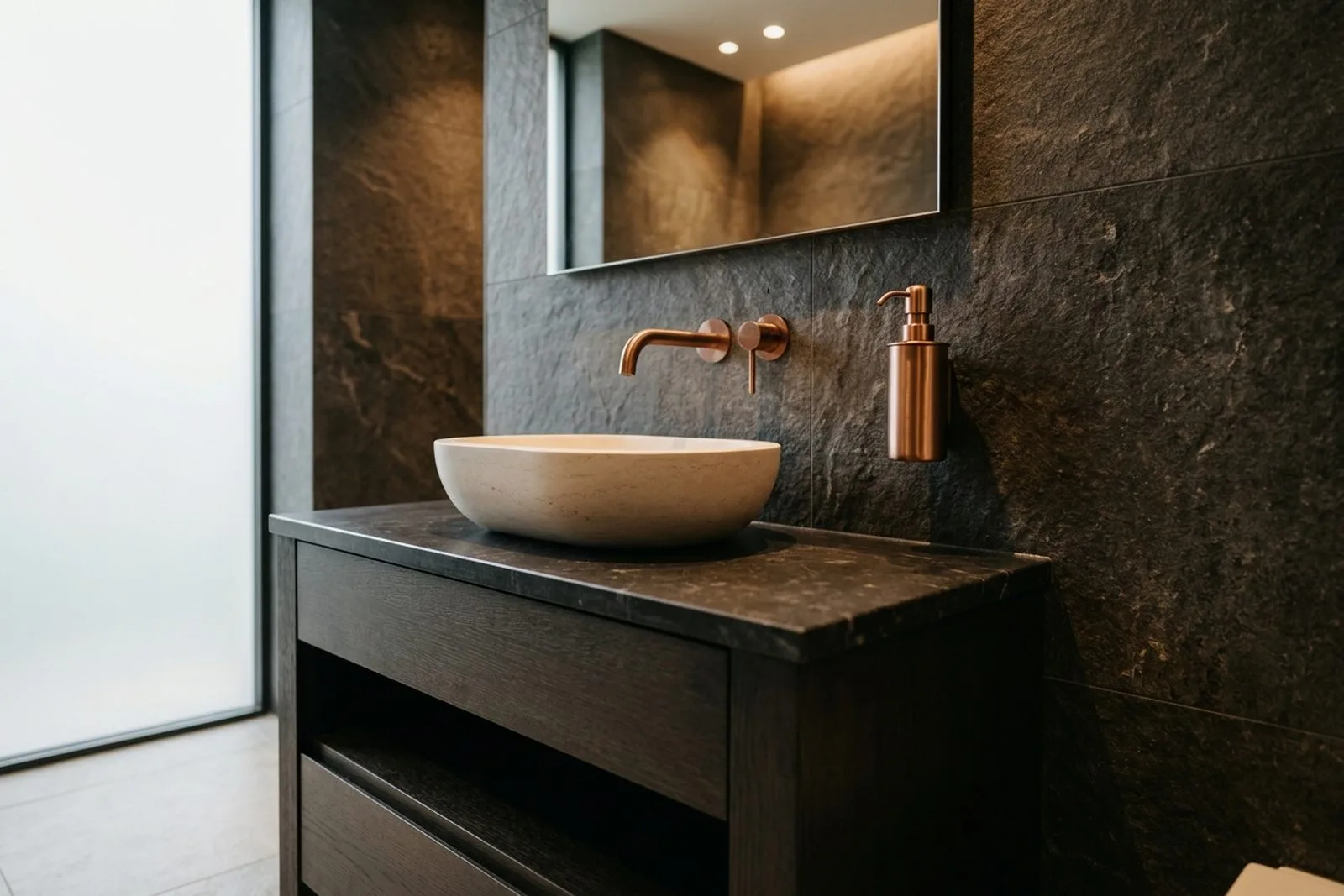
If you are matching accessories to taps or shower fittings in a set finish, check the full bathroom accessories range for the matching option before defaulting to chrome for the smaller fittings.
How should you care for each finish?
Mild cleaning helps both finishes last, and the harsh products differ only in detail.
- Stainless steel. The British Stainless Steel Association says soap or mild detergent in warm water, then a clear rinse, is usually adequate. It warns that chloride-containing products, including hydrochloric acid cleaners and hypochlorite bleach, can stain the surface, and that carbon steel wool must not be used (BSSA). Euro Inox adds that soft cloths and diluted vinegar for limescale are usually safe (Euro Inox).
- Chrome. Hansgrohe's UK guidance for taps and showers says never to use cleaners containing hydrochloric, formic or acetic acid or chlorine bleach, or abrasive materials, and to use gentle cleaners such as citric-acid products, then rinse thoroughly (Hansgrohe UK). That advice is written for taps, and it matters most for chrome because the plating is the only barrier.
Check the care sheet for your specific product and finish before using any descaler.
More from the journal
Find more on materials and finishes in the FONTEA journal, including the Stainless Steel and Accessories archives. If you are choosing for a specific project, get in touch with the room details and finish you are matching, and we can point you to suitable options in the catalogue.
Specify it from the catalogue
Every fitting mentioned here is stocked and specified in the FONTEA trade catalogue: full technical data, finishes and wholesale tiers.
Related reading
-
 Materials
Brushed stainless steel vs PVD vs chrome-plated brass: durability and cleaning compared
Brushed steel and PVD are two different decisions, not a menu of the same thing. Here is how each behaves with daily cleaning, limescale, scratches, and over a service life, and why our range is solid stainless throughout.
-
 Accessories
Black PVD stainless steel bathroom accessories: a UK specification guide
Black PVD gives bathroom accessories a dark architectural finish, but approval should cover the stainless grade, coating evidence, fixing details and cleaning regime.
-
 Accessories
How to Fix Bathroom Accessories: Wall Backing and Stainless Fixings
Plan wall backing, substrates and stainless fixings before installing towel rails, robe hooks and shelves in hotel or rental bathrooms.