 ONTEA
ONTEA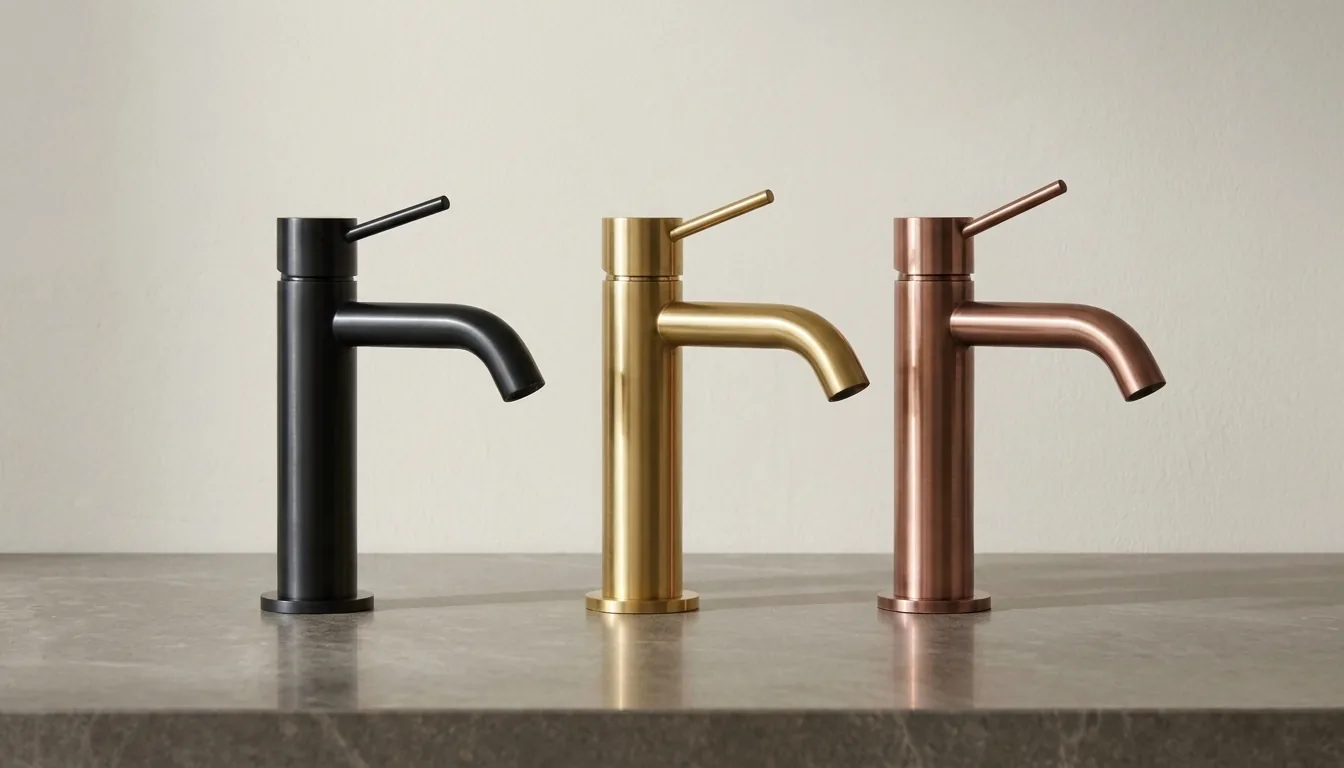
PVD is not a paint, a lacquer or a plating layer. It is a very thin metallic film fused onto the surface of a stainless steel tap in a vacuum chamber, which is why black, gold and copper PVD wear like the metal underneath instead of thinning away through it. The honest durability answer is that it will outlast a plated finish in ordinary use, but no supplier can give you a service life in years without product-specific test evidence.
Key Takeaways
- PVD is a dry vacuum process. The coating material is transferred atom by atom from solid to vapour and back to solid as a thin film on the steel (ISO 23100:2024, introduction).
- The deposited layer is genuinely thin. One manufacturer's published decorative process describes a layer 0.3 microns thick, so this is a surface modification, not a replacement for the metal (manufacturer PVD process page, linked below).
- Colour is decided in the chamber, not sprayed on afterwards. The gas mixture used during deposition determines the colour of the layer.
- The stainless steel underneath is still the corrosion decision. A finish colour does not change the AISI grade you should specify for the room.
- ISO 23100:2024 gives decorative PVD on kitchen and sanitary ware four testable properties: discoloration resistance, abrasion resistance, corrosion resistance and adhesion. That is the vocabulary for asking a supplier for evidence.
What actually happens to the metal
Physical vapour deposition is a vacuum coating process. The international standard for decorative PVD coatings on kitchen and sanitary ware fittings, ISO 23100:2024, describes it in its introduction: during PVD the target material is transferred atom by atom from solid phase to vapour phase and back to solid phase as a thin film coating on the substrate. There is no wet chemistry and no paint applied with a spray gun.
The standard also names the substrates used in this category. Stainless steel sits alongside copper alloy, zinc alloy, aluminium alloy and ABS, and it names the colour range achievable this way, which includes gold, bronze, rose gold, silver, black, smoke grey and copper. The three finishes this article is about are all inside that standard's stated colour range.
So what physically happens is straightforward. The part is cleaned, loaded into a chamber held under vacuum, and the coating material is vaporised. A manufacturer working in this technology describes its own sequence as industrial machine cleaning of the parts to remove contamination, followed by a second control and hand wiping, then placement in the PVD chamber, where the coating material is vaporised and the parts are rotated on a planetary gearset so the deposit lands evenly. Special gases are used in the chamber to deposit the vaporised metal on the surface, and the composition of that gas mixture is what determines the colour of the deposited layer.
That last point explains why black, gold and copper are variations of one process rather than three different products. Same chamber, same cleaning, same rotation. A different reaction chemistry gives a different colour.
The other important detail is how thin the result is. The same manufacturer states that its deposited layer is 0.3 microns thick. That is a useful corrective to the way PVD is usually marketed. You are not choosing a 0.3 micron sheet sitting on the tap. You are choosing a surface whose outermost fraction of a micron has been converted, with the rest of the steel still doing the structural work. This is also why the phrase "bonded at a molecular level", used on the Fontea black PVD finish page, is not an exaggeration of some thick lacquer. It is describing a genuinely thin, genuinely bonded layer.
Why it is not paint and not electroplating
Both comparisons are common in finish marketing, and both are misleading.
Against paint: a painted or powder-coated surface sits on the metal as a separate film with an adhesive boundary. It can chip at that boundary, it can flake where it has been abraded, and where it fails, the metal underneath is exposed. A vapour-deposited layer has no such thick adhesive boundary to break open, and the black PVD finish page puts the practical consequence plainly, describing the result as far harder and more scratch- and corrosion-resistant than painted or powder-coated black.
Against electroplating: this is the comparison that matters most for a tap buyer, because a plated finish thins with use. The gold PVD finish page makes the point directly, noting that because the colour is fused to the metal in a vacuum rather than electroplated, it keeps the hardness and corrosion resistance of steel and will not tarnish, discolour or wear thin the way plated brass gold does.
This is also why the substrate matters more here than it would for a plated tap. The brand page for the range these products come from makes the underlying point for the whole range: every component of every product is stainless steel, including the parts concealed inside the wall, and never a chrome-plated shell, so a finish bonded to solid metal cannot chip or wear through the way a plated shell can. Read that carefully. The claim is about the base material, and the PVD process is what lets a stainless steel body carry a colour finish in the first place.
A useful comparison for a specifier is to put PVD next to the other technologies a manufacturer might offer. One manufacturer of bathroom and kitchen fittings sets out four finish types, PVD, lacquer, powder coat and polished chrome, and ranks PVD as the most durable of the four and the one most commonly used for metallic surface finishes, describing its surfaces as exceptionally resistant to scratching, cleaning agents and salty sea air. That is one manufacturer's comparative view of its own range, not a universal ranking, but the distinctions it draws are the ones a buyer is actually choosing between.
What the stainless steel underneath still has to do
A bonded colour layer does not make the substrate irrelevant. It changes what the tap's surface looks like and how it wears, but the corrosion performance of a tap is still the performance of the steel underneath it.
The AISI 316L material page sets out the general case: molybdenum and low carbon content give markedly better resistance to pitting and corrosion than standard steel, especially against chlorides in coastal air, salt and hard water. The British Stainless Steel Association gives the mechanism, noting that localised corrosion is often associated with chloride ions in aqueous environments, and that a good supply of oxygen to all surfaces of the steel is essential to maintaining the passive layer, while higher levels of chromium, nickel, molybdenum and nitrogen all help in their individual ways to prevent these forms of attack.
The practical consequence for a buyer is a rule worth writing into your own selection process. Specify the stainless grade for the exposure of the room, then choose the PVD colour you want on top of it. Choosing black PVD is not a reason to accept 304 in a coastal or heavily cleaned commercial bathroom, and the reverse also holds: specifying 316L does not oblige you to take brushed rather than gold.
For the grade decision itself, see our guide to AISI 304 versus 316L stainless steel taps, which covers where 316L's molybdenum earns its cost and where 304 is a sound choice.
The honest durability story for each finish
Here is where marketing tends to overreach, so it is worth being precise about what can and cannot be claimed.
What can be said from the finish pages themselves:
- Black PVD will not fade in daylight, is harder and more scratch- and corrosion-resistant than painted or powder-coated black, and is bonded to the steel rather than sprayed or lacquered on (black PVD finish page).
- Gold PVD will not tarnish, discolour or wear thin the way plated brass gold does, because the colour is fused to the metal in a vacuum rather than electroplated (gold PVD finish page).
- Copper PVD does not oxidise, patina or turn green over time, unlike real copper or copper plating, because the vacuum-fused layer keeps its colour (copper PVD finish page).
What cannot be said without evidence: a number of years. Any claim of the form "lasts X years" for a specific PVD tap requires product-specific test data, and the properties worth testing are not a single quantity. ISO 23100:2024 specifies four of them for decorative PVD coatings on kitchen and sanitary ware, discoloration resistance, abrasion resistance, corrosion resistance and adhesion. Each answers a different buyer question. Does the colour shift? Does everyday handling wear it? Does it survive its chemical environment? Does it stay attached to the metal?
The honest position for a specifier is therefore this. PVD on solid stainless steel is a materially better finish technology than plating, paint or powder coat, and a UK buyer can expect it to look good across a normal service life if it is cleaned sensibly. But the only defensible durability claim is one tied to a named product and a named test. We publish no such test result for our own products, so we do not quote one.
The same standard gives a useful framing for what a test can and cannot establish. It is a laboratory method on a defined specimen under defined conditions, not a prediction of years in a specific room with a specific cleaning regime.
What does shorten PVD life, and what does not
Because the failure modes of a bonded layer are different from those of a plated one, the things that damage PVD are not always intuitive.
What does not matter as much as people assume:
- Occasional water contact. A tap is designed to be wet. Neither the finish pages nor the standard treat routine water contact as a wear mechanism.
- The colour fading in daylight. The black PVD page states this directly: it will not fade in daylight.
- Routine cleaning with a suitable product. Cleaning-agent resistance is precisely what one manufacturer claims as a PVD strength, describing PVD surfaces as exceptionally resistant to scratching, cleaning agents and salty sea air.
What does matter:
- Abrasive or contaminated cleaning. Abrasion resistance is a separate tested property in ISO 23100:2024, which is a strong hint that mechanical abrasion is the property most worth specifying evidence for. Abrasive pads and hard scrubbing are the obvious risk. Our guide to which cleaning chemicals damage stainless bathroom fittings covers the chemistry side in detail.
- Damage to the underlying steel. PVD changes the surface, not the base metal. If the substrate is attacked, the finish does not restore it.
- Edges, joints and mounting points. Coating behaviour at a sharp edge, a weld seam or a fixing point is not the same as coating behaviour on a flat face, which is why a test on a flat panel proves less than a test on the finished product.
- Light and UV exposure over very long periods. We are not aware of published field data from the sources cited here that quantifies this for a decorative PVD tap over decades, so we make no claim either way.
For advice on which finishes suit hard-water areas, see what tap finish hides limescale best.
The same tap in more than one finish, from the catalogue
The value of a bonded PVD layer is easiest to see when the same product is offered in more than one finish, because everything except the surface is held constant.
The Fontea brand page sets out the palette the brand publishes, and it is worth reading it precisely rather than loosely. It names four finishes across the range: brushed inox, gloss inox, gold PVD and deep grey PVD, and it states plainly that gold and deep grey are physical vapour deposition coatings, while brushed and gloss inox are treatments of the steel itself. So this range carries two PVD finishes, not three. Black PVD and copper PVD exist elsewhere in the catalogue, and both finish pages on this site are written about them, but neither is published in this brand. That is a fact about availability rather than about the process, and the difference matters when you are matching a room: you choose a PVD colour the range actually offers, not one the process can in principle make.
A deck-mounted basin mixer is the simplest place to see that. The one below is described as standing on the basin or vanity top with the splashback wall left uninterrupted behind it, supplied without a waste so the drain is chosen to match the basin, and built in AISI 316L stainless steel, the molybdenum-bearing grade. Its page records five finishes, brushed stainless steel, polished stainless steel, deep grey, gold PVD and Tinta, and the finish is chosen from those rather than from the wider catalogue.
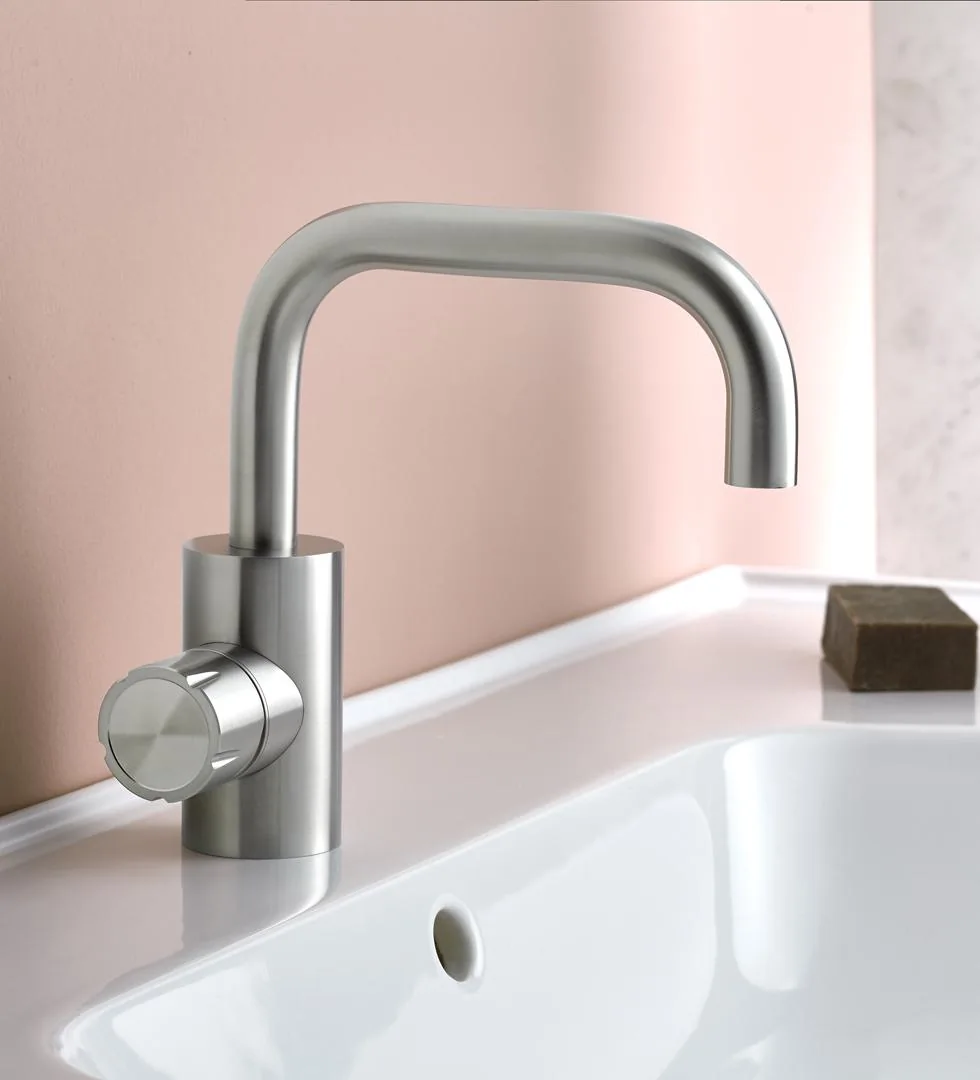 ProductDeck mounted basin mixer, no drain, 316L2AC6745-GDGold PVD variant, indicative guide price £750 ex VAT. AISI 316L body, five finishes. Cut-out size and connection thread are not recorded on the page, so confirm them against the basin before ordering.View in catalogue →
ProductDeck mounted basin mixer, no drain, 316L2AC6745-DGDeep grey variant, indicative guide price £750 ex VAT. Same body and spout as the gold PVD variant, with only the surface finish changed.View in catalogue →
ProductDeck mounted basin mixer, no drain, 316L2AC6745-GDGold PVD variant, indicative guide price £750 ex VAT. AISI 316L body, five finishes. Cut-out size and connection thread are not recorded on the page, so confirm them against the basin before ordering.View in catalogue →
ProductDeck mounted basin mixer, no drain, 316L2AC6745-DGDeep grey variant, indicative guide price £750 ex VAT. Same body and spout as the gold PVD variant, with only the surface finish changed.View in catalogue →
The second PVD option is deep grey. The brand page is explicit that deep grey is a physical vapour deposition coating, so it is the same process as the gold, arrived at with a different gas mixture in the chamber, which is the argument from earlier in this article playing out in the range itself. A scheme that wants a dark, non-polished metal has it here.
For a taller format on the same pattern, the tall-body basin mixer carries the identical five-finish set, including both PVD options, which makes it straightforward to run a whole room in one metal. Its page describes a tall body suited to stone and slim-topped basins, fitted through a single deck hole, again supplied without a pop-up waste.
 ProductDeck mounted basin mixer, no waste, tall body2SL33339586-GDGold PVD variant, indicative guide price £1050 ex VAT. AISI 316L, five finishes. Also available in deep grey PVD from the same product page.View in catalogue →
The same logic extends past the basin. The bath mixers and shower systems carry the same finish palette, which is what makes a whole-room schedule in one colour practical rather than a compromise. Across the Fontea range, brushed stainless steel covers 360 products, and gold PVD, deep grey and Tinta each cover 328, so a finish chosen on a basin mixer is almost always available on the shower set and bath filler that go with it. The shower set below is the same pattern at the other end of the room: the same five finishes, and the gold PVD variant at an indicative guide price of £3800 ex VAT against £2675 brushed.
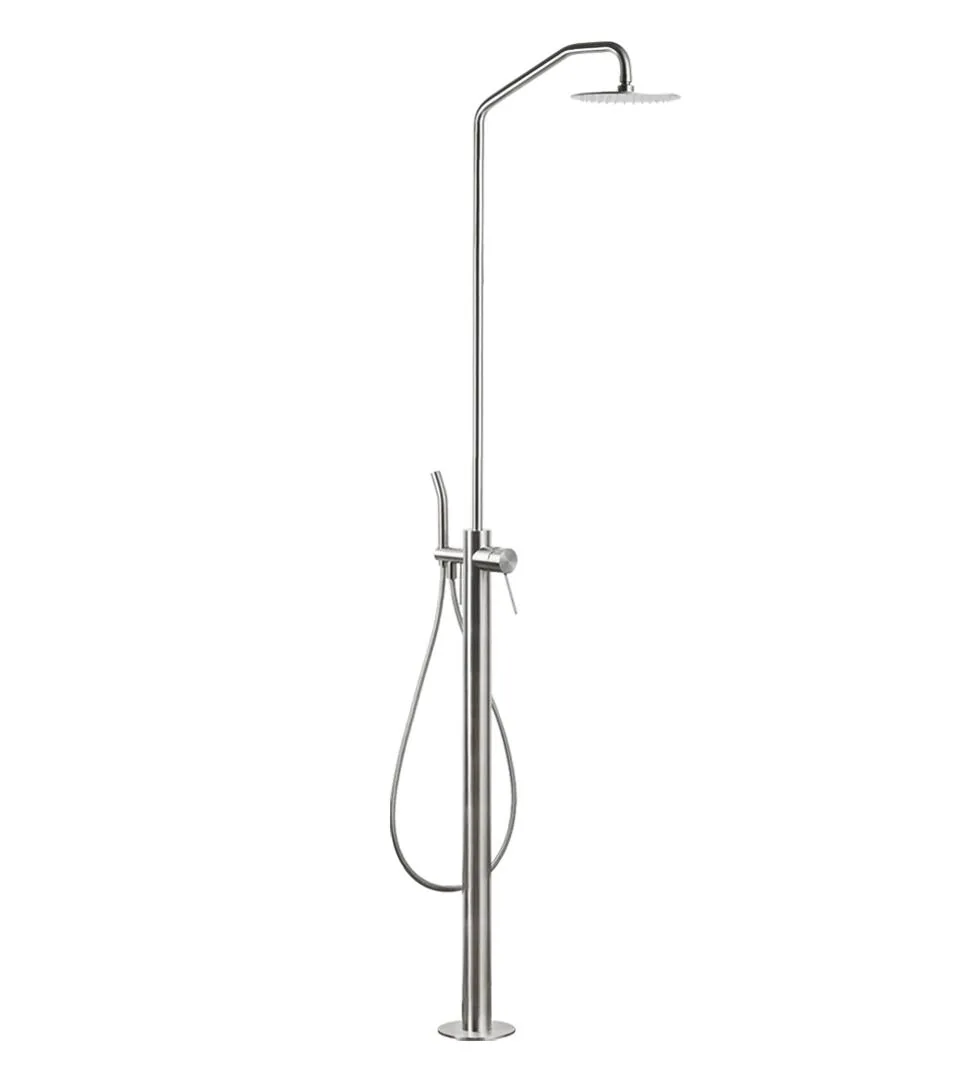 ProductFreestanding shower set with diverter, handshower and 200 mm head2SL33128157Z-GDGold PVD variant, indicative guide price £3800 ex VAT; brushed stainless steel is £2675 ex VAT. AISI 316L, five finishes. The same palette is carried on the bath fillers, so one colour can run basin to shower to bath.View in catalogue →
What to ask a supplier before you approve a PVD finish
- Which properties have been tested, and by what method? Name them in the vocabulary of ISO 23100:2024: discoloration resistance, abrasion resistance, corrosion resistance, adhesion.
- Was the tested item the finished product, or a representative panel? A flat test coupon proves less than the actual tap with its welds, edges and lever seam.
- What is the substrate, and what grade is it? A finish colour tells you nothing about whether the steel is 304 or 316L.
- Does the claim cover every finish you are specifying? Evidence for one colour does not automatically transfer to another in the same range.
- What is the care instruction for this specific finish? Not a generic stainless steel instruction.
If a supplier cannot answer the first two questions, that is a legitimate reason to hold approval rather than to accept a marketing sentence.
Frequently asked questions
Is PVD the same as chrome plating?
No. Plating builds a metal layer by electrolysis and that layer thins with wear, which is how plated brass gold tarnishes and wears through. PVD deposits a thin film by vaporising the coating material under vacuum and condensing it onto the surface, so it does not thin the same way. One manufacturer compares the two directly, describing polished chrome as an electroplated finish and PVD as the most durable of the four finish types it uses.
Does PVD scratch?
The layer is hard and bonded rather than sitting in a thick paint film, but it is not scratch-proof. ISO 23100:2024 specifies abrasion resistance as a tested property precisely because it is the property that matters in service. Avoid abrasive pads and hard scrubbing, and ask for product-specific abrasion evidence rather than relying on the word PVD.
Will gold PVD tarnish like real gold?
No. The gold PVD finish page states it will not tarnish, discolour or wear thin the way plated brass gold does, because the colour is fused to the steel in a vacuum rather than electroplated.
Will copper PVD go green?
No. The copper PVD finish page states that unlike real copper or copper plating it does not oxidise, patina or turn green over time, because the vacuum-fused layer keeps its colour.
Does choosing a PVD finish change which stainless grade I should specify?
No. The grade decision is made for the exposure of the room, and the finish sits on top of it. Our guide to AISI 304 versus 316L taps covers that decision in full.
Can you tell me how many years the finish will last?
Not honestly, and neither can anyone else without product-specific test evidence. We would rather quote you a named test method than a number we cannot support. Ask for the four properties in ISO 23100:2024 and a report that identifies the tested product.
The short version
PVD is a bonded surface layer on solid stainless steel, not a coating sitting on top of it, and that single fact is what separates it from paint, powder coat and electroplating in how it wears. Black, gold and copper differ by the chemistry used in the chamber rather than by the product underneath, which is why a bathroom can move between them without changing the tap. What it buys you is a finish that keeps the hardness and corrosion resistance of the steel. What it does not buy you is a guaranteed number of years, so specify the grade for the room, and ask for test evidence in the language of ISO 23100:2024 before you approve a colour.
Browse the black PVD, gold PVD and copper PVD finish pages on the FONTEA catalogue, or the materials and finishes hub to see every finish against every available stainless grade, then send quantities or trade pricing queries through the contact page.
Specify it from the catalogue
Every fitting mentioned here is stocked and specified in the FONTEA trade catalogue: full technical data, finishes and wholesale tiers.
Related reading
-
 Materials
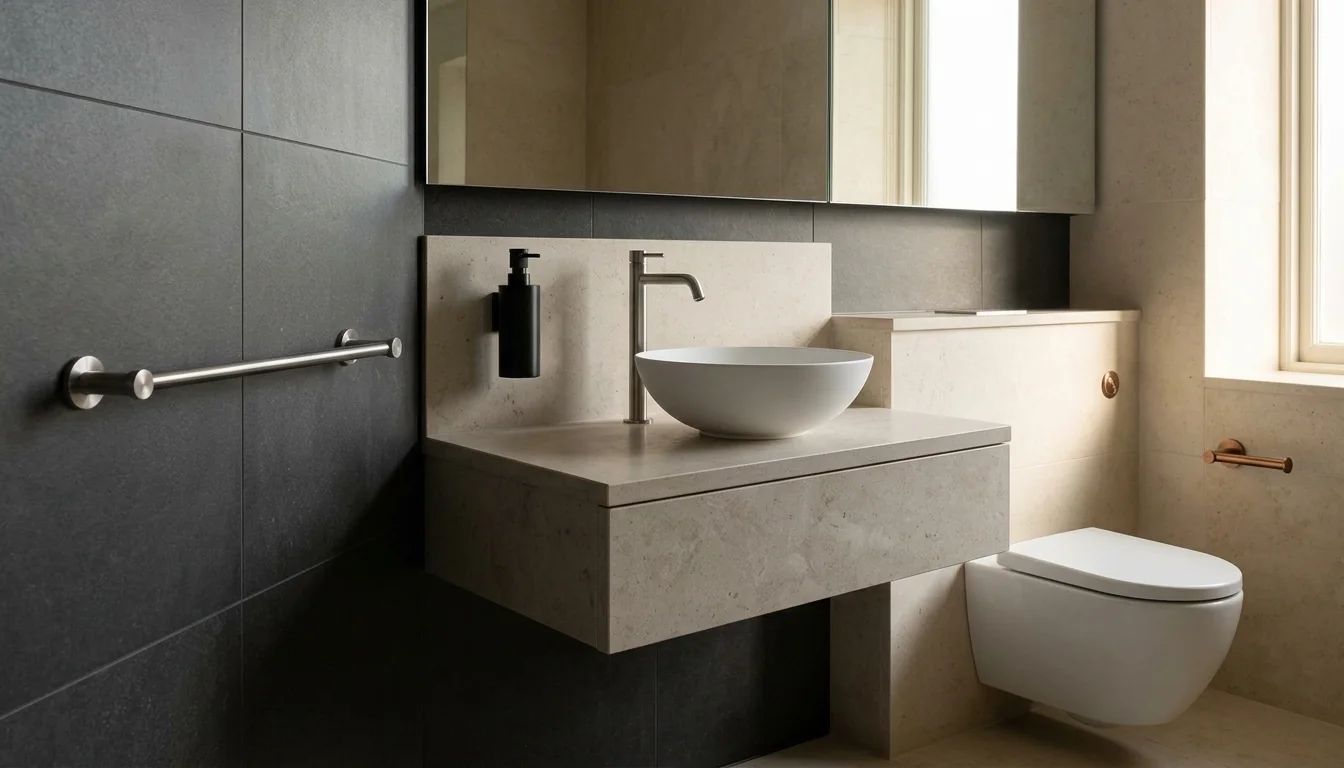
Brushed stainless steel vs PVD vs chrome-plated brass: durability and cleaning compared
Brushed steel and PVD are two different decisions, not a menu of the same thing. Here is how each behaves with daily cleaning, limescale, scratches, and over a service life, and why our range is solid stainless throughout.
-
 Maintenance
How to clean and care for PVD and brushed stainless steel taps without damaging the finish
A gentle routine of soft-cloth cleaning, warm water and mild detergent protects PVD and brushed stainless tap finishes, while acids, alkalis, chlorides and abrasives damage them.
-
 Finishes
Matching accessory finishes across a project: the extended accessory palette
How to hold one finish across every accessory in a scheme, which pieces must match exactly, which can vary, how to build a finish schedule, and what to do when a combination does not exist.