 ONTEA
ONTEA
Specify a thermostatic shower mixer wherever the temperature has to stay put while someone else in the building changes what the water is doing, and specify a manual mixer where it does not. That single distinction decides almost every commercial case, because the problem a thermostatic mixer solves is not hot water, it is hot water while the supply is disturbed. A manual single-lever mixer is not a cheaper version of the same thing. It is a different piece of equipment, and there are projects where it is the better answer, not the compromise.
Key Takeaways
- A thermostatic mixer holds the outlet temperature against changes in flow and supply pressure, because a wax element moves with the mixed water temperature and slides the hot and cold ports together. A manual mixer has no mechanism of this kind at all.
- That protection is about supply disturbance, not about a user forcing hot water. Someone who turns a manual tap to full hot gets full hot, and a thermostatic mixer set above its stop still gets defeated if the user can reach the control.
- UK rules require thermostatic control in specific places, not everywhere. HSE requires a Type 3 thermostatic mixing valve where vulnerable people can reach baths or showers and the scald risk is significant. Approved Document G paragraph 3.65 sets a 48°C limit on hot water supplied to a bath in a dwelling.
- NHS England guidance goes further and lower: HTM 04-01 Supplement D 08 caps shower and washbasin mixed water at 41°C, and 44°C for bath fill.
- A manual mixer is the right answer for a retrofit where the wall is tiled and cannot be reopened, for a shower fed from an unbalanced system where a thermostatic cartridge would be outside its stated conditions, and for any shower where every user is a competent adult and the design intent is to let them set their own temperature.
- A thermostatic mixer only works within the supply conditions its manufacturer states. Outside them, on a badly balanced system or at very low flow, its performance is not guaranteed by anything.
What a thermostatic mixer actually does
A thermostatic shower mixer blends hot and cold water to deliver a set mixed temperature, and it does so by measuring the mixed water and correcting for drift. The mechanism is a temperature-sensitive element that expands and contracts with the temperature of the water leaving the valve. As it moves, it shifts a mechanism that opens the hot port and closes the cold one, or the reverse, so the mixed temperature returns towards the setting.
The useful consequences are all about the supply, not about the water heater:
- Flow changes. Where another outlet on the same system opens or closes, the pressure at each supply to the mixer changes. The element responds and the mixed temperature holds.
- Supply pressure changes. NHS England's performance specification for healthcare valves requires valves to hold mixed temperature within stated limits across the whole operating pressure range, and specifies the permitted temperature change at each pressure step for each valve designation (HTM 04-01 Supplement, Performance specification D 08, Tables 12 and 13).
- Supply temperature changes. The same specification requires stability when either supply temperature moves within its normal range, and separately when the flow rate is reduced to a low value.
The catalogue describes this directly. The recessed thermostatic mixer in the range holds "water temperature steady when someone elsewhere in the building runs a tap or flushes, which matters in hotels and multi-bathroom houses more than in a single-occupant flat."
What it does not protect against
This is where specifiers get disappointed, so it is worth being exact.
- It does not limit the maximum temperature to a safe value by itself. A thermostatic mixer holds whatever temperature it is set to. Where a safety limit is required, it comes from a maximum temperature stop, a tamper-proof setting, or the specification the valve was bought against. Approved Document G addresses exactly this, asking that such valves "should not be easily altered by building users" (paragraph 3.66).
- It does not protect against a user who forces the control. A thermostatic mixer is an aid, not a lock. HTM 04-01 expects the manufacturer's means of limiting, locking or rendering the adjustment tamper-proof to be used at commissioning.
- It does not fix an unbalanced system. The performance specification states normal use conditions: hot supply at a minimum of 55°C, cold supply at a maximum of 20°C, flow pressure 1 to 5 bar for high pressure use or 0.2 to 1 bar for low pressure use, and a maximum static pressure of 10 bar. Outside those conditions the specified behaviour does not apply.
- It does not protect against a supply that stops entirely without a thermal shut-off working. The specification tests complete and sudden failure of each supply separately, and sets permitted leakage volumes and temperature transients for each. That is a defined behaviour, not an assumption that it cannot happen.
What a manual mixer does
A manual mixer sets a ratio and leaves it there. A single-lever exposed shower mixer opens one port and closes the other as the lever moves, and the mixed temperature at any moment is whatever the two supply conditions produce. It has no feedback from the mixed water.
That is a fair trade, because a manual mixer buys three things the thermostatic one cannot give:
- Simplicity. Fewer moving parts, a straightforward cartridge, and no element to scale or stick.
- Full range. A user can choose water cooler than any thermostatic maximum stop would allow. Many thermostatic mixers are deliberately set below what an adult might want.
- No dependency on supply conditions. It does not care whether the system is inside or outside the thermostatic specification, because it is not trying to hold a setpoint.
The range makes the manual case plainly. A freestanding column stands on the floor as one object carrying its own mixer and a 200 mm overhead head, so "nothing is chased and every joint stays reachable", and the catalogue is explicit that a single overhead outlet is the simple version, because "a diverter and a hand shower are unnecessary weight and cost".
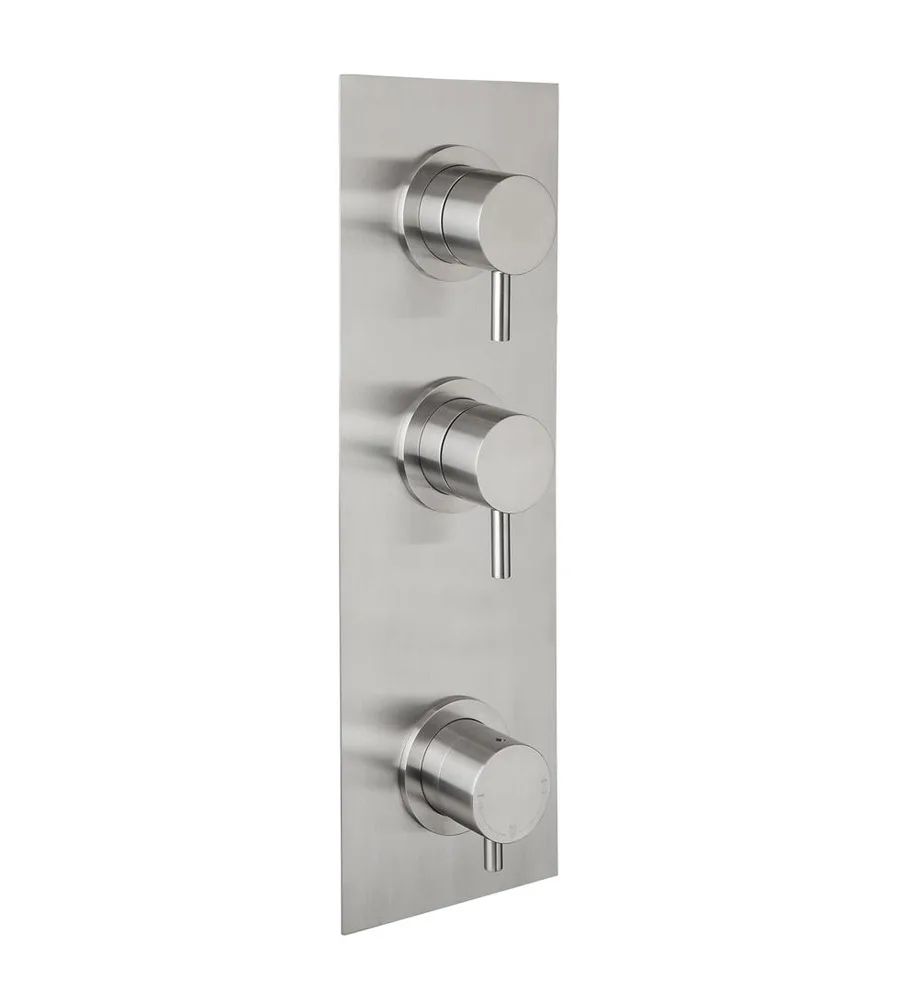 ProductHalf Inch Thermostatic Set with Two Shut-Off ValvesOne thermostatic mixer running two independently isolatable outlets, typically a riser and a hand shower rail. AISI 316L. Guide price £1775 per unit excluding VAT.View in catalogue →
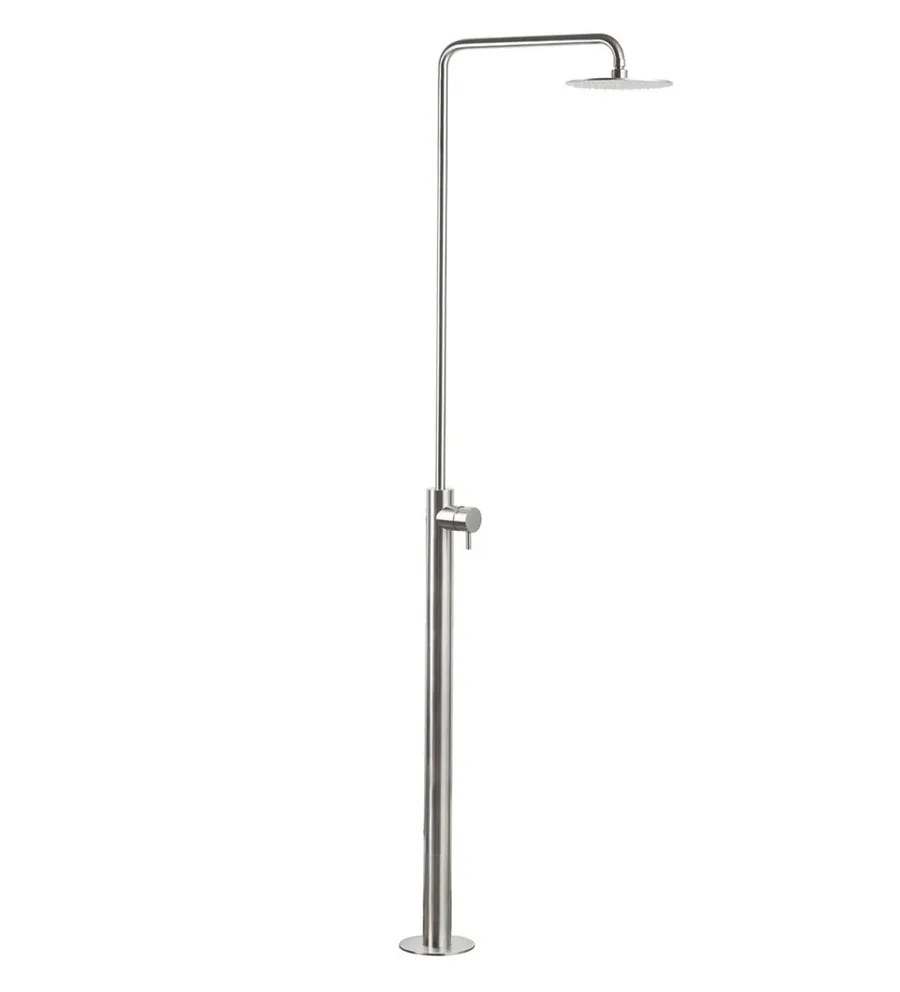 ProductFloor Standing Shower Column with Mixer and HeadMixer and 200 mm head on one floor standing column. Nothing concealed in the wall, so every joint is reachable. Set out before the floor finish and checked for plumb. Guide price £2250 per unit excluding VAT.View in catalogue →
Side by side
| Consideration | Thermostatic mixer | Manual mixer |
|---|---|---|
| Holds outlet temperature as supply changes | Yes, within its stated supply conditions | No, the outlet temperature follows the supply |
| Separate temperature and flow controls | Usually, which limits the rate a user can raise temperature | Usually no, a single lever does both together |
| Maximum temperature limit | Available as a temperature stop, tamper-proof once commissioned | Only what the user chooses |
| Behaviour at low flow | Specified in performance standards, and only inside those conditions | Follows the supply |
| Behaviour if a supply fails | Specified in performance standards, including thermal shut-off tests | Follows the failure |
| Range available to the user | Bounded by the setpoint and the maximum stop | The full range of the supply |
| Moving parts | Thermostatic element plus cartridge | Cartridge |
| Retrofit into an existing tiled wall | Possible as an exposed body on existing centres | Straightforward on standard centres |
| What it costs to specify well | Higher, and it needs commissioning and in-service testing | Lower, and it needs almost nothing |
Where UK rules actually require thermostatic control
This is the part most specification guides get wrong, so it is worth stating precisely. There is no general UK rule that all showers must have a thermostatic mixer. The requirement appears in specific settings, and the numbers are not the same in each one.
Dwellings: baths, at 48°C
Approved Document G, which gives guidance on Part G of the Building Regulations for new dwellings and dwellings created by a material change of use, states at paragraph 3.65 that "the hot water supply temperature to a bath should be limited to a maximum of 48°C by use of an in-line blending valve or other appropriate temperature control device, with a maximum temperature stop and a suitable arrangement of pipework."
Two things follow from that wording. It names baths, not showers. And it says "blending valve or other appropriate temperature control device", not a thermostatic shower mixer specifically. If you specify a thermostatic mixer on that bath feed, you are meeting the requirement. If you specify a correctly rated in-line blending valve to the same limit, you are meeting it too.
The same document sets out the evidence expected of the chosen device at paragraph 3.66: compliance with a relevant European Standard such as BS EN 1111 or BS EN 1287, demonstrated "to show that the maximum temperature of 48°C cannot be exceeded in operation and that the product will fail-safe (i.e. not discharge water above the maximum temperature)". A Note to paragraph 3.68 adds that in buildings such as care homes, in-line blending valves would need to meet the additional performance standards in the NHS model specification D 08.
Separately, Approved Document G paragraph 3.64 requires a tempering device where the storage vessel can exceed 80°C under normal operating conditions, so that supply to the distribution system does not exceed 60°C. That is a storage-side requirement, not a shower-mixer one.
Healthcare and care: a Type 3 valve, at 44°C or below
The Health and Safety Executive is more specific. Its guidance on hot and cold water systems states that "there is a risk of scalding where water comes out of taps at temperatures above 44°C", and that where vulnerable people can get access to baths or showers and the scalding risk is considered significant, "a thermostatic mixing valve (TMV) Type 3 must be fitted to prevent water being discharged at more than 44°C."
The mechanism behind that requirement is the Legionella tension. HSE states that hot water should be stored at least at 60°C and distributed so that it reaches 50°C, or 55°C in healthcare premises, within one minute at the outlets. You cannot deliver 41°C from a bath filler to a resident and keep the distribution system at 55°C without a thermostatic device somewhere between them.
HSE's scalding and burning guidance adds the care-home detail: where storage and distribution temperatures above 60°C and 50°C are used to control Legionella, "baths and showers should be fitted with thermostatic mixer valves (TMVs) to ensure water temperatures do not exceed 44°C". It also notes that for electric showers, output temperatures should be checked under fluctuating local conditions "to ensure temperatures above 44°C (maximum 41°C required in NHS) are not achievable".
That parenthesis is the whole point. The 44°C figure is the general care threshold. 41°C is the NHS figure.
NHS premises: 41°C at the shower, by type designation
For NHS work the binding figure comes from Health Technical Memorandum 04-01 and its Supplement, Performance specification D 08. Table 17 of D 08 sets the initial set temperature of mixed water at the point of discharge by application and designation:
| Application | Maximum mixed water at the point of discharge |
|---|---|
| Bidet | 38°C |
| Shower | 41°C |
| Washbasin | 41°C |
| Bath, 44°C fill | 44°C |
| Bath, 46°C fill | 46°C |
| Bath and shower diverter, D44 | Bath fill 44°C, shower 41°C |
| Bath and shower diverter, D46 | Bath fill 46°C, shower 41°C |
D 08 is a performance specification, not a product list. It defines what a valve must do to be used in those applications, sets the test methods for stability under changing pressure, changing supply temperature and reduced flow, and requires both commissioning and in-service testing against a recorded result. It also expects the means of limiting the maximum mixed water temperature to be used at commissioning, so the adjustment cannot be moved afterwards by whoever uses the shower.
Where no rule compels a thermostatic mixer
Stated plainly, so the article is not read as a sales argument: for a new-build or serviced single-occupancy dwelling where the occupants are competent adults, for an ordinary residential shower, and for most commercial showers serving a general adult public, no UK instrument requires a thermostatic mixer in the shower. The duties that do bite are risk assessment duties. The HSE frames the care requirement as a risk assessment outcome, and its health and social care guidance names staff accommodation, hostels and sheltered housing as settings where the risk should be assessed. In a general commercial washroom, the assessment may well conclude that no thermostatic device is needed.
What happens when the system is badly balanced
A thermostatic mixer cannot deliver what the specification assumes if the system does not provide it. The D 08 normal-use conditions are explicit: hot supply minimum 55°C, cold supply maximum 20°C, flow pressures of 1 to 5 bar at high pressure use or 0.2 to 1 bar at low pressure use, maximum static pressure 10 bar.
Three failures follow from ignoring them.
- Hot supply too cool. Below the stated minimum, the mixer cannot blend enough cold to reach the set temperature. In practice it delivers cooler water than set, and in the worst case the element sits wide open. This is why a thermostatic shower on a poorly maintained or heavily drawn-down system can feel like a fault when it is a system condition.
- Supplies too close in pressure. The mixer needs to be able to move both ports. Where one supply cannot shut off against the other, the setpoint drifts toward whichever side dominates.
- Very low flow. The specification has a separate reduced-flow test precisely because low flow is a distinct condition, with its own permitted temperature change. A thermostatic mixer at a trickle is not the same device as the same mixer at full flow.
A useful discipline for the specifier is to state the intended supply conditions on the drawing alongside the mixer, and to require the supplier to confirm the valve is appropriate for them. Where the catalogue publishes no flow, pressure or dimension figure for a concealed body, that question cannot be answered from the brochure. The high-flow concealed mixer in the range is described as the variant to reach for where water has to move quickly, filling a bath, running a rainfall head, or feeding more than one outlet from the same valve, and it explicitly says the supply and pipework must be confirmed as sized to feed it before the wall is closed.
And when a user defeats the mechanism
Two honest cases, both common.
A user reaches past the setpoint. If the maximum stop is not in place, or has been defeated, or the valve has no stop at all, a thermostatic mixer can be turned to very hot water. The mitigation is the stop, locked at commissioning, not the thermostat.
The shower sits unused for a while, then is run. The D 08 specification has a dedicated test for exactly this, and explains the mechanism honestly. Over a period of several hours an installed valve cools to ambient, which "commonly results in the thermostat adjusting the valve mechanism to fully open the hot water port, and thereby shut off the cold water port. Subsequently, as water is drawn off, the thermostat must respond quickly to limit the temperature of mixed water as hot water flows into the valve." It is a real transient, it is tested, and it is bounded.
Where a manual mixer is genuinely the right answer
Three cases where the manual mixer is the correct specification rather than the fallback.
A retrofit that cannot open the wall. A concealed thermostatic set needs a concealed body positioned at first fix, so where the wall is tiled and the pipework is already in, the choice is between a floor standing column and an exposed body. The freestanding column avoids the wall entirely, which the catalogue makes its reason for existing: "the whole thing stands on the floor as one object, so nothing is chased and every joint stays reachable." If thermostatic control is also needed there, an exposed thermostatic body is the answer, and the range has one: it holds outlet temperature at a 38°C ceiling, carries non-return valves on both supplies, and comes with the 38-degree safety block as standard rather than as an accessory.
 ProductConcealed Wall Mixer Without Spout, 316L Stainless SteelConcealed behind the tile leaving only the control plate, and supplied without a spout so the same body can feed a bath filler, a shower spout or a rain head. Fitted and tested at first fix. Guide price £610 per unit excluding VAT.View in catalogue →
A supply that falls outside the thermostatic envelope. Old systems, very low pressure, unusual pipe runs, or a system where hot water is stored at a temperature the thermostatic valve is not designed for, all push outside the D 08 normal-use conditions. A manual mixer is unaffected by that, because it makes no claim.
A shower where every user is a competent adult and the design intent is a personal temperature. In a private house or a changing room, the user setting their own temperature is the feature, not the risk. A thermostatic mixer with a 41°C NHS-derived setting would be actively wrong there, and a valve with a set ceiling above what a healthy adult wants is simply an unnecessary constraint. Where the outflow is fed from a fixed, correctly proportioned supply, a manual mixer is a smaller, cheaper, serviceable thing doing exactly the job asked of it.
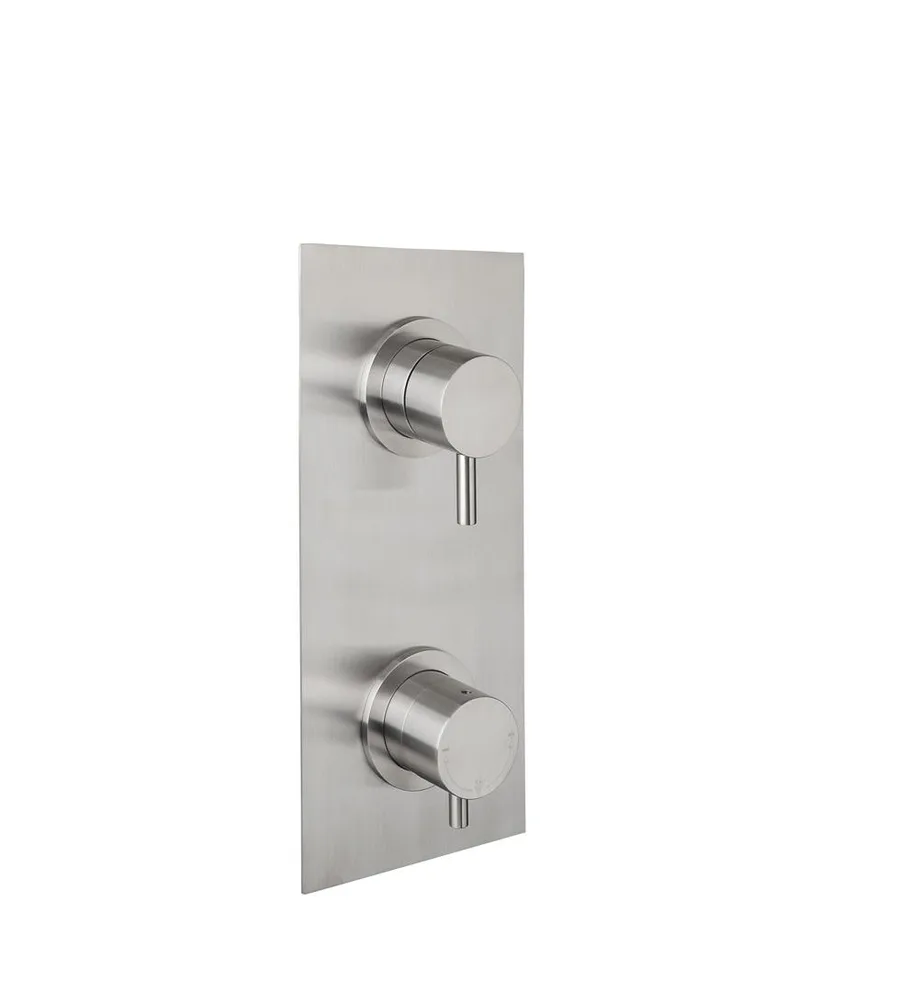 ProductHalf Inch Thermostatic Shower Set with Single Shut-OffMinimal set for a single outlet run, half inch connections to a concealed body. AISI 316L. Guide price £1225 per unit excluding VAT.View in catalogue →
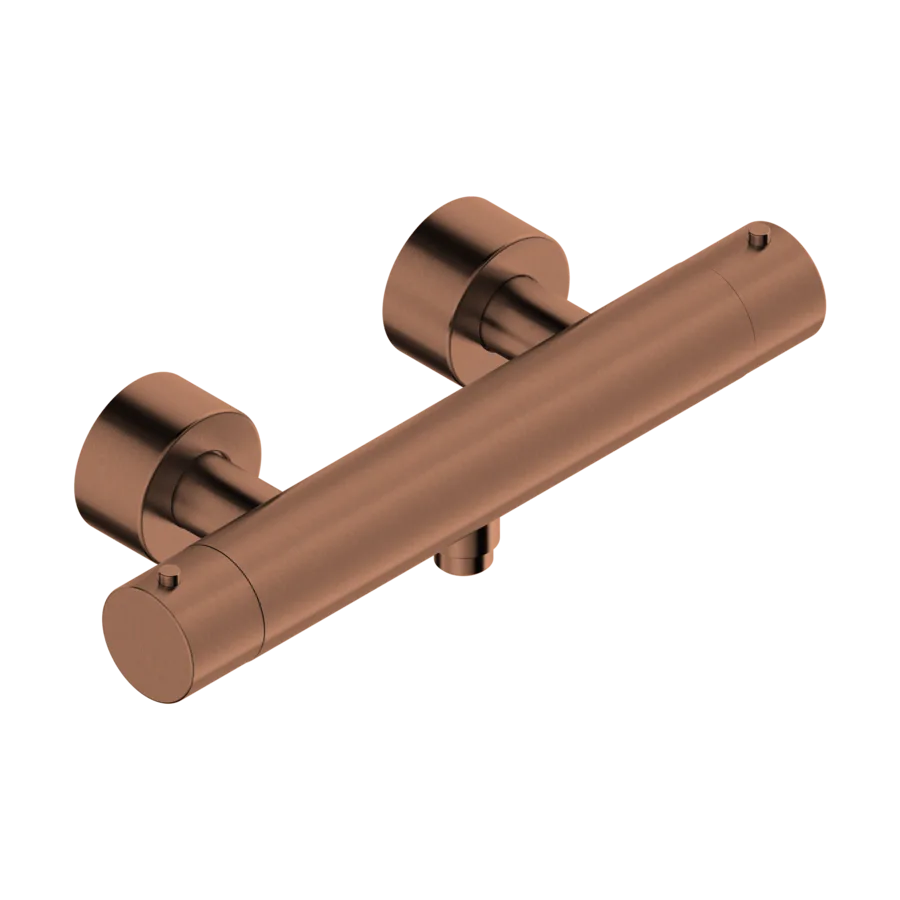 Product45 mm exposed thermostatic shower mixer in 316L stainless steelLocks outlet temperature at a 38°C ceiling with non-return valves and an anti-limescale cartridge system. G1/2" supply on 150mm centres, adjustable by around 20mm, published flow rate 2 L/min. Guide price £1125 per unit excluding VAT.View in catalogue →
What a specifier should ask a supplier
Record the answers in the schedule, not in a memory.
- Which supply conditions is the valve specified for? Ask for the pressure range, the minimum hot supply temperature and the maximum cold supply temperature the valve is rated against, and compare them with the system design. A thermostatic valve outside its stated conditions is not a warranty issue, it is a design error.
- What is the maximum temperature stop, and can it be locked? Ask how the maximum is limited, whether the limitation is tamper-proof once commissioned, and whether commissioning is available and how it is recorded.
- What failsafe behaviour is claimed, and against which standard? For any healthcare or care-adjacent work, ask for the designation and the test evidence. For ordinary work, ask whether the product is tested to BS EN 1111 or BS EN 1287 and ask to see the claim in writing rather than a logo on a box.
- What is published, and what is not? Which dimensions, flow rates and pressure figures are published, and which must be confirmed against the installation. Where the catalogue publishes none, treat them as unconfirmed.
- What happens at low flow and at reduced pressure? Ask for the stated behaviour, and check it against the outlet you have specified. A rainfall head and a hand shower are not the same flow condition.
- What are the first-fix commitments? For any concealed product, the position, the wall build-up and the pipe sizing are all fixed before the tile goes on. Ask for the cavity, the fixing centres and the connection sizes in writing.
Frequently asked questions
Does a thermostatic mixer stop a user being scalded?
Not by itself. It holds a set temperature against changes in the supply, and it holds the maximum temperature stop if one is fitted and has been commissioned. A user who can move the control past the stop has defeated it. In care settings the protection comes from the stop, from commissioning and in-service testing, and from the water system design, not from the thermostat alone.
Is a thermostatic mixer required by law in every UK shower?
No. The requirement appears where a specific duty applies. Approved Document G paragraph 3.65 requires the hot water supply to a bath in a dwelling to be limited to 48°C. HSE requires a Type 3 thermostatic mixing valve where vulnerable people can reach baths or showers and the scald risk is significant. NHS work goes further and lower. For an ordinary residential or general commercial shower, the question is a risk assessment, and the assessment may conclude no thermostatic device is needed.
Is a thermostatic mixer more reliable than a manual one?
No. It does a more demanding job, so it has more parts that can fail. A thermostatic element can scale, stick or wear, and a thermostatic mixer additionally depends on supply conditions being inside its rated envelope. A manual mixer is simpler and more tolerant, which is exactly why it is the correct answer in several genuine cases.
Does a thermostatic mixer waste less water?
Not inherently, and the honest answer is that it depends on the installation rather than on the valve. By holding temperature while flow changes, it removes one reason a user has to re-adjust and re-run a shower, which in some installations reduces waste. But a thermostatic mixer cannot fix an oversized pipe run or an unbalanced system, and D 08 requires the length of pipe between an in-line blending valve and the outlet to be kept to a minimum, which is a design measure rather than a valve measure. Claiming a water-saving benefit for the valve alone is not supported.
Can you add thermostatic control to a shower later?
Not easily, if the valve is concealed. A concealed thermostatic set needs a body positioned and built into the wall at first fix. Where that was not done, the realistic routes are an exposed thermostatic mixer on the existing pipework, or a separate thermostatic valve close to the outlet. Decide at first fix.
Does the finish or material affect the temperature performance?
The material affects durability rather than control. AISI 316L is the grade used in the shower and bath range specifically because its molybdenum content resists chloride attack in a wet room. The exposed thermostatic mixer in the range pairs that body with an anti-limescale cartridge system, because hard water is a real service-life issue for a cartridge. See our guide to 316L stainless steel for coastal and damp environments for the wider material argument.
The decision in one paragraph
The question is not which mixer is better. It is whether anything in the building can disturb the supply while the shower is running, and whether anyone who uses the shower cannot be relied on to leave the control alone. If the answer to the first is yes, or the answer to the second is yes, the mixer must hold temperature, and you specify thermostatic with a commissioned maximum stop, against the supply conditions stated on the drawing. If both answers are no, a manual mixer is not a compromise. It is the simpler answer to a simpler question, and it will serve the room for longer at less cost to maintain.
For a hotel, a care setting, a multi-outlet commercial shower or a high-end residential floor, send FONTEA your outlet schedule, your supply conditions and your temperature requirements through the contact page. Browse the shower and bath range, the AISI 316L material page and the wider Fontea collection once the thermostatic and manual decision is settled, and pair the mixer with the isolation and inlet parts covered in our guide to stop valves and water inlets.
Specify it from the catalogue
Every fitting mentioned here is stocked and specified in the FONTEA trade catalogue: full technical data, finishes and wholesale tiers.
Related reading
-
 Specification
Stainless Steel Bathroom Fittings for Coastal and Seafront Developments: A Salt-Air Corrosion Guide
What actually governs whether bathroom fittings survive a seafront elevation: the chloride gradient, finish, joint design, drainage and ventilation, how corrosion appears, and what to schedule.
-
 Materials
Is Marine-Grade 316L Stainless Steel Worth It for a UK Bathroom?
Sometimes. 316L earns its premium where chlorides genuinely reach the fittings, and wastes money on a standard inland bathroom. Here is how to tell which situation you are in before you pay.
-
 Tap Systems
Will European taps work on UK low-pressure and combi boiler systems?
European-style taps are often built to a higher pressure than a UK gravity-fed or combi system delivers. Here is what actually determines whether one will run properly, and how to check before you specify.