 ONTEA
ONTEA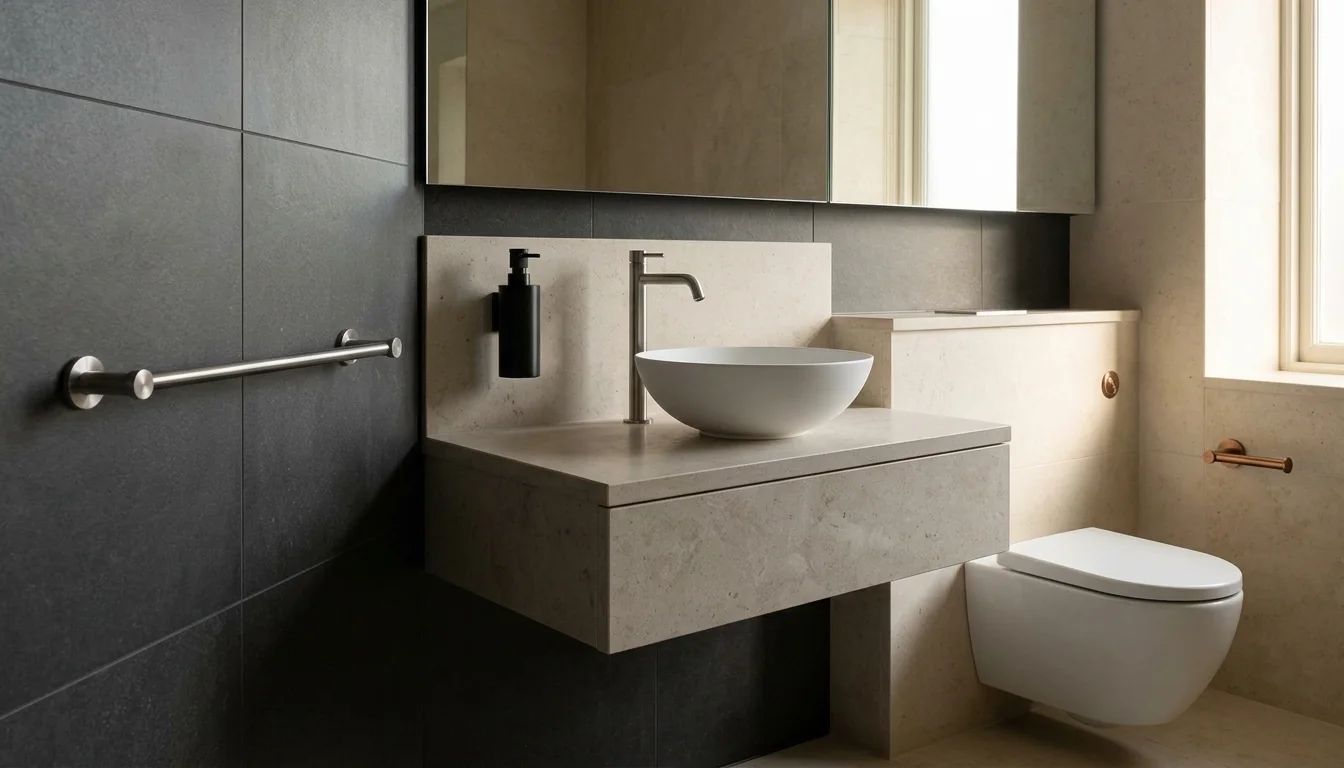
Brushed stainless steel and PVD are two separate decisions, not two ways of buying the same thing, and chrome-plated brass is a third thing again. Brushed steel is bare metal with a grain mechanically worked into its surface, PVD is a hard, coloured film vacuum-deposited onto that same solid steel, and chrome is a very thin flash of metal over a different base metal entirely. They clean differently, they show wear differently, and they are worth different amounts over the life of a fitting.
Quick answer: specify brushed stainless steel where you want the lowest maintenance and the lowest upfront commitment to a look, because there is no coating to chip and no colour that can go out of date. Specify PVD where the colour is the design decision, and accept that it is a coating whose life is set by its thickness and its cleaning regime rather than by the metal beneath. Chrome-plated brass is a legitimate choice for light domestic use in soft-water areas, but it is the only one of the three with a layer that, once breached, exposes a different metal and cannot be repaired in place.
Brushed steel, PVD and chrome at a glance
The three options differ most in what the surface actually is. Everything else, cleaning, marks and wear, follows from that.
| Brushed stainless steel | PVD on stainless steel | Chrome-plated brass | |
|---|---|---|---|
| What the surface is | Bare steel with a fine directional grain, cut mechanically into the metal | A thin hard film deposited in a vacuum chamber and bonded to solid steel | A thin flash of chrome over a nickel undercoat, over a brass or zinc-alloy body |
| Where the colour comes from | The metal itself | The deposited film | The deposited chrome |
| Has a layer that can chip | No | Yes, though it is very hard | Yes, and it is very thin |
| Shows fingerprints | Least | Matte, so little | Most, on a mirror surface |
| Hides limescale best | Yes, the matte grain is forgiving | Yes, matte surfaces hide deposits | No, a mirror finish shows every spot |
| Abrasive cleaners | Risk scratching the grain | Risk damaging the film | Risk damaging the plating |
| Acid descalers | Tolerable on the grain, rinse well | Use with care, check the maker | Can attack the plating and the brass under it |
| Upfront cost | Mid | Mid to high | Lowest |
| Repair after a chip | A scratch can be blended into the grain | The film cannot be grown back in place | The plating cannot be restored in place |
None of these rows is a ranking. A chrome rail in a quiet guest cloakroom and a black PVD holder in a hotel washroom are different purchases serving different rooms.
What each one actually is
Understanding the three surfaces is the fastest way to predict how they will behave, because almost every difference in cleaning and wear comes back to this.
Brushed stainless steel is the metal with a finish, not a finish on the metal. The brushed or satin surface is produced by cutting the steel with abrasive belts to remove a very small amount of metal without affecting its thickness, leaving a fine directional grain. The Australian Stainless Steel Development Association describes a No 4 surface exactly this way, produced by abrasive belts whose grains are refractory materials such as silica, alumina and zirconia. Because the grain is cut into the steel rather than laid on top, there is no coating to chip and no seam between surface and core. A scratch is a shallow line in metal and can be abraded back into the surrounding grain.
PVD is a hard, coloured film deposited onto the same solid steel in a vacuum. The peer-reviewed review PVD for Decorative Applications describes PVD as a vacuum technique in which target material is vaporised and transported through a low-pressure gas or plasma to the substrate, where it condenses. Decorative films are typically a micron or two thick; one published coating patent describes its decorative titanium-nitride or chromium-nitride layer as about 1.0 to 3.0 microns. Crucially, in our catalogue PVD sits on solid stainless steel, not on brass, so a damaged film exposes the same metal the brushed option is made of.
Chrome is a very thin flash of metal over a different metal. Decorative chromium is famously thin. A study in Materials notes that decorative chromium is typically about 0.25 microns thick, in contrast to functional hard chrome that can reach hundreds of microns. That flash sits over a nickel undercoat on a brass or zinc-alloy body, which is why a chrome fitting has three metals where brushed and PVD fittings have one.
How each behaves with daily cleaning
Cleaning is where most of the practical difference shows. The rule that surprises people is that the gentle cleaners are broadly safe for all three, and it is the harsh, acidic and chlorinated products that separate them.
The British Stainless Steel Association's guidance for stainless steel is that routine cleaning with soap or detergent in warm water, followed by a rinse, is adequate, and that limescale can be lifted with a phosphoric or vinegar solution. The caution is specific and severe: chloride-containing solutions, including hydrochloric-acid cleaners and hypochlorite bleaches, cause unacceptable staining and pitting on stainless and must not touch it, and carbon steel wool must never be used.
That warning maps onto real failure cases. An independent materials-characterisation institute, IGOS, publishes metallographic case studies of decorative chrome plating that include a die-cast zinc fitting attacked into pitting corrosion by aggressive media, and a brass fitting with decorative chrome that failed by selective corrosion, dezincification, under aggressive chemical attack. Both are the exact chemistry that household and housekeeping cleaning products deliver in a bathroom.
For PVD, care advice converges on the same middle ground: no abrasive cleaners or scouring pads, and acidic products used with care. The practical difference between brushed and PVD is small here, because both are solid steel at heart. The brushed surface has slightly more tolerance for a hard wipe because it is bare metal; PVD is marginally more forgiving of handling marks because it is matte, but the film is thinner and more brittle than the steel under it, so abrasive pads and metal scrapers are the thing to avoid.
For chrome, the plating is the only barrier between the product and the base metal, so harsh and acid cleaners carry the most risk. Gentle, mildly acidic cleaners used regularly, with a thorough rinse, are the mainstream advice for chrome taps and showers.
How limescale shows, and what it does
In a hard-water area, the deposit is the same calcium carbonate on all three finishes. What differs is how visible it is and how easily it lifts.
- Chrome is a mirror surface. Water spots, fingerprints and limescale are at their most obvious here because a reflective finish shows every mark. Descaling is straightforward but must stay gentle, because the acid that dissolves the scale can also attack the plating and the brass beneath, which is why over-aggressive, repeated descaling is what turns a chrome fitting into a pitted one.
- PVD and brushed steel are both matte, so they hide light water spotting far better. Matte surfaces scatter the light that would otherwise make a spot stand out, which is why they look cleaner between cleans in the same room where chrome looks marked. Because the deposit sits on top of a matte, slightly textured surface rather than a mirror, it lifts more readily with a mild descaler and does not etch the appearance the way it can on a polished plating.
- Brushed steel additionally forgives a missed spot. Because the grain scatters light, a faint mineral trace blends into the finish, whereas on polished chrome the same trace reads as a visible haze until it is scrubbed.
The honest caveat: in genuinely hard water, no finish removes the need to clean. Limescale builds up on matte finishes too. The difference is how often it becomes visible enough to bother you, and how forgiving the surface is of the cleaner you use.
What happens at a chip or scratch
This is where the three separate most clearly, and it is the reason the choice matters more over a service life than the day-one appearance.
Brushed steel. A scratch is damage to metal, not the loss of a coating. The British Stainless Steel Association notes that brushed striated finishes are susceptible to damage but that scratches can be readily abraded out, because the grain can be blended back together. A scuff or hairline scratch on brushed stainless is a cosmetic issue that blends in, not a failure.
PVD. A chip through the PVD film is more serious than a scratch in bare steel, because the film cannot be grown back in place. In practice a mark that does not break the film can often be blended at the grain, but a chip through the coloured layer is a permanent cosmetic change, which is why abrasive pads and metal scrapers are the thing to avoid. The mitigating factor is that the layer is hard: the review cited above notes that PVD coatings are typically harder and more wear-resistant than electroplated coatings, which resists casual abrasion.
Chrome-plated brass. Once the plating is breached, a different metal is exposed underneath and the part is effectively finished. Nickel plating handbooks describe the mechanism: corrosion initiates at cracks or pores in the chrome and, because chrome is more noble than the nickel beneath, attacks the nickel in pits that deepen toward the substrate, while the thin chrome layer can lift by undercutting. So the visible progression is a dull spot, then a blister or flake, then a pitted patch with a discoloured base metal showing through. That cannot be repaired in place; the fitting is replaced.
If a chip is your main worry, brushed stainless is the finish that most easily absorbs one, and solid stainless underneath a PVD film is a better substrate than brass underneath chrome.
What each is worth over a service life
Value is not just the price on the invoice. It is the price plus the maintenance plus the likelihood of an early replacement, over however many years you expect the room to stay as built.
Chrome-plated brass has the lowest entry price and can be the right call. In a low-traffic domestic bathroom in a soft-water area, cleaned with mild products, a plated fitting can give perfectly good service and look correct on day one. Its weakness is the tail risk: if the plating breaches, there is no in-place repair, so you are replacing the fitting, and in a project with hundreds of rooms that tail risk is multiplied across every unit.
Brushed stainless steel sits at a mid price with no coating to fail. Its whole value proposition is that the failure mode is a scratch you can blend rather than a chip you must replace. Over a long service life, in hard water, in a coastal air, or anywhere the fitting is handled hard, that difference in worst-case outcome is what the extra money at the start is buying.
PVD buys colour, and it should be judged as a colour decision. You are paying for a specific look, and in return you get a very hard, very thin film on solid steel. Judge it on whether the colour is worth a finish whose care is slightly more delicate than bare brushed steel. On a project where the whole room is designed around matte black or a warm metallic, that look is usually non-negotiable and the finish is justified; on a single rail in an ensuite, brushed steel usually delivers more value per pound.
There is no published, head-to-head service-life test that ranks these three for a UK bathroom, so we will not quote one. What the evidence does support is the mechanism: the difference between a finish you can blend back in and a plating you cannot, and the fact that all three clean safely with mild products but are damaged by abrasive and chlorinated ones.
Where this is why our range is solid stainless steel, never chrome-plated brass
This comparison is the reason the FONTEA catalogue sells solid stainless steel fittings and never chrome-plated brass. It is not that chrome is a bad product. It is that for the rooms our customers specify, we would rather build the fitting from one metal end to end.
The brushed finish page describes the catalogue's natural finish as the bare stainless steel with a fine satin grain and no coating and no plating, so the colour is the metal itself and a scratch can be blended back into the grain. The black PVD finish page describes PVD as a colour bonded to the stainless steel at a molecular level in a vacuum chamber, with the same solid 316L or 304 stainless steel underneath as every other finish. Across the range, brushed steel and the PVD colours all sit on one solid stainless body rather than a coating over brass, and the grade is published per product rather than assumed.
Three examples from the current bathroom accessories range, all solid stainless rather than a coating over another metal. Prices vary by finish, so check each product page for the current guide price.
 ProductWall Mounted Towel Rail 650 mm, Long Bath Towel2MS3794-BSSolid AISI 304 stainless steel bar, 650 mm long, wall mounted on a stand-off so the towel dries rather than rests. Four finishes from brushed stainless steel through to gold PVD. Confirm projection and fixing detail with the supplier.View in catalogue →
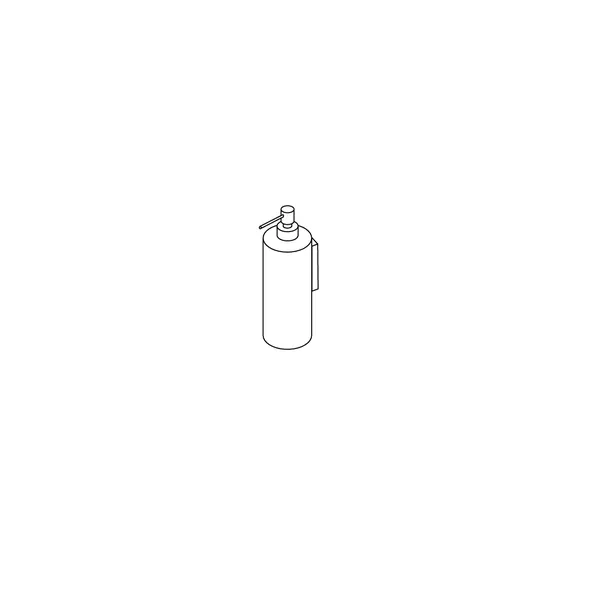 ProductWall Mounted Liquid Soap Dispenser2MS3720-BSSolid AISI 304 stainless steel body, fixed to the wall beside the basin above the splash line so the deck stays clear and the body resists washroom cleaners. Four finishes. Confirm reservoir volume, fixings and pump type with the supplier.View in catalogue →
 ProductWall Mounted Toilet Roll Holder2MS37630-BSSolid AISI 304 stainless steel body, no plating, with the roll held clear of the wall face so it changes without marking tile. Brushed stainless steel, deep grey, Tinta and gold PVD. Confirm fixing and projection with the supplier.View in catalogue →
How to choose, honestly
There is no single best option, because these are different decisions rather than one decision with three answers.
- Choose brushed stainless steel for the lowest-maintenance, lowest-commitment option and the easiest finish to live with in hard water and busy rooms. It is also the easiest to blend a scratch in. It is the value pick.
- Choose PVD when the colour is the design decision and you are finishing a whole room or project in matte black, gold or copper. You are buying a look, and you accept a slightly more delicate care regime and a finish whose marks are permanent if the film is broken.
- Choose chrome-plated brass when the budget is tight, the room is lightly used, the water is soft, and the day-one mirror look is what the room needs. Just know it is the only one of the three where a breach means replacement rather than blending.
The decision that is genuinely not the same whichever way you go is brushed versus PVD: one is a finish with no layer to fail, the other is a colour you choose. Chrome sits apart again, as the only option whose failure exposes a different metal. Whichever you choose, check the care sheet for the specific product and finish before using any descaler, and avoid abrasive pads and chlorinated cleaners on all three.
More from the journal
Find more on materials and finishes in the FONTEA journal, including the Stainless Steel, Chrome and PVD tags and the Materials archive. If you are choosing for a specific project, browse the materials and finishes hub to compare the grade and finish under each colour, and get in touch with the room details and the finish you are matching, and we can point you to suitable options in the catalogue.
Specify it from the catalogue
Every fitting mentioned here is stocked and specified in the FONTEA trade catalogue: full technical data, finishes and wholesale tiers.
Related reading
-
 Finishes
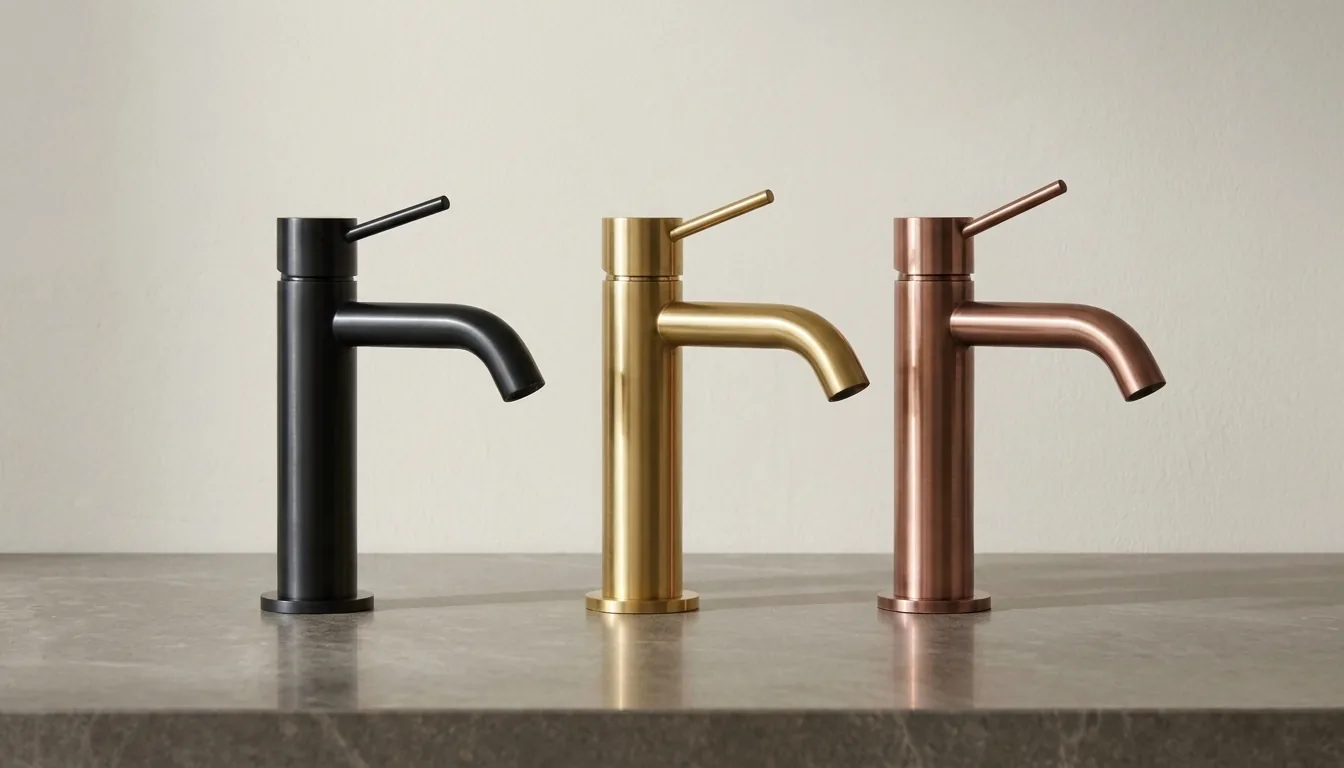
PVD Tap Finish Explained: How Black, Gold and Copper Are Applied
PVD bonds a thin metallic layer onto stainless steel in a vacuum, so the colour is part of the metal rather than a paint or electroplate. Here is what black, gold and copper PVD actually are and how long they last.
-
 Accessories
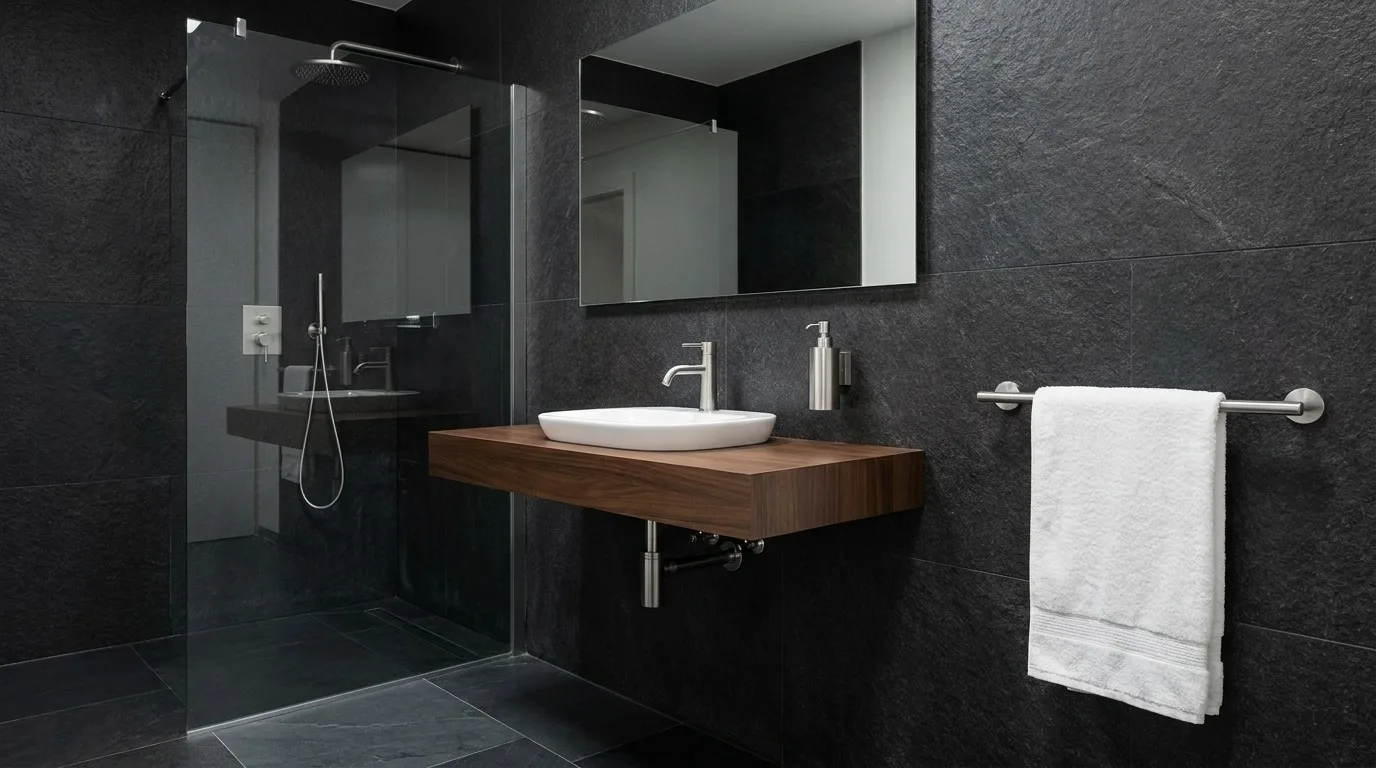
Stainless steel vs chrome bathroom accessories: how each one fails
Chrome-plated brass fails once the plating is breached. Solid 316L stainless has no plating layer to lose. See how each one fails in a UK bathroom.
-
 Materials
Kitchen Sink Mixer Materials: Why Food-Grade AISI 304 Rather Than Brass
A kitchen mixer is handled all day and splashed with fat, detergent and food acids. Here is why solid AISI 304 stainless is the right default there, where brass is a fair choice, and when to step up to 316L.