 ONTEA
ONTEA
"Ceramic cartridge" is the least informative line on most tap specification sheets. Every mainstream single-lever mixer uses one, the phrase describes a sealing technology rather than a performance class, and it tells you nothing about how many cycles the part was tested to or under what conditions. What a buyer should ask a supplier is narrower and more technical: which cartridge type, which endurance standard the cycle count comes from, what the test conditions were, and whether the number applies to the cartridge alone or to the assembled tap.
Key Takeaways
- "Ceramic cartridge" names a sealing mechanism, not a durability rating. Ceramic mixing cartridges for single-lever taps are close to universal, so the phrase alone distinguishes almost nothing.
- Cycle counts are not comparable across standards. Published cartridge data sheets give 70,000 cycles to EN 817 and 500,000 cycles to ASME A112.18.1M for the same class of part, because the tests are not the same test.
- A credible figure names the standard, the test conditions and the tested configuration. "500,000 cycles" with none of those attached is a marketing claim, not evidence.
- This article does not supply a cycle-life figure, and none should be inferred from it. Where a specification is needed, ask a supplier for the underlying report instead of accepting a headline number.
What a ceramic cartridge actually is
A ceramic cartridge is a self-contained valve insert that sits inside the tap body and does two jobs at once: it meters the flow of water and it blends hot and cold to set the temperature. Both jobs happen because the user moves a single lever, which shifts a component inside the cartridge.
The sealing mechanism is the part that earns the word "ceramic". Inside the cartridge are two highly precise, flat alumina discs held face to face. One disc is fixed and the other moves with the lever. Water passages are cut into the faces of both discs, so when the faces align, the passages line up and water flows; when they misalign, they are sealed off by a face-to-face contact between two very hard, very smooth surfaces. Nothing is compressed against anything to stop the water. That is why these taps feel light to operate and why they do not gradually weep as a rubber washer does.
The discs are made from alumina, and the proportion matters. Published technical data sheets for this class of part specify alumina content, surface roughness, hardness and flatness, and they vary considerably between suppliers. One published cartridge specification lists discs at 92% to 96% Al₂O₃, surface roughness of Ra 0.1 to Ra 0.3 µm and hardness above 1000 HV; another lists a higher alumina figure with a flatness tolerance of 0.3 µm. Flatness in particular is the parameter that decides whether the discs seal cleanly, because any deviation becomes a channel for water to track through.
Ceramic mixing cartridges also come in different physical sizes, and the size is a real specification point. Diameters of 25 mm, 35 mm, 40 mm and 45 mm all appear in published cartridge ranges, and the diameter correlates with body size and flow capacity. A published 45 mm cartridge specification, for example, gives a 25° opening angle, a 110° mixing angle, a maximum temperature of 90 °C, a recommended tightening torque of 12 Nm, and a pressure test at 6 bar pneumatic and 35 bar hydraulic.
The practical point for a buyer is that a cartridge is a consumable wearing part inside a tap. It can usually be changed without replacing the tap, which is precisely why its specification matters to the person who owns the building rather than the person who fitted it once.
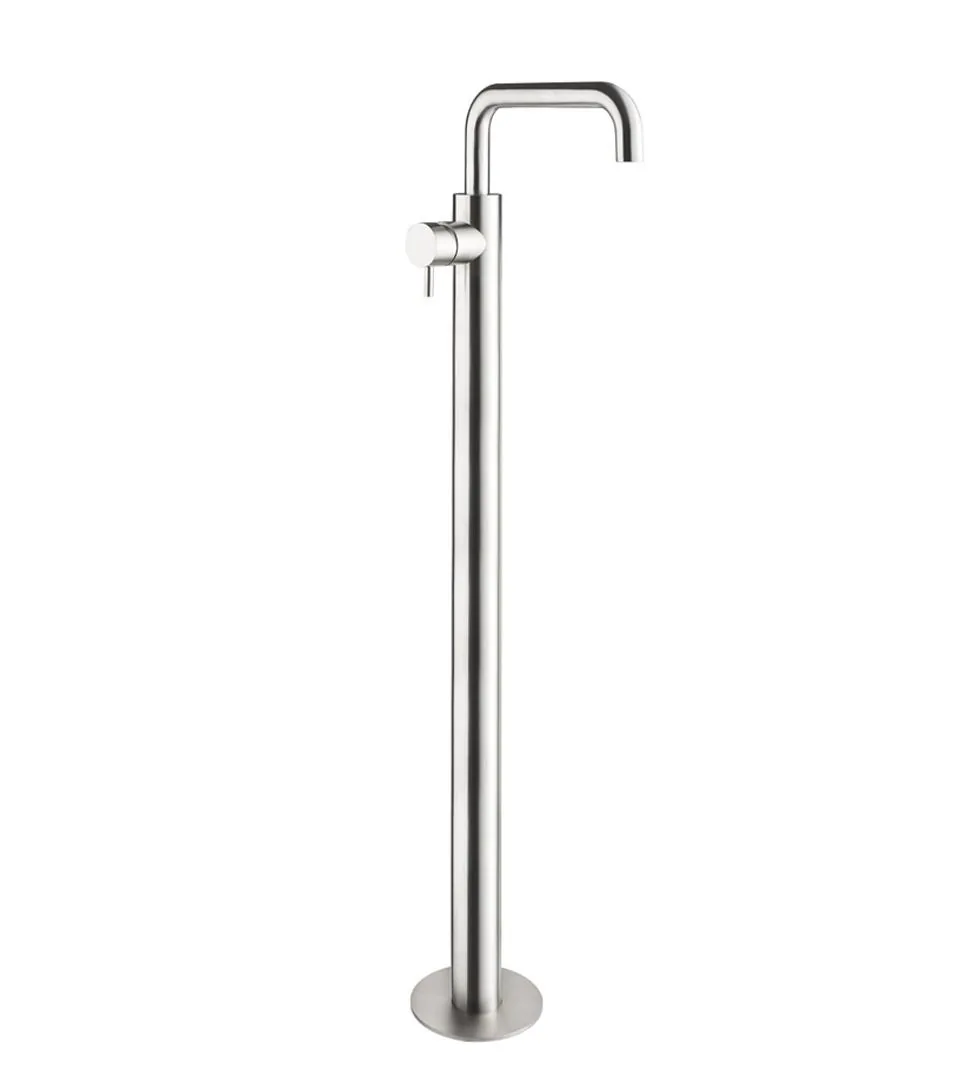 ProductFloor Standing Washbasin Mixer on a Column2LI8523Z-BSAISI 316L stainless steel, five finishes, guide price £1925 ex VAT. As a mixer the column carries its own control, so the cartridge sits inside the visible column and still needs floor-level access to reach, which makes the cartridge a first-fix question rather than a retail one. Height and reach are not recorded, so confirm both.View in catalogue →
The cartridge types you will be asked about
Three cartridge families cover almost all the mixers a UK trade buyer will specify. They are worth telling apart, because they behave differently under use and they are tested differently.
Ceramic mixing cartridges for single-lever mixers. This is the standard mechanism in contemporary single-lever taps, and the one most suppliers mean when they write "ceramic cartridge". A single lever controls both flow and temperature through the two-disc arrangement described above. Because the mechanism is now so settled, naming it tells a buyer very little, which is the central problem this article addresses.
Ceramic disc cartridges for two-handle taps. A pair of taps with separate hot and cold handles uses two single-supply cartridges rather than one mixing cartridge. Each is simpler, controlling only flow, not temperature, and they are commonly supplied as a matched pair with opposite closing directions. This distinction matters when ordering spares, because the two sides are not interchangeable.
Thermostatic cartridges. These do not regulate temperature by proportioning flow the way a mixing cartridge does. They use a wax element or equivalent thermal sensor that expands and contracts with the mixed water temperature, shifting the mechanism to hold a set temperature. This is a different control principle with a different failure mode, and it is what appears in thermostatic shower and bath controls rather than in an ordinary basin or kitchen mixer.
There is also a distinction worth keeping clear, because suppliers and specifiers use the words loosely. "Cartridge" in parts catalogues often means the replaceable insert, whatever is inside it, so a ceramic mixing cartridge is frequently listed simply as a cartridge. Reading a spares list as though the two words were separate mechanisms will send you to the wrong part.
Across the stainless steel taps in the catalogue, the basin and bath mixers are single-lever designs, so the cartridge question for a specifier concerns a mixing cartridge. Where a floor-standing fitting is supplied as a spout rather than a mixer, the cartridge moves out of the column and into the separate valve that controls it, so the specification has to name which of the two is being bought.
What cycle life means and how it is actually measured
Cycle life is the number of times a cartridge can be operated through a specified motion before failing to meet the standard's acceptance criteria. The number sounds objective, and it is measured rather than estimated, but it is only meaningful alongside three things: the standard it comes from, the conditions it was tested under, and what was actually tested.
The standard defines the number. The two most common figures in this industry belong to different standards and are not interchangeable. Against EN 817, the European standard for mechanical mixing valves, a single-lever ceramic mixing cartridge passes 70,000 cycles; the same published family of data sheets gives 500,000 cycles against ASME A112.18.1M, the North American standard. Both numbers appear on the same manufacturer's datasheets for the same part because they are results of two different tests. Australian standard AS 3718 uses a different figure again, at 50,000 cycles.
A supplier quoting only "500,000 cycles" has told you which test they ran, or has copied a number from another market without explaining it. Either way the buyer has no way to tell.
The conditions are part of the result. A published account of EN 817 endurance testing gives the conditions in detail, and they are demanding: hot water at 65 ± 2 °C, cold water at 30 °C or below, flow adjusted by downstream resistance to 6 ± 1 litres per minute, static pressure of 0.4 ± 0.05 MPa, an operating speed of 60 ± 5 degrees of angular travel per second, a dwell time of 5 ± 0.5 seconds, and water at a pH of 8 ± 1. The motion itself is described as combining rectangular and triangular movement patterns. These are hot, pressurised, abrasive conditions, not a gentle laboratory cycle.
What was tested matters as much as how long. A cartridge tested loose on a bench is a different claim from a tap tested as an assembled product with its handle, spout and connections. Where a figure applies to the assembled fitting rather than the cartridge alone, the datasheet should say so, because the standard is written for the product.
One further caution belongs here. An endurance figure is a laboratory result on a test rig under a fixed protocol. It is not a warranty, and it is not a service-life prediction for a specific installation. Test conditions are deliberately standardised, and a real building imposes conditions the rig does not model: limescale, debris, aggressive cleaning chemistry, and supply pressures at the extremes of the range. The correct reading of a cycle count is "this part was tested to this standard under these conditions", not "this part will last N years".
What to ask a supplier, in the order that gets an answer
- Which cartridge type, and which size? Mixing cartridge for a single-lever mixer, or a thermostatic cartridge? If a diameter is specified, 25 mm, 35 mm, 40 mm or 45 mm, that fixes the physical part and tells you whether the spares story is realistic for the building.
- Which standard is the cycle count from, and how many cycles? Ask for both together. If a supplier cannot name the standard, the number is not evidence.
- What were the test conditions? At minimum hot water temperature, pressure and cycle rate. A figure quoted without conditions is a headline.
- Was the cartridge tested alone or in the assembled tap? This determines whether the figure transfers to the product you are buying.
- What is the replacement part, and is it available? A cartridge specification is only useful if the part can be identified and reordered in five years. Ask for the cartridge reference and whether spares are stocked.
- Is there a report rather than a claim? A test report, a certificate or a datasheet with the conditions printed on it is answerable. A sentence in an email is not.
These questions work on any supplier, not only on a manufacturer. They are the same six questions whether the tap is sourced from a distributor, an importer or the factory that made it.
Telling a real answer from a marketing one
The gap between the two is mostly about specificity, and it is easy to read once you know what to look for.
A claim looks like this: "Ceramic cartridge, tested to 500,000 cycles for ultimate durability." Nothing is attached to the number. No standard name, no conditions, no tested configuration. The same sentence could describe any cartridge in the industry, because it was not written about a particular part.
An answer looks like this: the standard is named, the conditions are stated, the tested configuration is identified, and the figure is tied to a part. It reads more like a datasheet and less like an advertisement, which is exactly what a buyer should want.
Four quick tests when a claim arrives:
- Ask for the standard. If the reply names EN 817 or ASME A112.18.1M, and gives the matching cycle count, the supplier understands their own product. A mismatch between the named standard and the quoted figure is the clearest warning sign there is.
- Ask for the conditions. A supplier with real data can supply them. One working from a marketing summary cannot.
- Ask what was tested. "The cartridge" and "the tap" are different claims and the difference decides whether the number is relevant to you.
- Compare across suppliers. Published data sheets from different cartridge manufacturers sit in the same range for the same standard. A figure far outside that range, with no test detail to account for the difference, deserves a question rather than acceptance.
It is also worth saying plainly what this means for anyone reading this page. This article does not supply a cycle-life figure, and none should be inferred from it. Where a specification is needed, the right move is to ask a supplier for the underlying cartridge datasheet or test report, and to judge it against the standards and conditions set out above.
A short specification checklist
- Write the standard into the specification, not just the cycle count. "70,000 cycles to EN 817" is checkable; "70,000 cycles" is not.
- Record the cartridge type and size for anything that will need spares, and confirm the replacement part is identifiable and orderable years later.
- For floor-standing or concealed installations, settle the cartridge question at first fix. Whether the fitting is a mixer that carries its control in the column or a spout worked from a separate floor-level valve, the cartridge and its supply are behind the floor finish, so a cartridge or valve change later is a floor-level job, not a basin-level one.
- Match cartridge durability to the environment, not to the budget. The harder the water, the heavier the use and the more aggressive the cleaning regime, the more the endurance figure matters. Specifiers choosing between stainless steel grades for coastal and commercial work are making this same judgement at the material level, which we cover in AISI 304 vs 316L stainless steel taps.
- Treat any endurance figure as a laboratory result. It is evidence that the part was tested, not a promise about the building it goes into.
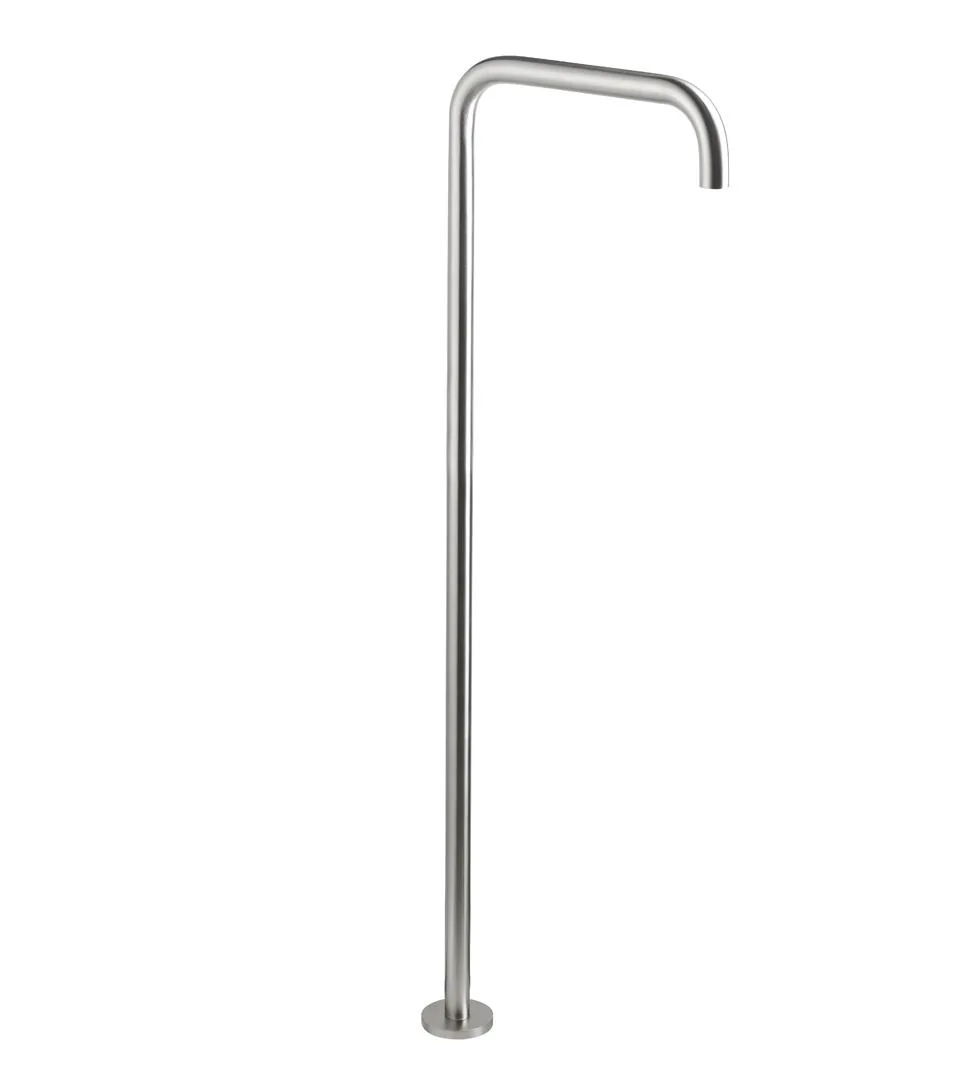 ProductFloor Standing Freestanding Basin Spout2AC6553Z-BSAISI 316L stainless steel, five finishes, guide price £560 ex VAT. As a spout it is controlled from a separate valve, which may sit under the vanity or be grouped with a matching freestanding mixer, so the cartridge sits in that valve rather than in the column. Specify the valve body at the same time as the spout, and state which cartridge it takes, because the column is only reachable at floor level afterwards.View in catalogue →
In summary
"Ceramic cartridge" describes how a tap seals, not how long it lasts, so it is a poor basis for specification on its own. The information that matters is the cartridge type, the endurance standard behind any cycle count, the test conditions, and whether the cartridge or the assembled tap was tested. Those four things turn a marketing phrase into something a buyer can verify, and they are the questions to put to any supplier before a cartridge goes onto a schedule.
For the wider specification picture, browse stainless steel taps and the AISI 316L material page, or compare AISI 304 and AISI 316L before you settle a material.
Specify it from the catalogue
Every fitting mentioned here is stocked and specified in the FONTEA trade catalogue: full technical data, finishes and wholesale tiers.
Related reading
-
 Specification
Commercial vs residential taps: why cycle life and chemical resistance matter for hospitality fit-outs
Where the money genuinely belongs on a hospitality fit-out. How cycle life is measured, why exposed coatings see a harsher corrosion duty than concealed ones, and what a specifier should refuse to accept without a test standard.
-
 Specification
A tap and fitting spec-sheet checklist for architects writing a schedule
A practical checklist for specifying taps and fittings: the fields a schedule must state, what to ask a supplier to confirm, what gets left out and causes site problems, and how to spot a complete submittal.
-
 Specification
Specifying Taps for a Hotel Bathroom: Flow Rate, Thermostatic Safety and Finish Durability
What actually decides a hotel bathroom tap specification: flow rate for comfort and water duty, where thermostatic safety is required by regulation, and finishes that survive commercial cleaning.