 ONTEA
ONTEA
A kitchen sink mixer earns its material in a way a basin mixer never does. It is gripped hundreds of times a day, splashed with fat and detergent, and sits inches from lemon juice, vinegar and salt, so the usual answer of "brass with a chrome plate" quietly puts a thin decorative layer over an alloy that reacts with exactly those things. Solid AISI 304 stainless steel, the grade professional kitchen sinks and worktops are made from, has no plating to lose and is the standard the kitchen ranges on this catalogue are built to.
Key Takeaways
- "Food grade" is a general safety requirement, not a certified grade label. Regulation (EC) No 1935/2004, Article 3 sets the test: a material must not transfer constituents to food in quantities that could endanger health, change composition or spoil taste and odour.
- 304 is not certified as "the food grade". The British Stainless Steel Association states the 316 grades "are often referred to as the 'food' grades" but that "there is no known official classification for this", and 304 is equally common in food processing.
- Brass has a specific kitchen failure mode that stainless does not have. Dezincification leaches zinc out of copper-zinc alloys, and UK law requires concealed water fittings to be made of gunmetal "or another material resistant to dezincification" (Water Supply (Water Fittings) Regulations 1999, Schedule 2, para 7(3)).
- 304 is the right default for a normal kitchen. Step up to 316L where the water or the environment loads the tap with chlorides, or where the spec is being written for an exposed or coastal installation.
What "food-grade AISI 304" actually means
Start with the part that gets used loosely. "Food grade" is not a certificate and it is not a grade of steel. It is the shorthand for meeting the general safety requirement that applies to any material intended to touch food. As retained in UK law, that requirement is Article 3 of Regulation (EC) No 1935/2004: materials and articles "shall be manufactured in compliance with good manufacturing practice so that, under normal or foreseeable conditions of use, they do not transfer their constituents to food in quantities which could: (a) endanger human health; or (b) bring about an unacceptable change in the composition of the food; or (c) bring about a deterioration in the organoleptic characteristics thereof" (legislation.gov.uk).
Two things follow. First, there is no UK or EU rule that says a food-contact fitting must be 316 rather than 304. The BSSA is blunt about it: the 316 grades "are often referred to as the 'food' grades", but "there is no known official classification for this and so, depending on the application, the equally common 1.4301 and 1.4016 grades may be suitable for food processing and handling", with the corrosion-resistance ranking given as 316 types, then 304 types, then 430 types (BSSA, retrieved 2026-10-03). Second, the burden sits on the material and its finish, not on the word "food grade" printed on a spec sheet. That is why "food grade" on its own is worth very little to a buyer, and why a material declaration naming the actual grade and standard is worth a great deal.
AISI 304 is the European grade 1.4301, an austenitic stainless steel of roughly 18% chromium and 8% nickel. The British Stainless Steel Association's advisory service puts the mechanism plainly: a stainless steel must contain a minimum of 10.5% chromium to be classified as stainless at all, and the corrosion resistance "arises from a 'passive', chromium-rich, oxide film" that, "if the film is damaged, will normally self repair" (BSSA Info Sheet 4.01). That self-repairing film is the single most important fact in this article, because it is what a plated brass body does not have. Plate is a finite layer sitting on top of the alloy. It can blister at a machined edge, thin at a wear point, or lift where a handle is rubbed, and once it is gone the alloy underneath starts corroding. The stainless body has no layer to lose; wear shows up as dulling on a surface that is still the same material all the way through.
What a kitchen sink does to a metal that a bathroom does not
The reason this article exists separately from the bathroom material articles is that the exposure is different, and it is worth being concrete about how.
A basin mixer sees water, soap and a wipe down. A kitchen sink mixer sees water, washing-up detergent, fat and film from cooking, and then the acidic foods that sit on the worktop next to it. A slice of lemon left on the draining board puts citric acid against the tap base. Vinegar used to descale the sink does the same thing on purpose. Salt from cooking gets carried into the joint between the spout and the body, where it stays wet in a crevice.
The good news is that 304 handles exactly that list well. On citric acid the BSSA's guidance is direct: "Either the 304 or 316 types can be considered for most storage and handling applications" and "The 304 types should be adequate for most applications" (BSSA, citric acid, retrieved 2026-10-03). That same page notes citric acid is itself used to clean and passivate stainless, so the acid on your worktop is closer to the acid the metal is cleaned with than it is to an attack. Across the wider food environment, the BSSA's food-industry guidance describes stainless as the material of choice for commercial kitchen countertops and sinks, and notes it "does not react with food or beverages" and is "non-reactive with cleaning and sanitising agents" (BSSA, Stainless in the Food Industry).
One qualifier belongs here rather than being buried. The BSSA is equally direct that the failure mode of austenitic stainless is not general corrosion but localised attack, and that acidic conditions and higher temperatures "promote pitting and crevice corrosion" (BSSA, food processing). The practical reading is that 304 is comfortable at a sink but it is not indestructible, and a kitchen tap that is left permanently wet with salt sitting in a sealed spout joint is the case the BSSA describes, not the case it excuses.
Brass in the same position, and what actually goes wrong
Brass is a copper-zinc alloy, and that pairing is exactly what creates the kitchen-specific problem. UK legislation recognises it directly. The Water Supply (Water Fittings) Regulations 1999 require that "any concealed water fitting or mechanical backflow prevention device, not being a terminal fitting, shall be made of gunmetal, or another material resistant to dezincification" (legislation.gov.uk, Schedule 2). That is the law naming the failure mode, not a trade habit.
The mechanism is well documented. Dezincification "selectively removes zinc from the alloy, leaving behind a porous, copper-rich structure that has little mechanical strength", and copper-zinc alloys containing more than 15% zinc are the ones susceptible. The conditions that favour it are strikingly close to a kitchen: "contact with slightly acid or alkaline water", stagnant or slow-moving liquid, and permeable deposits on the surface (AMPP, retrieved 2026-10-03). The visible signs are a white powdery deposit on the outside of the fitting and mineral staining. A kitchen tap that sits under a permanently damp splashback, in constant contact with washing-up chemistry and food film, is sitting in those conditions.
There is a second brass issue, and it is a water-quality one rather than a cosmetic one. UKWIR's measured analysis of brass fittings found UK models "contain between 2.0 and 3.5% lead", with ferrules higher again at "between 4.5% and 6.0% lead", and it also found nickel present in the alloy of every fitting examined, plus nickel overspray from the chrome plating process reaching into the water pathway at cartridge insertions, tail and body connections and the spout joint. The same report's water sampling found "that fittings leached copper, zinc and manganese" (UKWIR Report 15/DW/04/17). Lead and nickel are both regulated parameters in drinking water, which is why the alloy in a wetted fitting is a specification item rather than a purchasing detail.
Stainless is not a zero-release answer, and it would be dishonest to present it as one. A peer-reviewed study of stainless cookware found nickel and chromium concentrations in tomato sauce rising after six hours of cooking, with the largest increases from new pans, and concluded stainless can be "an overlooked source of nickel and chromium" dependent on grade, cooking time and usage (Journal of Agricultural and Food Chemistry). A tap spout is not a pan and the exposure is far shorter, but the honest position is that both materials release trace metals and the difference is one of mechanism and control, not of presence versus absence.
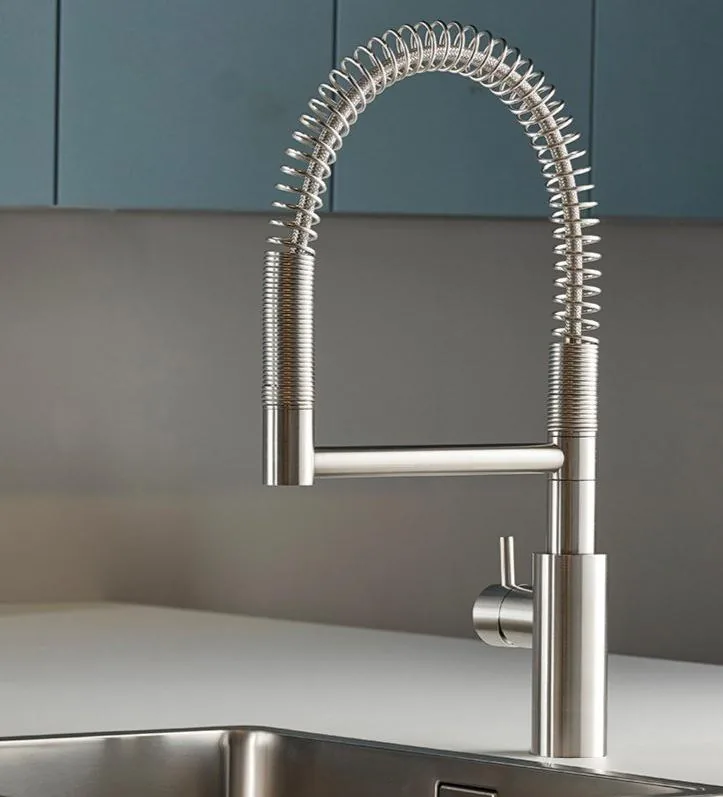 CollectionKitchen sink mixers, AISI 316LThe kitchen sink mixer category. Swivel and pull-out spouts, handshower sets and wall mounted spouts, all published in AISI 316L across five finishes.View in catalogue →
Where brass is still a fair choice
None of this means brass taps are bad products. A chrome-plated brass mixer in a domestic kitchen that is wiped down, dried and not left standing in salt water will look good for years, and for a lot of buyers it is the cheaper route to the same look. The trade-offs are honest on both sides.
The case for specifying brass is cost and familiarity. Brass is easier to cast into complex lever and spout forms than a stainless billet, which is why the elaborate traditional mixer shapes are almost all brass, and it is a mature, well-understood alloy for plumbing work. Where the brief is a domestic kitchen, a modest budget and no coastal or commercial exposure, a good brass mixer is a defensible choice.
The case for stainless is where the two diverge on a kitchen worktop. There is no plating to chip, tarnish or wear through at the lever or the spout joint. The finish cannot be "refinished" because it is not a coating to lose. It is inert around the acids and detergents a sink sees. And because a stainless body and a stainless sink are the same alloy, they age together rather than as two different materials in one visible assembly.
When a kitchen application justifies stepping up to 316L
304 is the right default for a normal kitchen, and saying otherwise would be overselling the case. Step up to 316L when one of these is genuinely true:
- Coastal or exposed installation. Salt-laden air is the condition 316L's molybdenum content was added for. The kitchen type page on this catalogue describes the 316L kitchen range as the one where "316L shrugs off the acids and chlorides a kitchen sink sees daily" (Flows collection).
- Hot, acidic, standing use. The BSSA notes that at temperatures above 80 °C the 316, or preferably the 316L types, should be considered, and that low-carbon variants matter near welds at higher temperatures.
- Heavy washdown with chlorine chemistry. Commercial and hospitality kitchens use hypochlorite disinfectants, which the BSSA warns "can liberate free chlorine, which can cause pitting".
- A hard-water area. Chlorides and minerals concentrate on a standing body and in a crevice joint.
The catalogue answer to that last set of conditions is the kitchen sink mixer category in AISI 316L, which covers pull-out spouts, swivel spouts, handshower sets and wall mounted spouts in five finishes. Buying up into 316L where the exposure does not justify it costs money without buying a measurable improvement, which is why a standard single lever model is the specification to reach for first.
One thing a specifier should know before turning that recommendation into an order: the AISI 304 kitchen mixers in this catalogue sit with the other brand, while the kitchen category page here is published in 316L only. A schedule written around the material default this article argues for is therefore a 304 order placed against a 316L category page, and the grade has to be confirmed on the individual product rather than inherited from the listing. That is the same item-level check the rest of this article makes, and it is easier to do at the enquiry stage than after the tap is on the worktop.
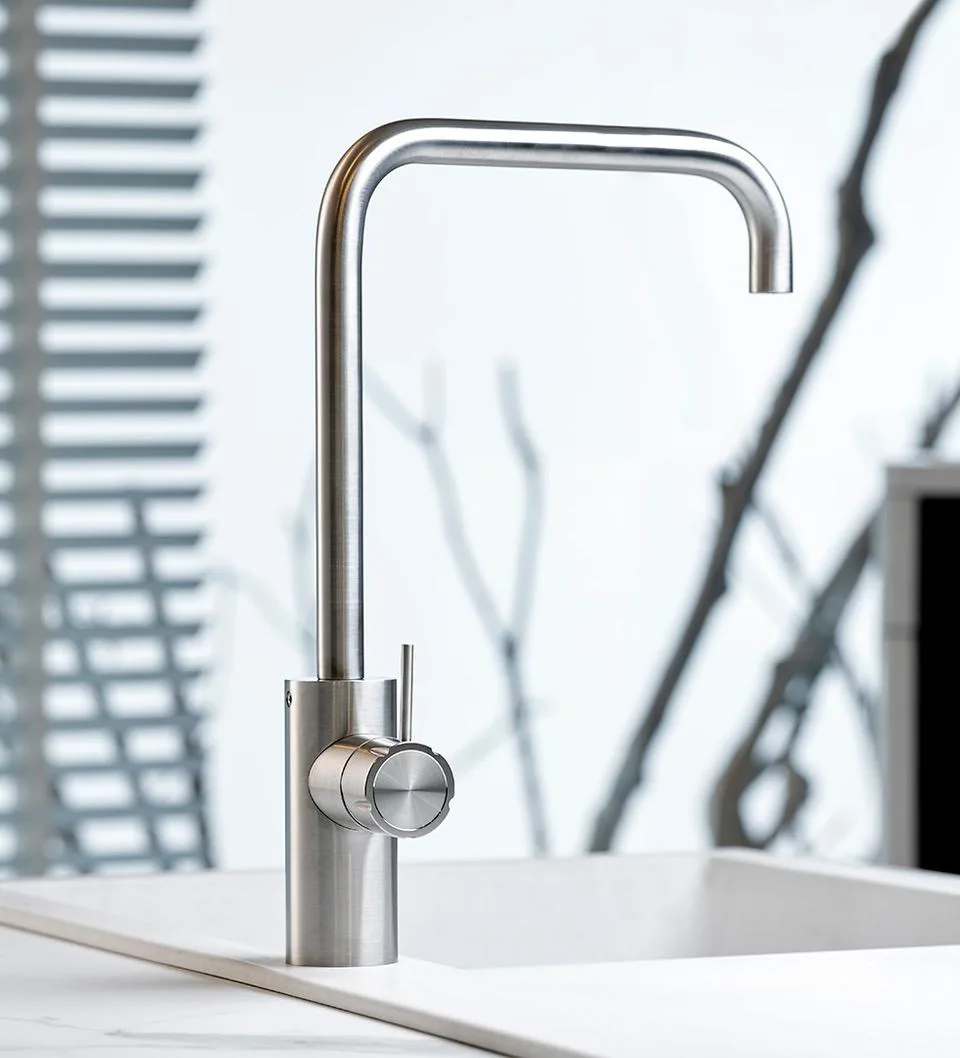 ProductDeck Mounted Single Lever Sink Mixer with Swivelling Spout2AC1374-BSAISI 316L, five finishes including brushed and polished stainless steel, deep grey, Tinta and gold PVD. Guide price £630 ex VAT. The straightforward deck-mounted specification for a standard kitchen.View in catalogue →
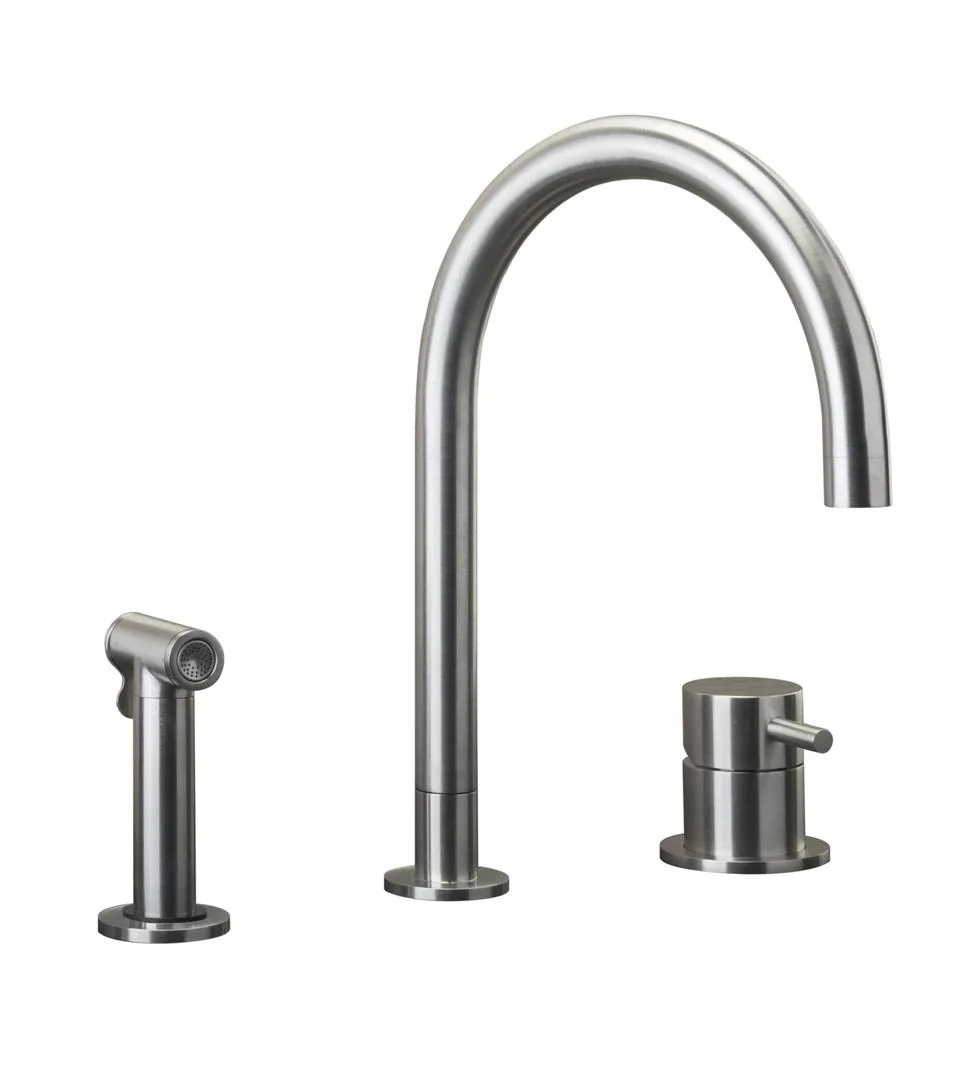 ProductKitchen Set Sink Mixer with Swivel Spout2ST12911-BSAISI 316L, five finishes, guide price £1,025 ex VAT. The swivelling spout and pull-out handshower cover a wide prep bowl, the shape a busy prep sink actually needs.View in catalogue →
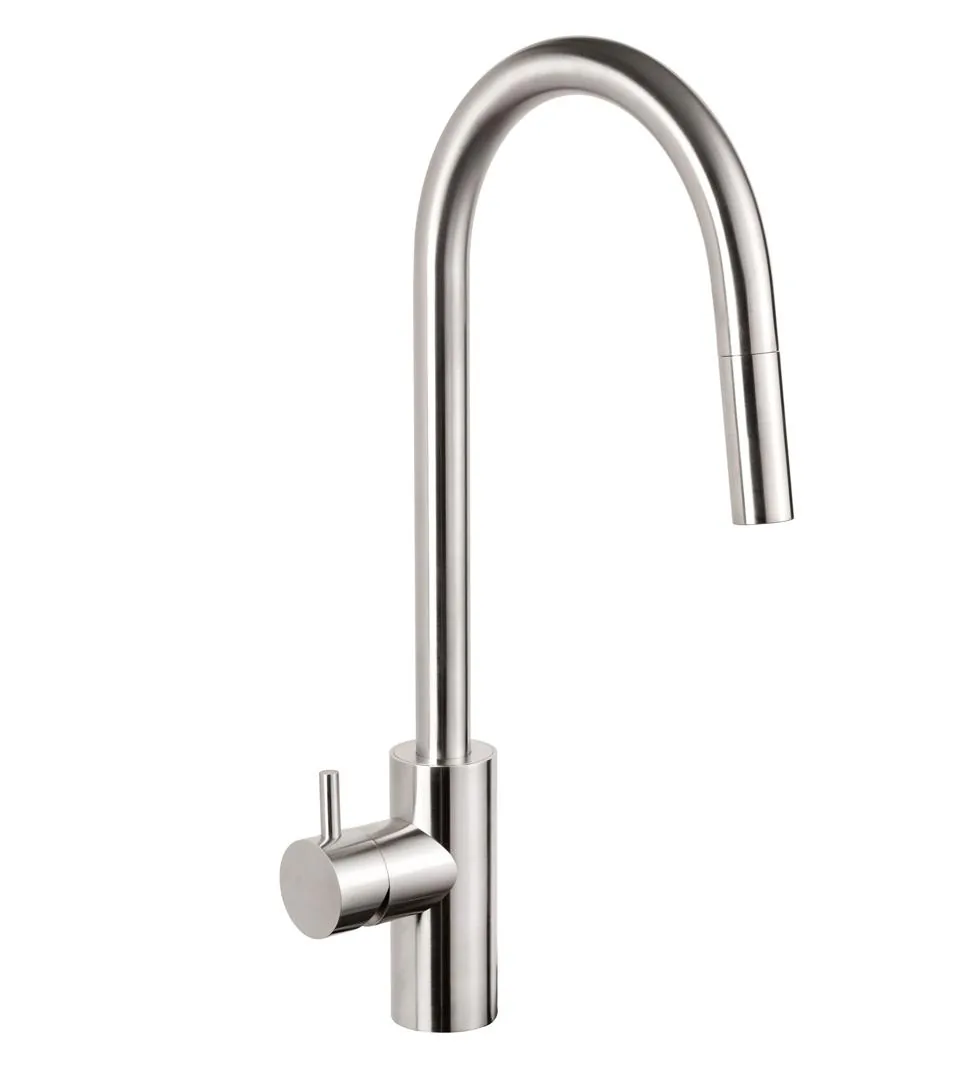 ProductDeck Mounted Single Lever Sink Mixer with Pull Out Swivel Spout2AN1262-BSAISI 316L, five finishes, guide price £1,150 ex VAT. The step up where chlorides, coastal air or commercial washdown are in play.View in catalogue →
What to ask a supplier, and how to check the answer
The material argument is only worth anything if the answer arrives in writing and can be checked. These are the questions that separate a real specification from a marketing phrase.
- What is the grade, by number and standard? "Food grade stainless" is not an answer. EN 1.4301, AISI 304 or UNS S30400 are answers, and they are the same material named three ways.
- Is the body solid metal, or plated? Ask specifically what the body is. A plated brass body and a solid stainless body can look identical on day one, and the phrasing worth asking other suppliers to match is the one the catalogue itself uses on its solid-body kitchen mixers: "Built in AISI 304 stainless steel ... rather than plated brass".
- What are the concealed parts made of? A stainless body with brass isolation valves underneath has moved the dezincification risk rather than removed it.
For the wider bathroom-side material comparison, the AISI 304 against 316L guide covers the coastal and hard-water argument in more depth, and stainless steel against chrome accessories covers the plating argument for fittings that are not wetted.
The short version
Solid AISI 304 stainless is the right default for a kitchen sink mixer because the material is the surface, it survives the acids and detergents a kitchen puts on it, and it has no plating layer to lose. Brass with a chrome plate is a fair choice for a modest domestic kitchen and a weaker one for anything with coastal, commercial or standing-salt exposure. Ask for the grade by number, ask whether the body is solid or plated, and step up to 316L when the exposure genuinely calls for it.
Specify it from the catalogue
Every fitting mentioned here is stocked and specified in the FONTEA trade catalogue: full technical data, finishes and wholesale tiers.
Related reading
-
 Materials
Brushed stainless steel vs PVD vs chrome-plated brass: durability and cleaning compared
Brushed steel and PVD are two different decisions, not a menu of the same thing. Here is how each behaves with daily cleaning, limescale, scratches, and over a service life, and why our range is solid stainless throughout.
-
 Materials
AISI 304 vs 316L Stainless Steel Taps: Which Grade for Which Job
How AISI 304 and 316L stainless steel taps differ, when 316L's molybdenum content earns its extra cost, and how to specify the right grade for coastal, hard-water and commercial jobs.
-
 Tap Systems
Will European taps work on UK low-pressure and combi boiler systems?
European-style taps are often built to a higher pressure than a UK gravity-fed or combi system delivers. Here is what actually determines whether one will run properly, and how to check before you specify.