 ONTEA
ONTEA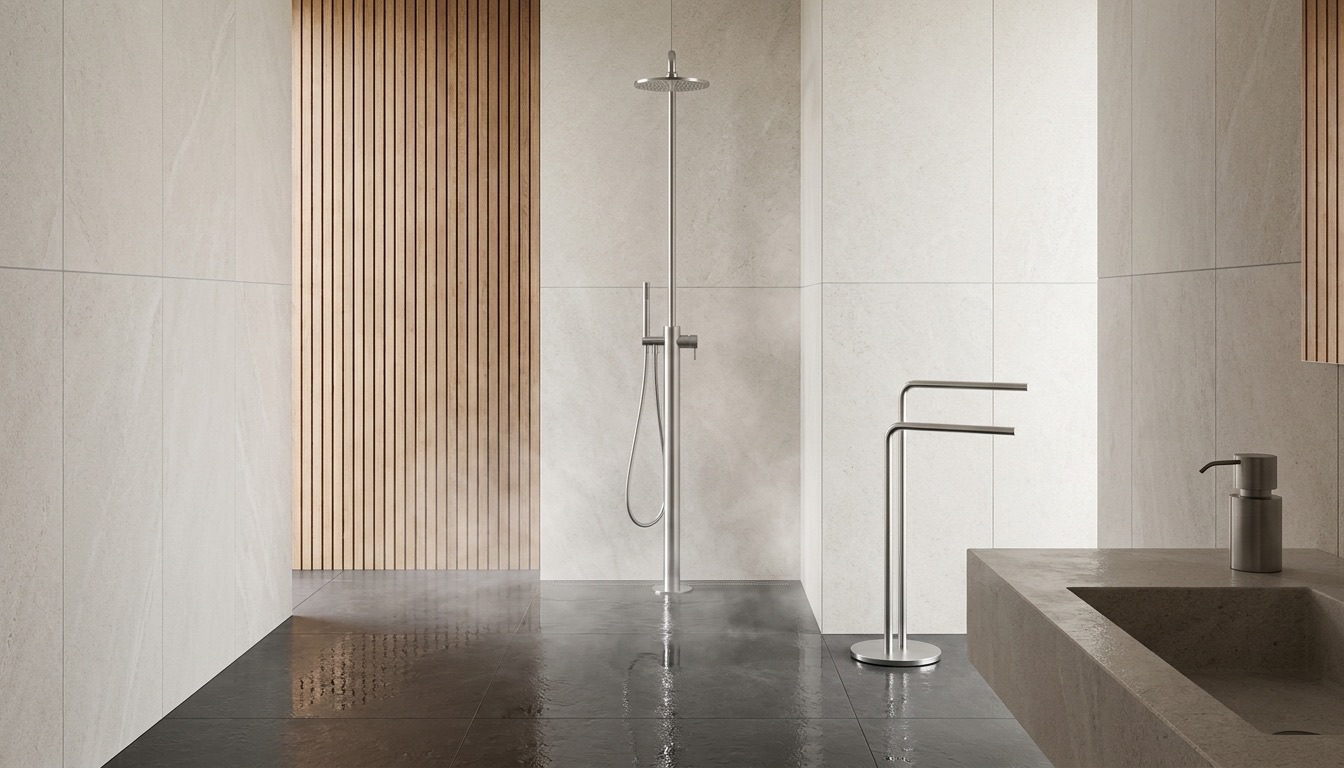
Specify AISI 316L stainless steel, in a brushed or PVD finish, for shower fittings and accessories that sit in or beside a treated spa, pool or wellness wet room, because that environment combines constant humidity, standing water, water treatment chemicals and daily commercial cleaning in a way a domestic bathroom never does. Where an item is genuinely remote from pool water and pool hall atmosphere, AISI 304L can still be adequate, and the British Stainless Steel Association is explicit that both 304 and 316 "have given excellent service when properly maintained". The grade is only half the specification. The other half is cleaning chemistry, slip resistance, joint design and whether anyone will rinse the fitting between users.
This article is for the person writing the schedule: the architect, interior designer, spa operator or main contractor who has to defend a material choice to a client and to a facilities team. It covers what actually differs from a domestic bathroom, where a bathroom-grade stainless steel is the wrong answer, and what to put in the tender documents.
Key Takeaways
- A spa wet room is not a bathroom with better styling. Treated water, standing moisture, thermal cycling and daily commercial cleaning attack fittings together, not one at a time.
- AISI 316L is the cautious default for anything splashed, drenched or sat in pool hall atmosphere. Its molybdenum content raises calculated pitting resistance to 23.1 to 28.5 against 17.5 to 20.8 for 304.
- 316L is not corrosion-proof. Concentrated hypochlorite, hydrochloric acid mortars removers and chloride cleaners will pit stainless of any grade.
- Neither 304 nor 316 belongs in load-bearing safety-critical components inside a pool hall. That is a stress corrosion cracking risk with a documented higher-alloy answer.
- Floor specification is a safety decision. Pendulum test values of 0 to 24 are classified as high slip potential.
What makes a spa wet room different from a domestic bathroom
A domestic bathroom is wet for a few minutes a day and dries between uses. A spa or wellness wet room is wet for most of the day, is cleaned by staff with a commercial product rather than a household one, and in a pool or hydrotherapy setting sits in an atmosphere that carries treatment chemicals onto every surface in the room.
Four exposures stack up, and a fitting has to survive all four at once.
Standing water and permanently damp air
A wet room has no enclosure and no shower tray, so water runs across the floor for the whole session and collects at the drain. Fittings low on the wall, floor-standing columns and anything with a horizontal surface see far more standing water than a wall-mounted bathroom item ever does. Grout lines and tile junctions keep the substrate wet behind the fitting.
Thermal cycling
A bath is filled once. A spa and wellness room cycles between hot and cold use through the day, and a pool hall swings between warm humid air and the cooler, drier building when the doors open. Repeated wetting and drying is the condition under which a passive film has to repair itself repeatedly, and it is also the condition where deposits concentrate as water evaporates.
The British Stainless Steel Association's guidance on hot water storage makes the same point about concentration: chlorides concentrate "in splash zones or at the water/air line by evaporation" (BSSA, selection of stainless steels for water tank applications). Fittings in a wet room live permanently in that splash zone.
Water treatment chemicals
This is the exposure most often left off a spa specification. Treated pool water is not neutral water.
The World Health Organization's Guidelines for Safe Recreational Water Environments states that for a conventional public or semi-public pool, "adequate routine disinfection should be achieved with a free chlorine level of 1 mg/l throughout the pool", that "higher concentrations (up to 2 to 3 mg/l) may be required for hot tubs, because of higher bathing loads and higher temperatures", and that "the pH should be maintained between 7.2 and 7.8 for chlorine disinfectants" (WHO, Volume 2: Swimming Pools). The same guidance caps free chlorine at 3 mg/l in public and semi-public pools and 5 mg/l in public and semi-public hot tubs.
For a UK operator the equivalent reference point is the Health and Safety Executive's HSG282, which gives spa pool guidance of "At pH 7, free chlorine residual measured by DPD1 should be 3 to 5 mg/l" with pH "maintained between pH 7.0 to 7.6" (HSE, HSG282).
Read those figures as a permanent ambient condition, not an accident. A fitting beside a treated pool lives in a lightly chlorinated, mildly alkaline spray.
Heavy commercial cleaning
Staff cleaning on a schedule with a contractor-supplied product is a different risk from a householder with a bottle under the sink. Left to a facilities team, the product is often a chloride or hypochlorite cleaner, because that is what kills biofilm.
Key point: the chemistry that keeps the pool clean is the same chemistry that pits stainless steel. The specification has to control the cleaning regime as carefully as it controls the alloy.
How the material choices actually differ
316L is the default, not a premium upgrade
The honest summary of the corrosion science is short. Molybdenum in 316 and 316L improves resistance to chloride-driven pitting and crevice corrosion, and the British Stainless Steel Association quantifies it as a pitting resistance equivalent number (PREN = Cr + 3.3Mo + 16N):
| Grade | Calculated PREN | Where it belongs |
|---|---|---|
| 304 | 17.5 to 20.8 | Sheltered dry interiors, weak chloride exposure |
| 316 / 316L | 23.1 to 28.5 | Coastal, treated water, marine-influenced and pool-side fittings |
| Super austenitics such as 254SMO | 42.2 to 47.6 | Load-bearing safety-critical pool hall components |
Source: British Stainless Steel Association, calculation of pitting resistance equivalent numbers.
Note the caveat the same body attaches to the table. PREN figures "cannot be used to predict whether a particular grade will be suitable for a given application, where pitting corrosion may be a hazard". Use the numbers to rank grades against each other, never to promise a service life.
The pooling body of evidence for a treated environment is more direct. The BSSA's pool guidance states that for items "fully immersed or drenched every session", for those "only splashed with pool water but neither safety-critical nor load-bearing", and for "decorative panelling" in the pool hall, "types 304 and 316 are widely used and have given excellent service when properly maintained. Type 316 is strongly preferred for its greater resistance to staining, pitting and crevice corrosion in the majority of pool conditions" (BSSA, stainless steels for swimming pool building applications).
Two things follow. First, 316L is not exotic and does not need justifying; it is the standard answer where treated water or pool hall atmosphere is present. Second, and less comfortably for a specifier, that same guidance confirms 304 is not automatically wrong. The honest position is that 304 belongs where the item is remote from pool influence, and that the difference between the two grades is margin rather than a bright line.
Where a bathroom-grade stainless steel is the wrong answer
There is one environment where 304 stops being a defensible economy and becomes a mistake, and the guidance is unambiguous about it.
Types 304 and 316 "have been found to be susceptible to SCC in laboratory tests and in some swimming pool atmospheres, and must not be used for components vulnerable to SCC if failure could result in personal injury" (BSSA, pool building applications). The named vulnerable items are structural: "brackets for suspended light fittings, loudspeakers, pipework etc", "supports for suspended ceilings", "supports for ventilation trunking, water slides etc", "wire rope supports for water slides" and "fasteners".
The recommended grades for those components are higher-alloy austenitics: 1.4547 (254SMO), 1.4529 (1925hMo) or 1.4565 (Nirosta 4565S).
A spa wet room contains all five of those categories, often hidden above a ceiling or behind a wall. If your specification includes a ceiling-mounted rain head, a suspended luminaire or a ceiling bracket, that structural fixing deserves separate attention from the visible fitting.
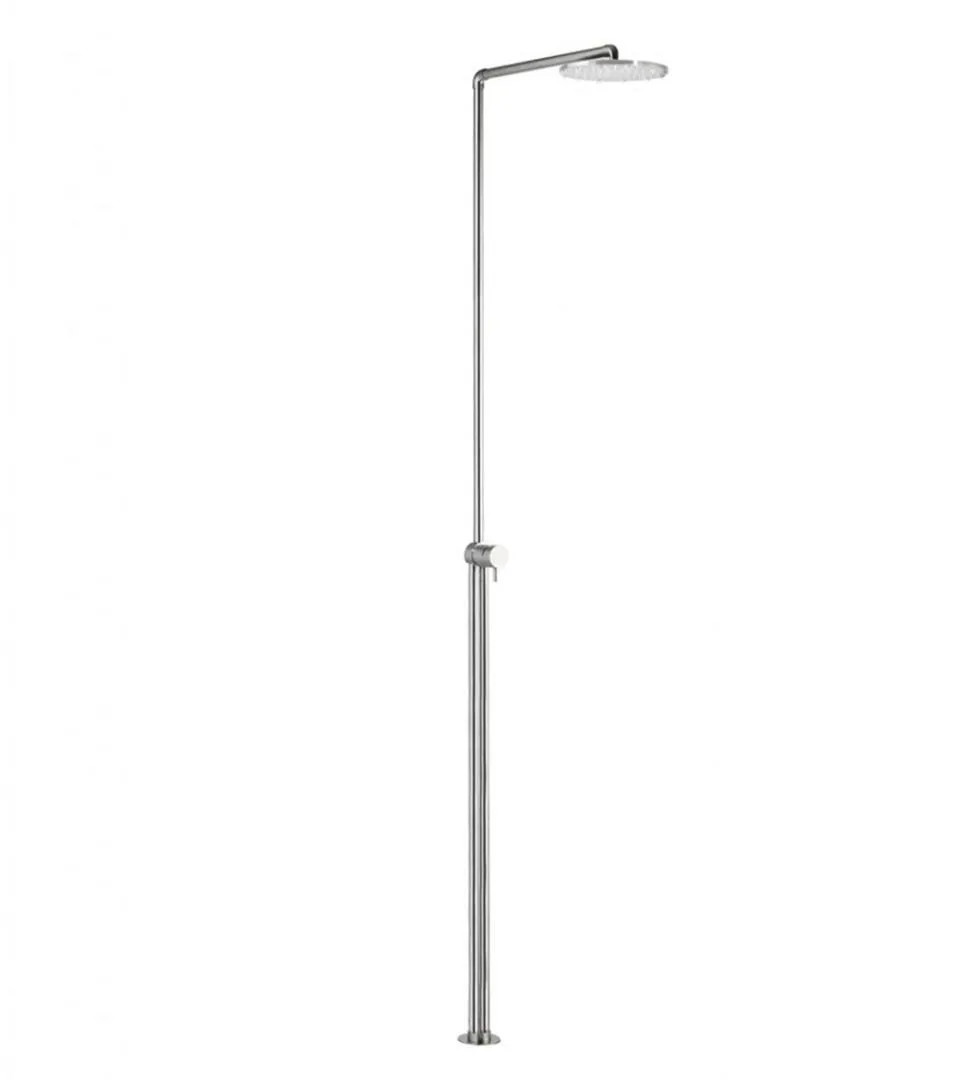 ProductFreestanding shower column with diverter and hand shower2LI82128946Z-BSAISI 316L in brushed stainless steel, polished, deep grey, gold PVD or Tinta. Mixer, diverter, 200 mm overhead head, hand shower and hose as one column, with nothing chased into the wall and every joint reachable.View in catalogue →
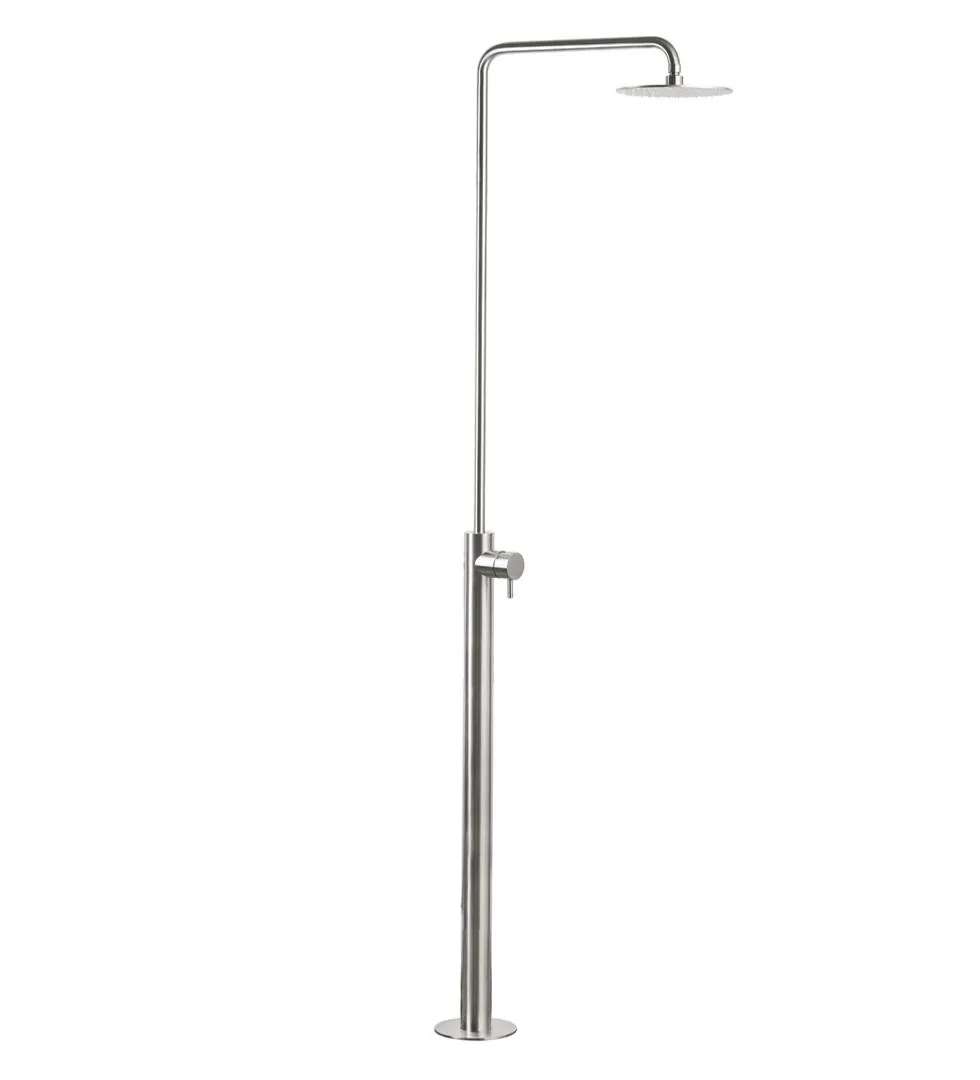 ProductFloor standing shower column with mixer and head2LI82127X-BSAISI 316L, the single-outlet version for where one overhead spray is enough. Stand it on the floor, set the position and supply before the floor finish, then check it for plumb and level before the head is fitted.View in catalogue →
Choosing 316L rather than 304L for the overhead head
The ceiling and recessed overhead heads are the most tempting place to economise, because they sit above head height where nobody looks closely. They are also the fittings a user stands directly beneath while warm water runs across them.
The catalogue describes a 304 overhead head as "AISI 304, the standard stainless grade for interior ceilings" (catalogue, 700 x 380 mm ceiling mounted rainfall shower head). An interior ceiling in a domestic or light-commercial bathroom is a fair claim. A treated-water spa ceiling is a different environment, and the more cautious grade is the right call there, with the cost difference known at quotation.
 Product700 x 380 mm ceiling mounted rainfall shower head2TE292374-BSAISI 304, the longest plate in the range at 700 x 380 mm, carrying both a rain and a waterfall pattern. Listed here to mark the grade boundary: a standard interior-ceiling grade, not the pool-side recommendation.View in catalogue →
Compare the AISI 304L material page with the AISI 316L material page when you are writing a material schedule, because neither page compares the two directly.
Cleaning chemistry: the part that voids warranties
Material selection does not protect a fitting from the wrong cleaner. This is the most common failure mode in a commercial wet room and the one that appears first on a maintenance log.
The British Stainless Steel Association's cleaning guidance is specific about what must not touch stainless steel: "Chloride-containing solutions, including hydrochloric acid-based cleaning agents and hypochlorite bleaches can cause unacceptable surface staining and pitting, and should not be used in contact with stainless steels. Under no circumstances should concentrated bleaches contact decorative stainless steel surfaces." It adds that "hydrochloric acid based solutions, such as silver cleaners, or building mortar removal solutions must not be used", and that sulphuric and hydrochloric acids "can be very corrosive and should not be used for cleaning and maintenance of stainless steel items" (BSSA, cleaning methods for stainless steel).
The pool guidance adds the operational rule: "All stainless steel items around the pool should be washed down daily. Other stainless items should be cleaned by wiping once a week where practicable. Brown staining of stainless steel items is an indication of either an inadequate cleaning regime or an aggressive pool hall atmosphere. Carbon steel brushes or carbon steel wire wool should never be used on stainless steel. Chemical cleaners must be compatible with stainless steel" (BSSA, pool building applications).
That last sentence is a specification item. The approved cleaner list belongs in the handover pack, not in the head cleaning contractor's own supply chain.
Dilute chlorine is not the same as spilt concentrate
There is a nuance worth getting right, because it is the difference between an unreasonable restriction and a workable one. Hypochlorite is genuinely aggressive: "The hypochlorite ion, (OCl-), is aggressive to stainless steels, acting in a similar way to wet chlorine gas, and like the chloride ion, (Cl-), is a dangerous pitting corrosion hazard. Pitting or crevice corrosion can occur on most stainless steel grades in a 5% solution at ambient temperatures" (BSSA, selection of stainless steels for handling sodium hypochlorite).
The same source sets the workable boundary: "As a guide, 15-20 ppm, (mg/lt), residual chlorine solutions at ambient temperatures should be safe with 316 types for a 24-hour maximum contact time, if followed by rinsing", and it advises that hypochlorite disinfecting "can be done with care, but it is important that the temperature and contact time is kept to a minimum and that the solution is thoroughly rinsed away afterwards."
So a maintained pool at 1 to 3 mg/l is in a different category from a decanted bottle of neat bleach. What must never happen is concentrated hypochlorite or a hydrochloric mortar remover sitting on a fitting, and what must always happen is prompt, thorough rinsing.
Floors: the slip decision is a specification decision
A wet room floor is a safety-critical surface, and specifying the wrong tile is a far more likely source of a claim than specifying the wrong stainless grade.
The Health and Safety Executive has adopted the pendulum test as its standard method for assessing floor slipperiness in both dry and contaminated conditions, and reproduces the UKSRG classification bands in Assessing the slip resistance of flooring:
| Pendulum test value | HSE slip potential |
|---|---|
| 0 to 24 | High slip potential |
| 25 to 35 | Moderate slip potential |
| 36 and above | Low slip potential |
Source: HSE, GEIS2 Assessing the slip resistance of flooring.
For barefoot areas such as a poolside deck or a spa changing area, HSE directs that the Slider 55 rubber is used rather than Slider 96, which is specified for shod pedestrians. The same document reproduces the DIN 51097 classes for barefoot areas at slip angles of 12 to 17 degrees, 18 to 23 degrees and above 24 degrees.
Specify the floor finish by its measured value under wet conditions, not by a photograph. And note that a non-slip floor has consequences for the fittings above it: a textured surface is harder to clean, so the cleaning regime for a wet room floor and the cleaning regime for the stainless in that room have to be written together.
What to put in the specification
A spa or wellness wet room schedule should carry these items. Each one is a decision the fitter cannot make on site.
Material and grade
- Grade for every shower column, overhead head, valve, hose, holder and dispenser
- Grade for brackets, fixings and fasteners, not only the visible body
- Grade for anything structural above a ceiling or inside a void
- Material declarations taken from the product page, not inferred from the finish
The BSSA design list is the right checklist to hand to a supplier: "choose an appropriate grade", "choose an appropriate surface finish", "use smooth, flowing lines which avoid crevices", "allow for the lower corrosion resistance of some free machining grades when specifying fasteners", "design any safety-critical, load-bearing structure to be fail-safe", "use correct welding and post-weld cleaning procedures" and "allow access for inspection and maintenance" (BSSA, pool building applications).
That seventh point is a maintenance requirement disguised as a design requirement. A shower head that cannot be reached for nozzle inspection will be replaced rather than cleaned, and replacement cycles drive whole-life cost.
Joints, crevices and drainage
Water traps and crevices are where stainless fails first, and in a wet room they are designed in by accident. Specify:
- No horizontal ledges on shower fittings that will hold water
- Drainage paths at dispensers, shelves and column bases
- No unsealed gaps between a fitting and the tile that cannot be reached by a cloth
- Smooth, cleaned welds rather than site-cut and left-welded stainless
Finishes
Brushed stainless is the practical default in a wet room, because a matte directional surface hides water marking better than a bright polish. Approve a sample under the project's own lighting before it goes into the schedule, and keep the whole room on one finish family so that replacement parts match.
For colour, PVD over a stainless substrate can coordinate a spa scheme, and the finish options across this range run brushed, black PVD, gold PVD and copper PVD. Remember that the visible colour does not identify the substrate: ask for the grade separately from the finish name.
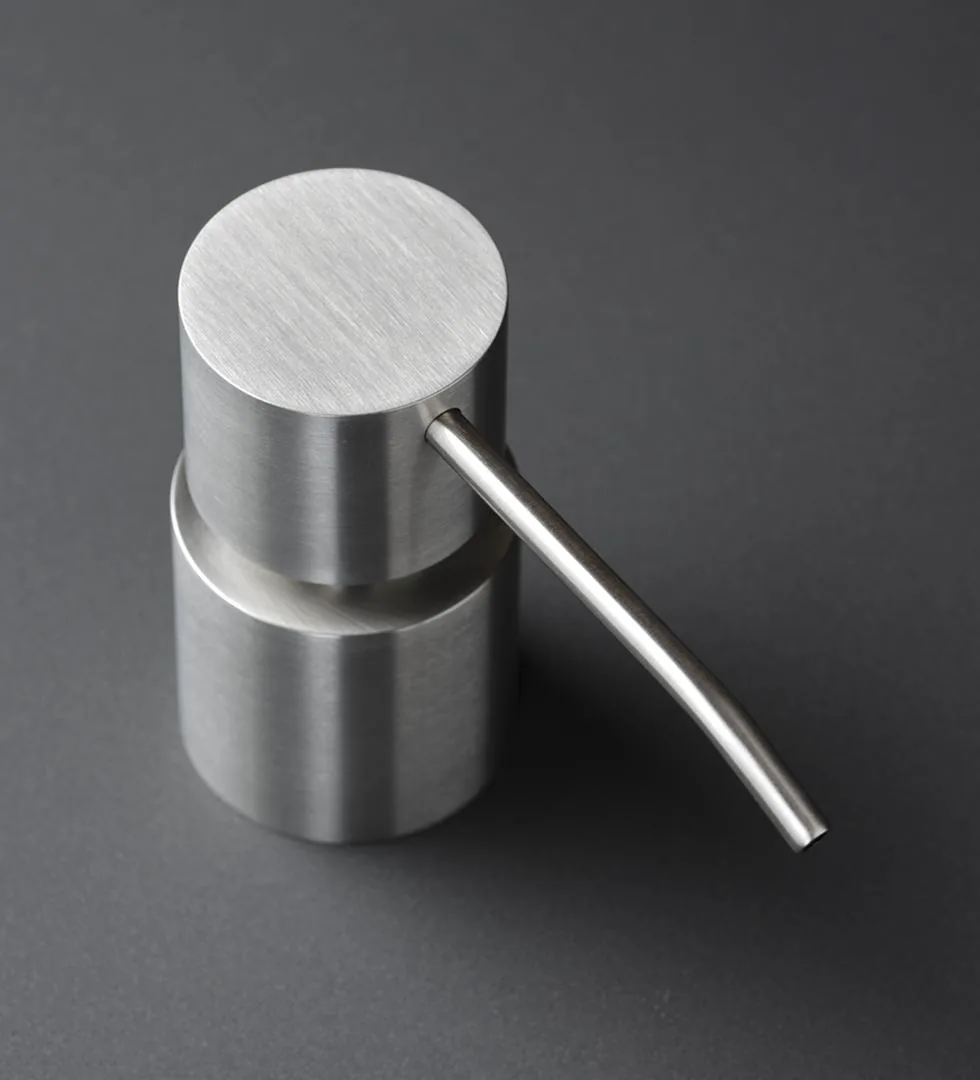 ProductDeck mounted stainless steel soap dispenser2AE0315-BSAISI 316L throughout, mounted on the basin rim or adjacent counter so the wet zone is finished without touching wall tiling. Seal the fixing so no water tracks into the cabinet below.View in catalogue →
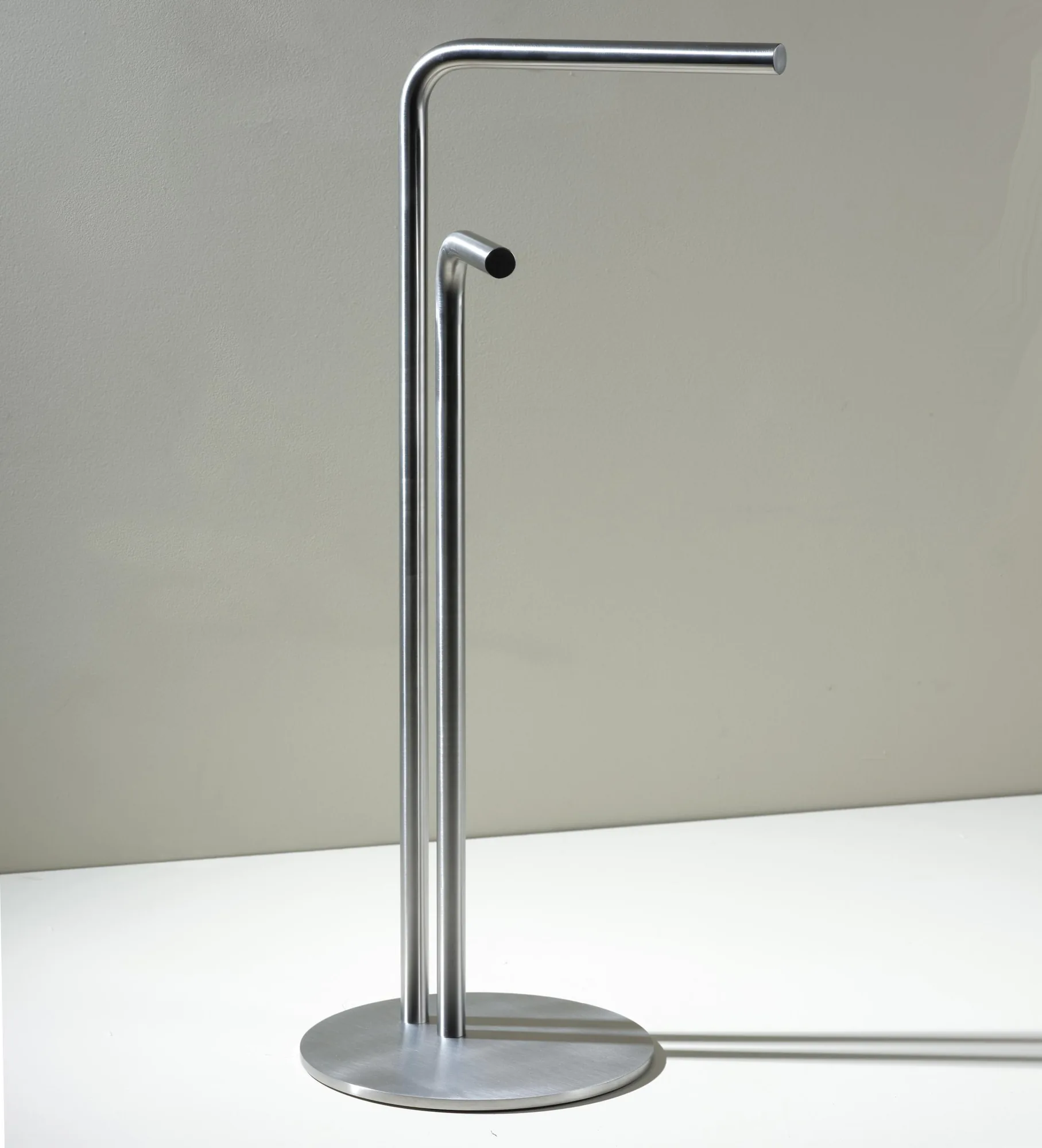 ProductFreestanding two-rail towel stand2MS3408-BSAISI 316, two rails at different levels so a bath towel dries clear of a damp hand towel. Stands on the floor, so no wall fixing enters the wet zone. Level the base, as a stand on an uneven floor will rock under load.View in catalogue →
CollectionFONTEA wellness rangeCeiling, recessed and wall-mounted rain heads plus floor-standing and riser shower columns, in 304 and 316L and five finishes.View in catalogue →
ProductFreestanding two-rail towel stand2MS3408-BSAISI 316, two rails at different levels so a bath towel dries clear of a damp hand towel. Stands on the floor, so no wall fixing enters the wet zone. Level the base, as a stand on an uneven floor will rock under load.View in catalogue →
CollectionFONTEA wellness rangeCeiling, recessed and wall-mounted rain heads plus floor-standing and riser shower columns, in 304 and 316L and five finishes.View in catalogue →
Cleaning regime and handover
Attach to the specification, not to a later conversation:
- The approved cleaner list, with the chloride and hypochlorite exclusions stated
- Daily wash-down requirement for pool-side items and the weekly wipe elsewhere
- A prohibition on carbon steel wire wool and brushes
- Rinsing and drying instructions, including after any chlorine contact
- Inspection intervals for nozzles, hoses and moving parts
- Replacement references for every item on the schedule
Spa wet room specification checklist
Material
- AISI 316L confirmed for shower columns, heads, valves and accessories in treated water or pool hall atmosphere
- AISI 304L accepted only where the item is remote from pool influence, with the reason recorded
- Brackets, fixings and fasteners graded, not assumed
- Structural and load-bearing items above ceilings reviewed for stress corrosion cracking risk
Detail
- No water traps, crevices or unsealed ledges
- Drainage at dispensers, shelves and column bases
- Access for nozzle inspection and hose replacement
- Welds cleaned, not left raw
Floor and safety
- Floor finish specified by pendulum test value in wet conditions
- Barefoot areas specified to the appropriate barefoot test
- Slip potential band stated in the handover documentation
Cleaning and handover
- Approved cleaner list issued with the pack
- Chloride and hypochlorite exclusions stated
- Daily wash-down regime agreed with the operator
- Inspection and replacement schedule issued with product references
Frequently asked questions
Is 316L sufficient for a spa wet room?
For shower fittings and non-load-bearing accessories in a treated water or pool hall environment, 316L is the cautious default and is what the BSSA pool guidance strongly prefers. For safety-critical, load-bearing components such as ceiling supports and brackets inside a pool hall, the same guidance says 304 and 316 "must not be used" and points to higher-alloy austenitics instead. Neither grade is corrosion-proof, so cleaning practice still determines how long the visible fitting lasts.
Can I use the same fittings in a domestic bathroom and a spa?
You can, but the more exposed item will outlast the less exposed one and the visible finish will differ once one has been cleaned for two years and the other for two years of spa operation. Specifying one grade across a mixed project is simpler to run, and the 316L material page covers the shower and tap range for that reason.
Does chlorine damage stainless steel in a wet room?
Maintained pool chemistry is not the problem. The BSSA hypochlorite guidance treats 15 to 20 ppm residual chlorine at ambient temperature as safe for 316 types over a 24-hour maximum contact time provided the surface is rinsed. Concentrated hypochlorite at around 15 per cent, household bleach at around 5.25 per cent sitting undiluted, and hydrochloric acid mortar removers are the actual damage mechanisms, and all three must be kept off the fitting.
Who chooses the cleaning products in a spa?
That should be you, in the specification. The BSSA pool guidance states plainly that "chemical cleaners must be compatible with stainless steel". If the cleaning contract is let separately, write the compatibility requirement into it.
Does the floor finish affect the fittings?
Indirectly, and in both directions. A correctly specified non-slip floor may be a profiled or textured surface, which is harder to clean and therefore needs a compatible regime; and the joints and falls around a linear drain are exactly where a freestanding column base and a low-level accessory will sit. Specify the floor by measured slip resistance and confirm the fitting positions against the drain layout.
Can PVD finishes be used in a spa?
PVD over a stainless substrate is offered across this range in black, gold and copper. The colour does not tell you the substrate grade, so ask for the grade separately, approve a finish sample under project lighting, and obtain the care instructions before the schedule is signed. As with brushed stainless, the colour does not protect the surface from the wrong cleaner.
Specify the regime, not just the fitting
The reason a spa wet room defeats a domestic specification is that the environment is a regime, not a room. Treated water, permanent damp, warm and cool cycling, staff cleaning and a wet floor happen together, every day, for years.
AISI 316L is the right default because it adds margin against chloride pitting, and the technical literature is clear about the limits of that margin. The specification earns its keep in the parts a material grade cannot fix: which cleaners are approved, which crevices were designed out, whether anything load-bearing sits above a ceiling in pool hall atmosphere, what the floor measures wet, and who inspects the nozzles.
Write those down, hand them to the operator at completion, and the fitting will still be there in year five.
For the wider material picture, our guide to AISI 304 versus 316L stainless steel sets out the grade comparison in full, and 316L bathroom accessories for coastal properties covers the accessory side of the same argument.
Specify it from the catalogue
Every fitting mentioned here is stocked and specified in the FONTEA trade catalogue: full technical data, finishes and wholesale tiers.
Related reading
-
 Specification
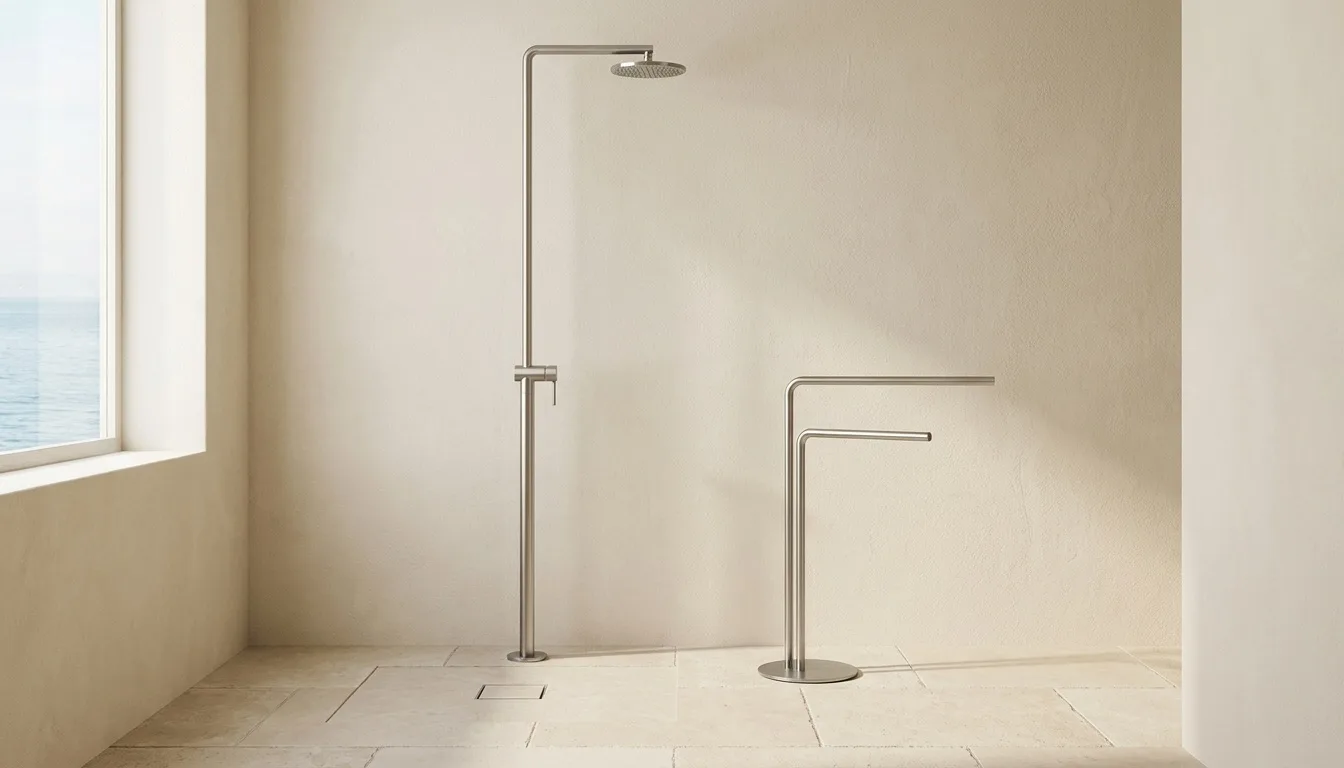
Stainless Steel Bathroom Fittings for Coastal and Seafront Developments: A Salt-Air Corrosion Guide
What actually governs whether bathroom fittings survive a seafront elevation: the chloride gradient, finish, joint design, drainage and ventilation, how corrosion appears, and what to schedule.
-
 Accessories
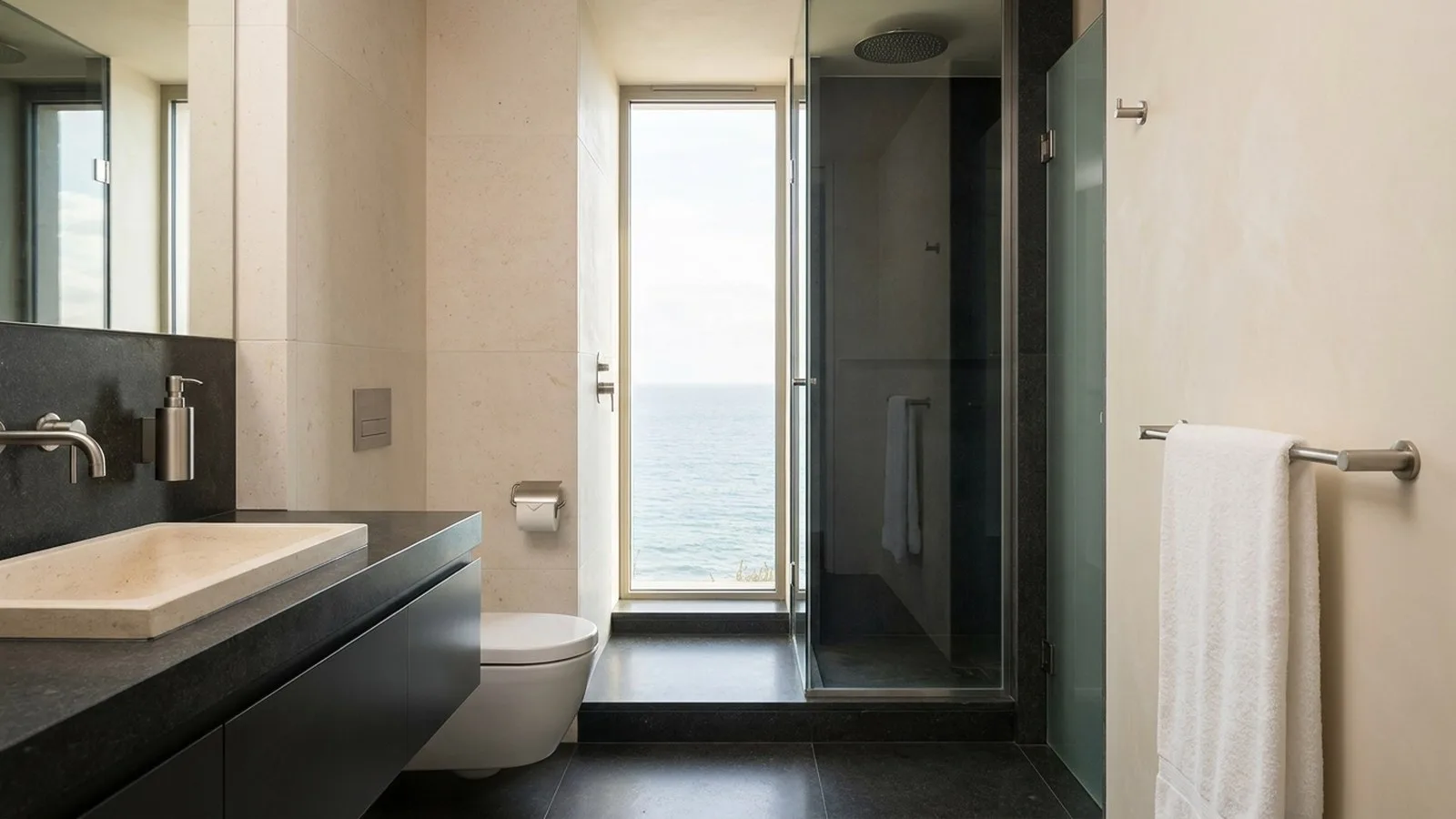
316L Stainless Steel Bathroom Accessories for Coastal and Seafront Properties
How to specify 316L stainless steel bathroom accessories for coastal homes, hotels and seafront projects, from finishes and fixings to cleaning.
-
 Specification
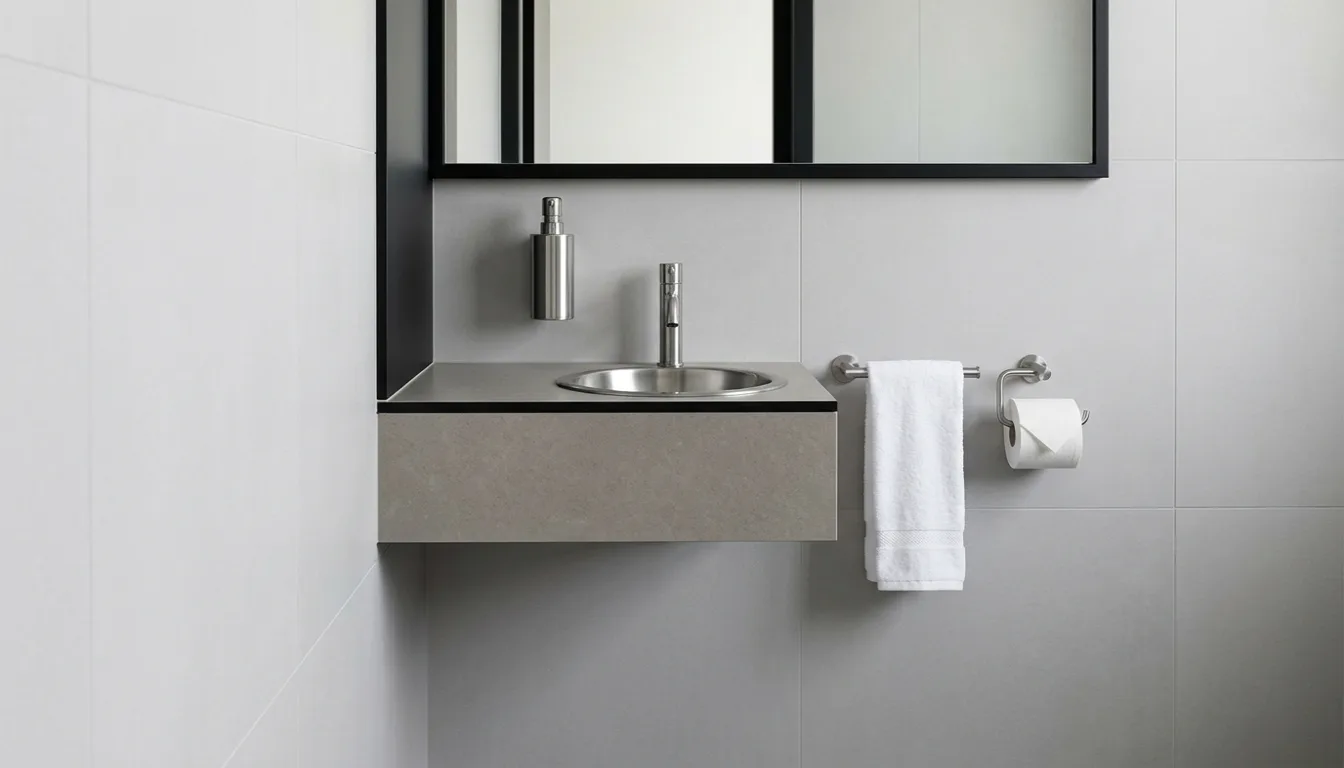
Commercial vs residential taps: why cycle life and chemical resistance matter for hospitality fit-outs
Where the money genuinely belongs on a hospitality fit-out. How cycle life is measured, why exposed coatings see a harsher corrosion duty than concealed ones, and what a specifier should refuse to accept without a test standard.